
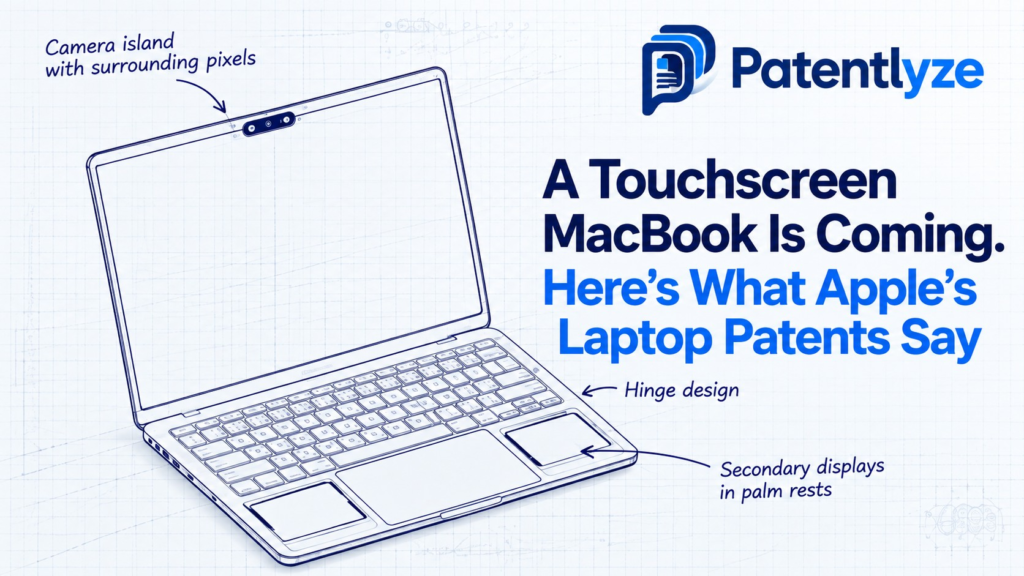
Apple is expected to ship its first touchscreen MacBook before the end of the year. Apple has not announced it, but Bloomberg has reported the details for months: an OLED MacBook Pro, which MacRumors calls the MacBook Ultra, with touch on the display, a camera cutout in place of the notch, and a stiffer hinge.
Over the past two weeks, three Apple laptop filings published at the U.S. patent office. None of them is about a touchscreen lid. They cover the parts around it: a camera set inside the screen, small displays beside the keyboard, and a keyboard deck that senses touch across its whole surface.
All three are continuations. A continuation is a new application that reuses the drawings and text of an older one, so the company can keep writing new claims on the same idea. The oldest idea here was first filed in 2015. Apple refiled all three this spring.
One caution before we start. A patent application describes an idea a company wants to own, not a product. None of these filings mentions a touchscreen or the MacBook Ultra. What we can do is set each one next to the reports and show where they match and where they don’t.
| Filing | Idea first filed | Granted from this family | Refiled | Published |
|---|---|---|---|---|
| Camera island in the screen | Sep 2015 | Yes, latest Nov 2023 | Apr 28, 2026 | Sep 10, 2026 |
| Displays under the palm rests | May 2018 | Yes, latest May 19, 2026 | May 8, 2026 | Sep 17, 2026 |
| Touch-sensing keyboard deck | Mar 2017 | Five patents, latest May 19, 2026 | May 6, 2026 | Sep 17, 2026 |
What has been reported about the touchscreen MacBook
Bloomberg’s Mark Gurman has reported that the new MacBook Pro will be the first Mac with touch input on the display. Apple has also built a reinforced hinge and screen hardware so the display does not bounce back when you tap it, per the same reporting. MacRumors has a summary of the reports.
The notch would go away, replaced by a cutout like the iPhone’s Dynamic Island. The keyboard and trackpad would stay. According to Bloomberg, macOS will show larger controls when you tap a menu bar item, and pinch-to-zoom will work on the screen.
The reported release window is October to December, with a chance it slips into 2027. It would be a change of course for Apple. Steve Jobs said in 2010 that “touch surfaces don’t want to be vertical,” and Apple has kept touch off the Mac screen ever since.
A camera inside the screen
This is the filing that lines up most closely with the reports. Published September 10, it covers a laptop display with a small island for the camera, surrounded by pixels.
The first claim describes a laptop with two halves joined by a hinge and a keyboard in the bottom half. The display has an active area, where the pixels are. Inside that area is an island with no pixels, and a camera or other optical part sits in the island.

On today’s MacBook Pro the camera sits in a notch, a black cutout that comes down from the top edge of the screen. An island is a hole with pixels on every side. The iPhone’s Dynamic Island is built that way, and Bloomberg says the new MacBook Pro may get a cutout like it.
The idea is old. This family of filings goes back to September 2015, and the same three inventors are on every version we checked: Mikael Silvanto, Dinesh Mathew, and Victor Yin. MacRumors wrote up an earlier version in 2021 as a sketch of the MacBook Pro notch.
Apple has already been granted patents from this family, including one in November 2023. The new application’s first claim names a laptop and an island specifically.
The filing allows either an LCD or an OLED panel. Neither the first claim nor the abstract, the filing’s short summary, says anything about touch, or about a cutout that changes shape the way the iPhone’s does.
Screens where your palms rest
Published September 17, this filing puts a display under each palm rest, on either side of the keyboard.
The claim is short. A keyboard sits in the middle of the base. A clear cover on each side of it reads touch, and there is a display under each cover. The screen in the lid stays as the main display.
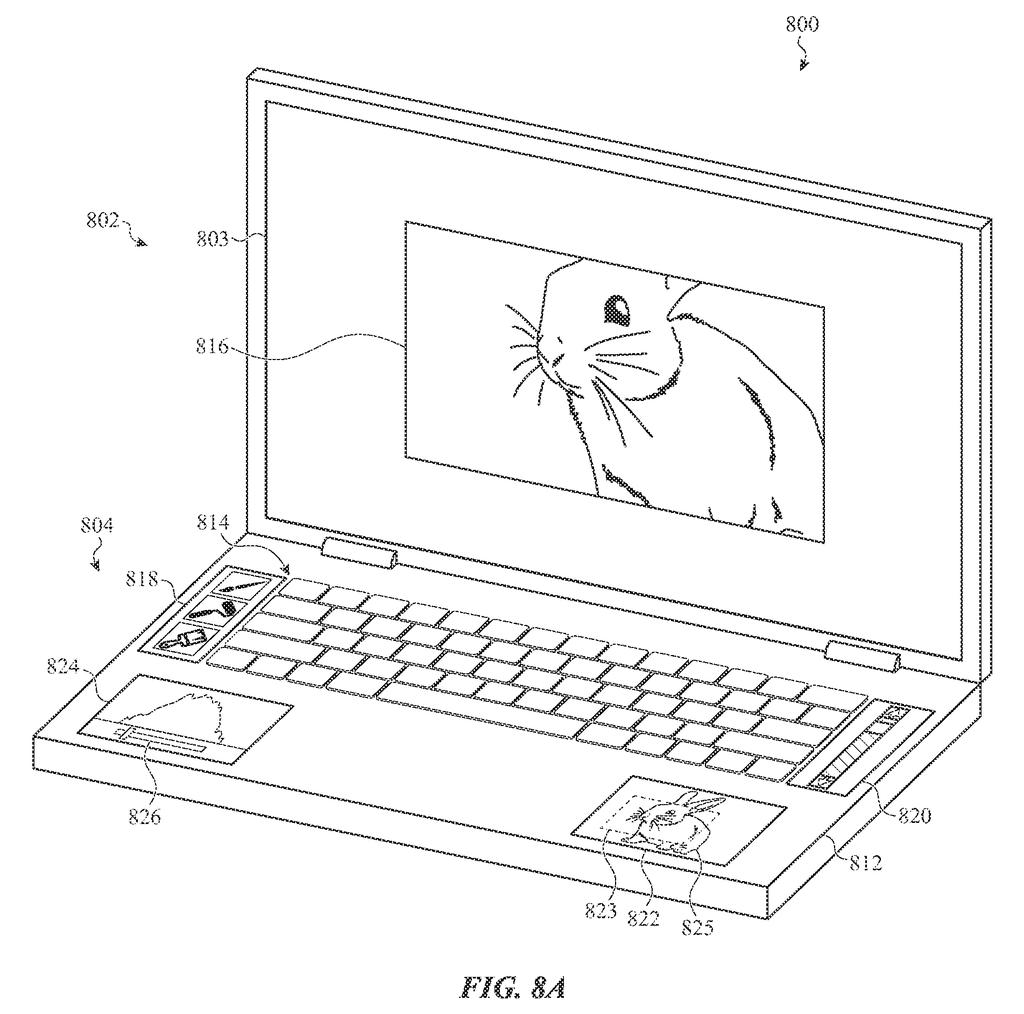
In plain terms, the two flat areas where your wrists sit while you type become small touchscreens. The original application describes trackpad areas that change size and shape depending on the app, plus scroll bars and controls shown through the glass. The new claim does not say what appears there.
Apple first applied for this in 2019, building on a May 2018 filing, with one inventor, Chang Zhang. The previous application in the family became U.S. Patent 12,632,131 on May 19, 2026. Apple filed this continuation on May 8, 11 days earlier, which keeps the family open for new claims.
This would be Apple’s second try at a screen on the keyboard half of a MacBook. The Touch Bar, a strip that replaced the function keys, arrived in 2016 and was gone from every new MacBook by late 2023. This design puts the screens where your hands rest, not where keys used to be.
A keyboard deck that senses where and how hard you press
The third filing, also published September 17, covers a MacBook base whose whole top surface senses touch and pressure.
The claim describes a top case made of a dielectric material, meaning one that does not conduct electricity, such as glass or ceramic. The top surface and the sides are one piece. One sensing system finds where you touch it, and a second measures how hard you press.
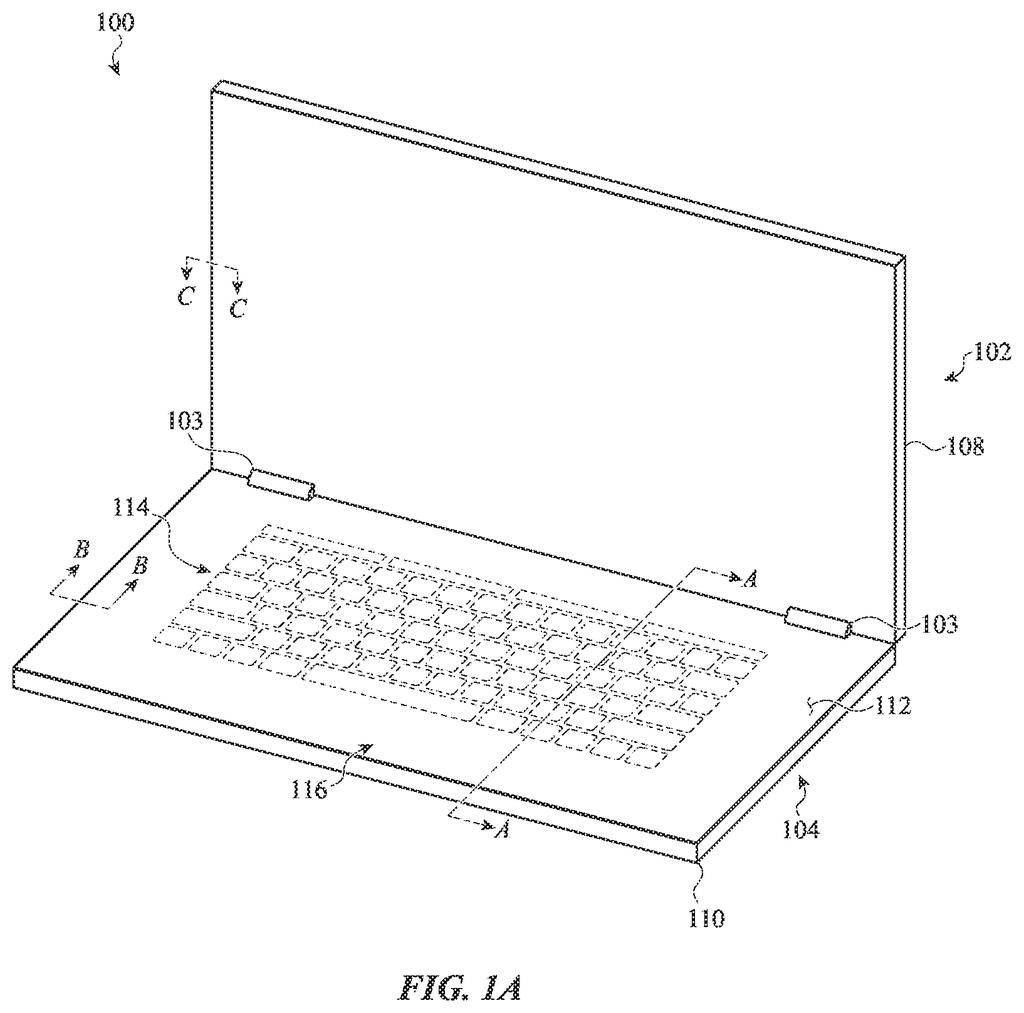
The material matters. A MacBook’s aluminum deck blocks the electrical field that touch sensors rely on, which is why only the glass trackpad responds to your finger today. A glass deck would let the whole surface work like a trackpad.
Apple first filed this idea in March 2017 as “Device having integrated interface system.” Five U.S. patents have been granted from the family since 2021, the latest on May 19, 2026. This application was filed on May 6, 13 days before that grant, and lists 13 inventors, including Christiaan Ligtenberg.
The 2017 application also describes showing an image of a keyboard on the glass and using small motors to make a press feel like a click. The new claim covers only the touch and pressure sensing. It does not put a display under the deck.
One team, three filings
The same names run through all three. Chang Zhang is the only inventor on the palm-rest displays and one of the 13 on the glass deck. Dinesh Mathew and Mikael Silvanto are on both the camera island and the glass deck. That suggests one group of Apple engineers is behind all three.
Two more Mac filings from this summer
A September 10 filing covers a locked device, such as a Mac, that opens only when you are looking at it. Another device you are using, one that can tell where your eyes are pointed, makes the check. If someone presses a key while you are looking elsewhere, it stays locked.
That filing sits on our watchlist of Apple’s eye and hand controls. Apple first filed it in March 2025, so it is much newer than the three above.
A July filing moves the motor that makes a MacBook trackpad click out from under the glass to one side. That frees space under the trackpad, which fits the reports that the new MacBook Pro will be significantly thinner.
The filings in this post
- Camera island inside a laptop display. US 2026/0268876, published September 10, 2026. Family dates to 2015.
- Displays under both palm rests. US 2026/0277348, published September 17, 2026. Family dates to 2018.
- Keyboard deck that senses touch and pressure. US 2026/0277330, published September 17, 2026. Family dates to 2017.
- Opening a Mac by looking at it. US 2026/0267945, published September 10, 2026. First filed 2025.
- Trackpad click motor moved to the side. US 2026/0195003, published July 9, 2026.
What these filings do and don’t prove
All five are published applications. The patent office has not examined any of them yet, and claims often get narrower before a patent is granted.
None of them describes a touchscreen on the lid, which is the feature every report leads with. The camera island is the only one that matches a reported feature directly. We have not seen a report of palm-rest displays or a glass keyboard deck in the new MacBook Pro.
Filing a continuation keeps the right to write new claims on old drawings. Companies do it for products they plan to ship and for ideas they want to keep competitors away from. The glass deck and the palm-rest displays have been in Apple’s files since 2017 and 2018 without shipping.
What the filings do show is timing. Apple refiled all three between April 28 and May 8, 2026, two of them days before the older applications became patents. Whatever Apple ships this fall, it wants these ideas on file.
What to watch next
The reported launch window runs from October to December. When Apple announces the new MacBook Pro, we will compare it with these filings.
The filings we are watching for next: a claim that puts a display under the keyboard deck, a claim that names an OLED panel for the camera island, and anything on making a laptop hinge stiffer for touch, the reinforced hinge Bloomberg describes.
For everything else Big Tech filed this week, start at the Patentlyze front page. If you are new to reading patents, start with our guide to how Big Tech patents work.
Patentlyze reads every new patent application that Apple, Google, Microsoft, Meta, Nvidia, Samsung, OpenAI, Qualcomm, Sony, Intel, AMD, IBM, Adobe, Salesforce, Tesla, Amazon, and Disney file at the USPTO, and writes a plain-English breakdown of the ones that say something about where products are heading. New filings drop every Thursday. The full archive lives in our patent library.
Get lists like this in your inbox
We read every patent application Big Tech publishes and send you the ones worth knowing. Plain English, free, every week.