
Apple's New Patent Covers a MacBook Top Case That Senses Touch and Pressure Anywhere on Its Surface
Apple is exploring a MacBook design where the entire top surface of the base, not just the trackpad, can detect where you touch it and how hard you press. That's a significant expansion of what a laptop's body can sense.
What Apple's whole-deck touch sensing actually does
A MacBook sits on a desk, its keyboard deck a flat, inert surface that only really pays attention to your fingers in two places: the keyboard and the trackpad. Everything else is just aluminum.
Apple's patent describes a laptop where the entire top case, the big surface your wrists rest on, is one continuous sensing layer. Touch it anywhere and the machine knows where your finger landed. Press down and it also knows how hard. The top case would be made from a dielectric material (a non-conducting substance that lets sensor signals pass through it) rather than metal, which would otherwise block the sensing hardware underneath.
In practice, this could mean the area currently occupied by a fixed trackpad, or by nothing at all, becomes interactive real estate. You could tap, swipe, or press in zones that today do nothing.
… a top case, formed from a dielectric material, coupled to the bottom case and comprising: a top member defining a top surface of the base portion; and a sidewall integrally formed with the top member and defining a side surface of the base portion; …
Translation: The laptop body uses a special insulating material that forms both the wrist rest area and the outer edges.
How the two sensor systems split the work
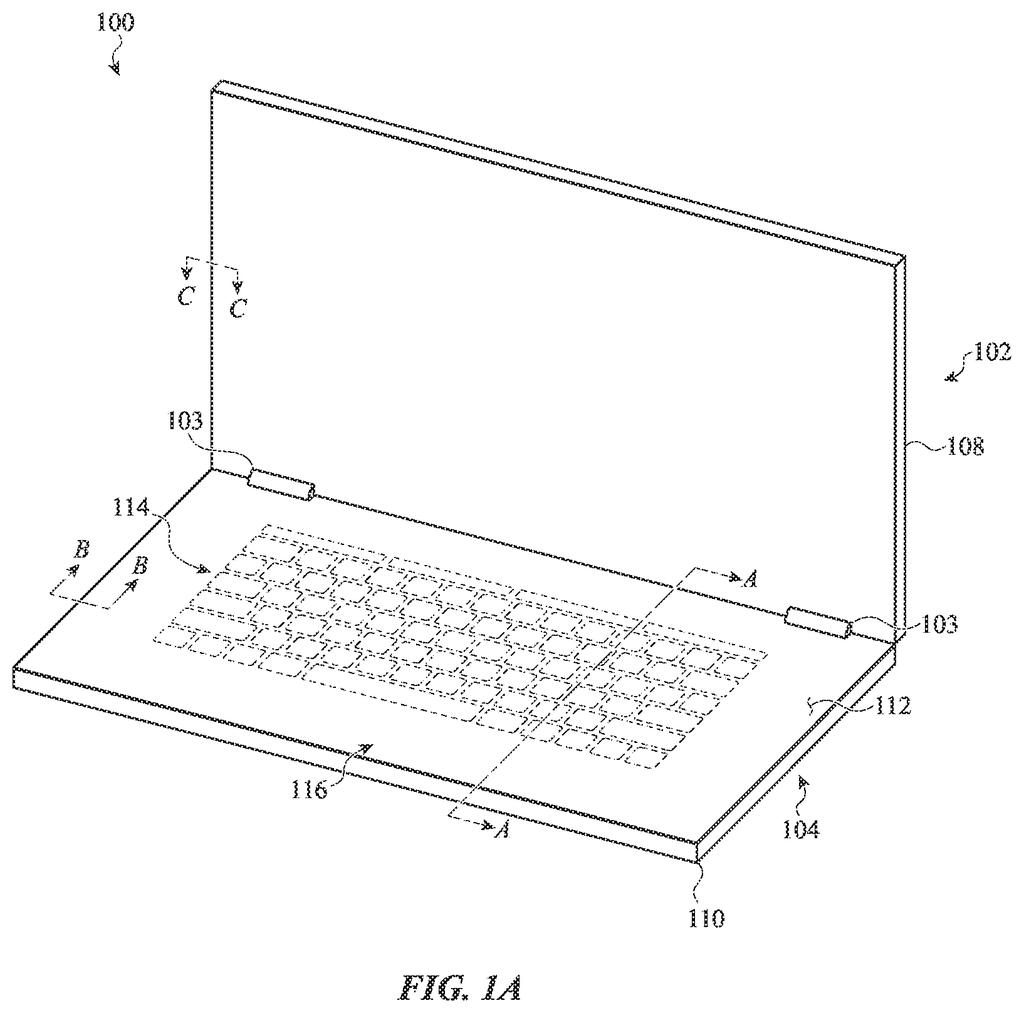
The patent describes a portable computer split into two main physical sections: a display portion (the screen lid) and a base portion (the keyboard deck), connected by a hinge.
The base portion uses a top case made from a dielectric material, meaning a non-metal, non-conducting material like glass or ceramic. Standard MacBook aluminum would block the electric fields that capacitive touch sensors rely on, so switching to a dielectric lets sensors underneath the surface actually work across the entire deck.
Inside, two separate sensing systems handle different jobs:
- First sensing system: determines the location of a touch, mapping where on the surface a finger or object made contact, much like a large touchpad grid.
- Second sensing system: determines the force of the same touch, measuring how hard the user is pressing, similar to Apple's Force Touch technology already found in MacBook trackpads.
The top member (the flat upper surface) and the sidewall are described as integrally formed, meaning they are one continuous piece rather than separate panels joined together. That single-piece construction is important for distributing sensor coverage without gaps or seams interrupting the sensing area.
… a first sensing system configured to determine a location of a touch input applied to the top surface of the base portion and a second sensing system configured to determine a force of the touch input.
Translation: Internal sensors track exactly where your fingers touch the laptop body and how hard you press down.
What this means for the future MacBook keyboard area
If Apple builds this into a real product, the physical keyboard deck of a MacBook could become a large, pressure-sensitive touch surface. That opens the door to gestures anywhere on the wrist-rest area, dynamic input zones that appear on a display embedded in the deck, or a larger version of today's trackpad that stretches across most of the base.
Claim 1 covers essentially any portable computer with a dielectric top case and those two sensing systems working together. That's a fairly broad structural claim: it does not specify how big the sensing area must be, what material exactly the dielectric is, or what software interprets the inputs. If granted as written, it could give Apple a blocking position on an entire category of whole-deck sensing laptops, not just one specific implementation.
Apple's tenth filing in input and haptics we've tracked since May joins earlier work on a pressure-sensing side button and air gestures for Siri.
Claim 1 covers any portable computer where the top surface of the keyboard deck is made from a non-metal material and the whole surface can sense both where you touch it and how hard you press. That scope is wide. Apple did not write in a specific material, a specific sensor type, or any size limit on the sensing area.
In practice, that breadth means the claim reaches well beyond a trackpad. A full glass or ceramic deck that responds to location and pressure anywhere across its surface falls inside the boundary Apple has drawn here.
That matters because the combination of location and force sensing is claimed as a structural feature of the case itself, not as a discrete component tucked underneath it. Any design that puts those two capabilities into a non-metal laptop deck would need to reckon with this claim.
There are more where this came from
We read every patent application Big Tech publishes and send you the ones worth knowing. Plain English, free, every week.
The drawings
108 drawing sheets from US 2026/0277330 A1 · click any drawing to enlarge


Want this weekly breakdown for a company we don't cover? Patentlyze Pro →