
Samsung Patents a Way to Automatically Match the Look of Multiple Video Clips
Editing together clips shot in different lighting or on different cameras always looks mismatched — Samsung is patenting a system that quietly fixes that for you before you even notice the problem.
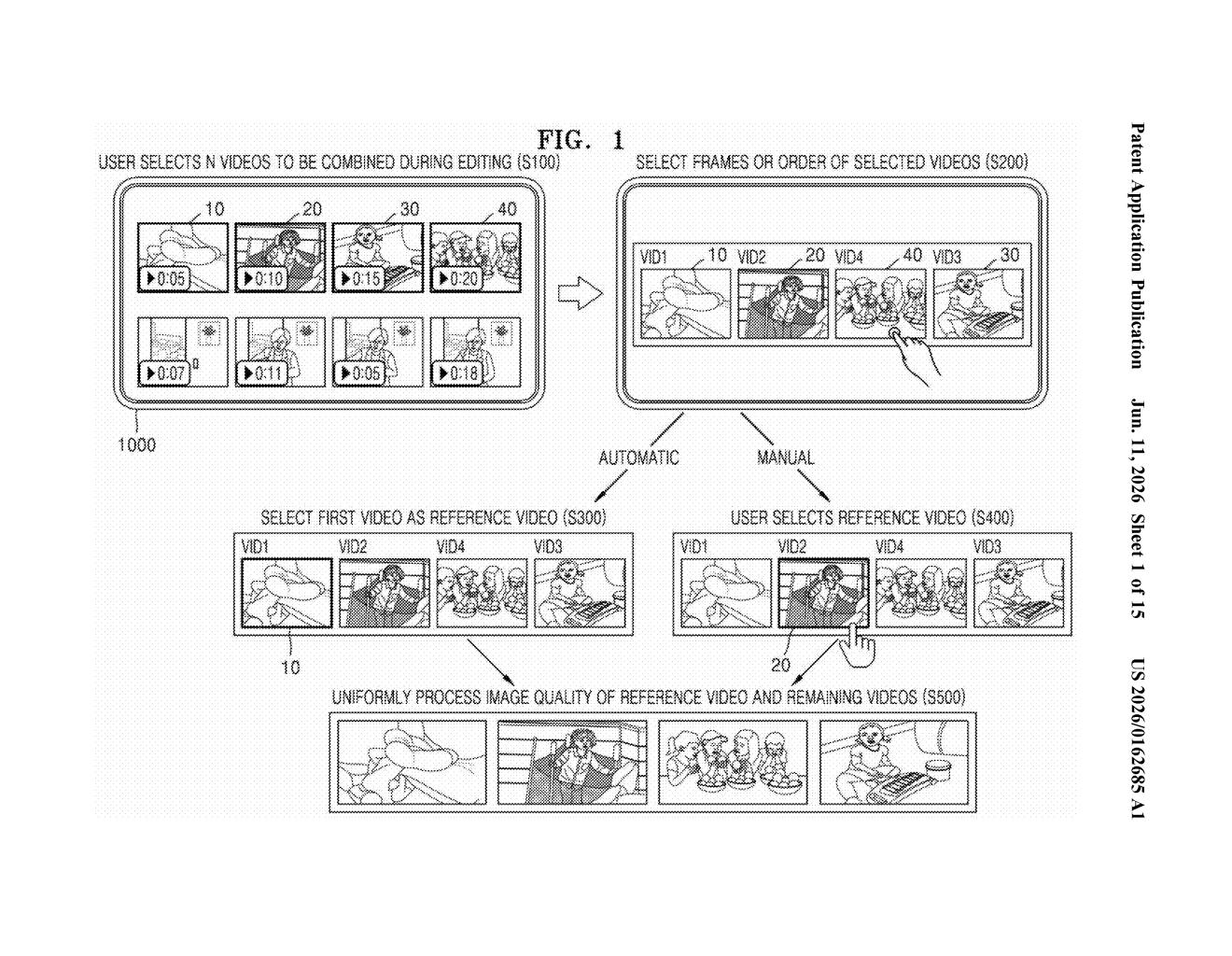
What Samsung's auto video-matching actually does
Imagine you filmed a birthday party across three different phones — yours, your partner's, and an older one a guest handed you. The clips look completely different: one's warm and bright, one's cool and flat, one's a bit washed out. Stitching them together into a single video looks awkward.
Samsung's patent describes a tool that picks one of your clips as the visual "master" — the one whose color, brightness, and image quality sets the standard — and then automatically adjusts all the other clips to match it before combining them.
You don't have to manually tweak contrast or color on each clip. The device does the analysis and the matching on its own. The result is a single, cohesive-looking video where every clip feels like it came from the same camera on the same day.
How the device picks and applies the reference parameters
The patent describes a five-step editing pipeline built into an electronic device (most likely a smartphone or tablet).
- Step 1 — Selection: The user picks a set of videos they want merged into one output file.
- Step 2 — Reference determination: The device picks (or the user designates) one clip as the reference video — the quality benchmark all other clips will be matched to.
- Step 3 — Parameter extraction: The device analyzes the reference video to pull out its image quality-related parameters — things like brightness levels, contrast, color temperature, saturation, and sharpness.
- Step 4 — Parameter application: Those same parameters are applied to every other selected clip, producing a set of adjusted videos that now visually match the reference.
- Step 5 — Combination: The adjusted clips are merged into a single output video.
The patent doesn't fully specify how the reference video is chosen — it could be automatic (perhaps the highest-quality clip) or manual — but the core idea is a consistent, one-pass quality-normalization step before the final merge.
What this means for Galaxy phone video editing
For anyone who edits home videos or short social content directly on their phone, this kind of automatic color-matching is currently something you'd need a desktop app — or real editing skill — to pull off. Baking it into the device's native editing tools would make polished multi-clip videos far more accessible.
For Samsung specifically, it fits a pattern of Galaxy software trying to close the gap with more dedicated editing apps. If this ships in something like Samsung's Gallery editor or a future version of Video Editor on Galaxy devices, it would be a quiet but genuinely useful upgrade for the average user who just wants their clips to look like they belong together.
This is a modest, practical patent — not a flashy AI showcase, but the kind of quality-of-life feature that actually gets used every day. The concept of normalizing video quality across clips before merging is well understood in professional editing software; what Samsung is patenting here is the implementation on a device. Worth watching for a Galaxy software update, but don't expect a press release about it.
There are more where this came from
We read every patent application Big Tech publishes and send you the ones worth knowing. Plain English, free, every week.
Want this weekly breakdown for a company we don't cover? Patentlyze Pro →