
Google's New Patent Fixes Blurry Text in AR Glasses by Reading How Far Away a Wall Is
When you look at a wall through AR glasses and the floating text goes blurry, that's a real problem — and Google has a patent for fixing it by making the virtual content bigger or smaller depending on how far away the wall actually is.
What Google's depth-aware AR text sizing actually does
Imagine you're wearing AR glasses and looking at a restaurant menu stuck to a wall a few feet away. A digital overlay — maybe a translation or a calorie count — appears floating near the menu. But your eyes are focused on the wall, not on some invisible focal plane where the glasses project the text. The result: blurry virtual text, and a headache.
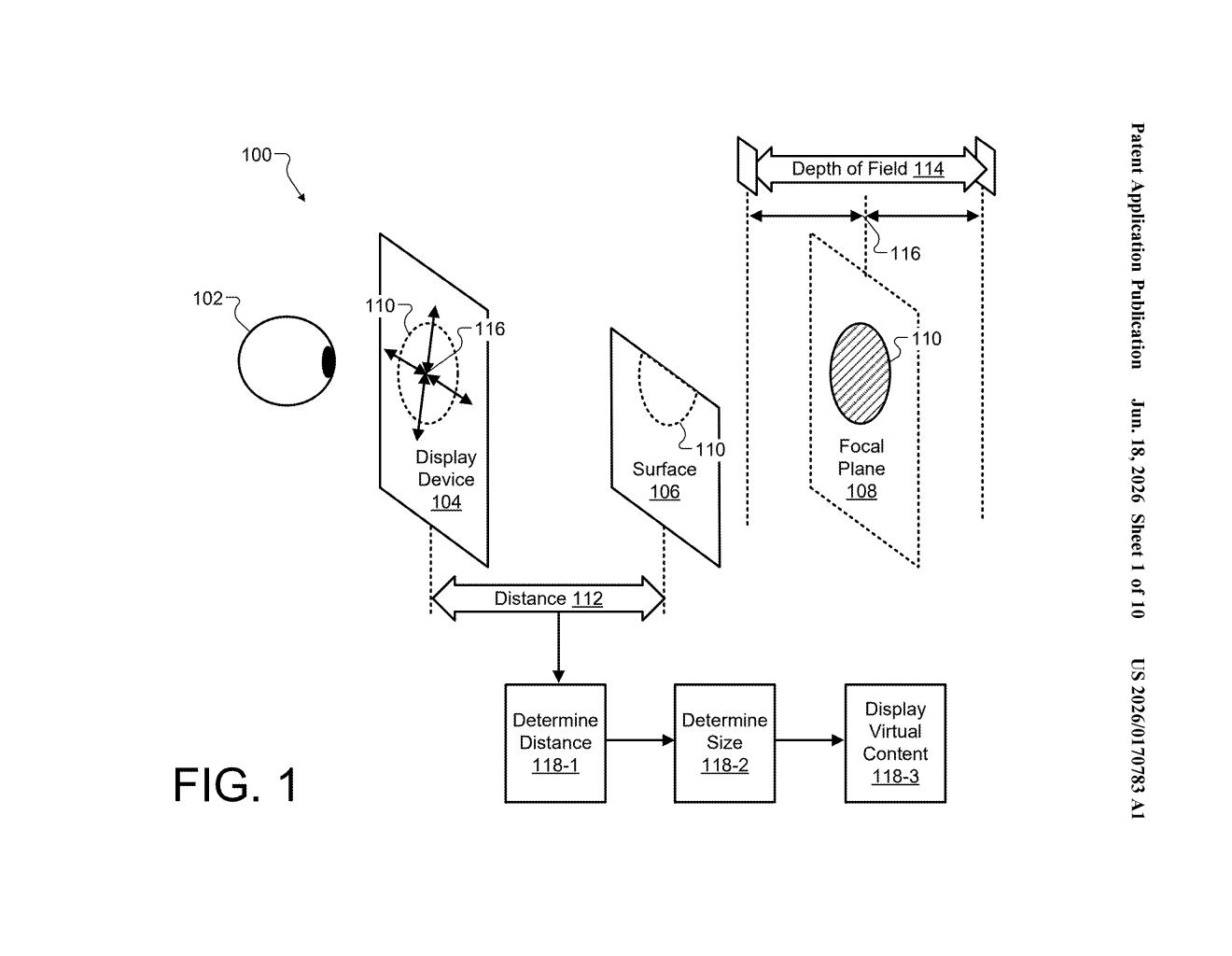
Google's patent describes a system that measures how far away that real-world surface is, then automatically adjusts the size of the virtual content so that your depth of field — the range of distances that look sharp to your eye — covers both the physical surface and the digital overlay at the same time.
In short, the glasses figure out where you're looking and resize whatever they're showing you so it stays sharp. It's a bit like auto-focus, but for the floating text in your vision instead of a camera lens.
How the display measures distance and adjusts overlay size
The patent describes a three-step process running continuously on an AR display device (think glasses or a headset):
- Distance measurement: The device determines how far away a real-world surface is — the wall, the table, the page — that sits in the part of your field of view where virtual content will appear.
- Configuration calculation: Based on that distance, it calculates a configuration — primarily the size — for the virtual overlay. The goal is to ensure the depth of field (the range of distances that appear sharp to a human eye at a given focus level) spans all the way from that real surface to the focal plane where the AR content is projected.
- Adaptive display: The device renders the virtual content at the calculated size on that focal plane, keeping both the physical object and the digital overlay simultaneously in focus.
The key insight is that human eyes have a limited depth of field. If a surface is close, the usable depth of field is shallow. By sizing the virtual content appropriately — likely making it larger when surfaces are nearby — the patent aims to keep the overlay within that sharp zone. The claim covers the method itself, meaning Google is staking out the core logic of distance-to-configuration mapping for AR displays.
What this means for AR glasses and visual comfort
Eye strain and blurry overlays are among the top complaints from people who try AR headsets for more than a few minutes. If Google can make virtual content stay sharp without the user needing to consciously refocus, it removes one of the most physically uncomfortable aspects of current AR devices. That matters a lot for extended daily use — the use case Google's Android XR platform is clearly targeting.
This also signals that Google is thinking carefully about the optics of AR, not just the software. Solving the focus problem in firmware or software — rather than requiring exotic new lens hardware — could make the technology cheaper and more practical to ship at scale.
This is a real problem that real AR users actually notice, and Google's approach of solving it in software rather than specialized optics is genuinely worth attention. It won't generate headlines on its own, but it's exactly the kind of unglamorous comfort fix that determines whether people actually wear AR glasses for more than 20 minutes.
There are more where this came from
We read every patent application Big Tech publishes and send you the ones worth knowing. Plain English, free, every week.
Want this weekly breakdown for a company we don't cover? Patentlyze Pro →