
Google Patents a System That Automatically Attributes Sources in AI Summaries
When an AI gives you an answer, where did that answer actually come from? Google has filed a patent for a system that tries to answer that question automatically, by checking AI output against its training data and inserting clickable source links wherever it finds a match.
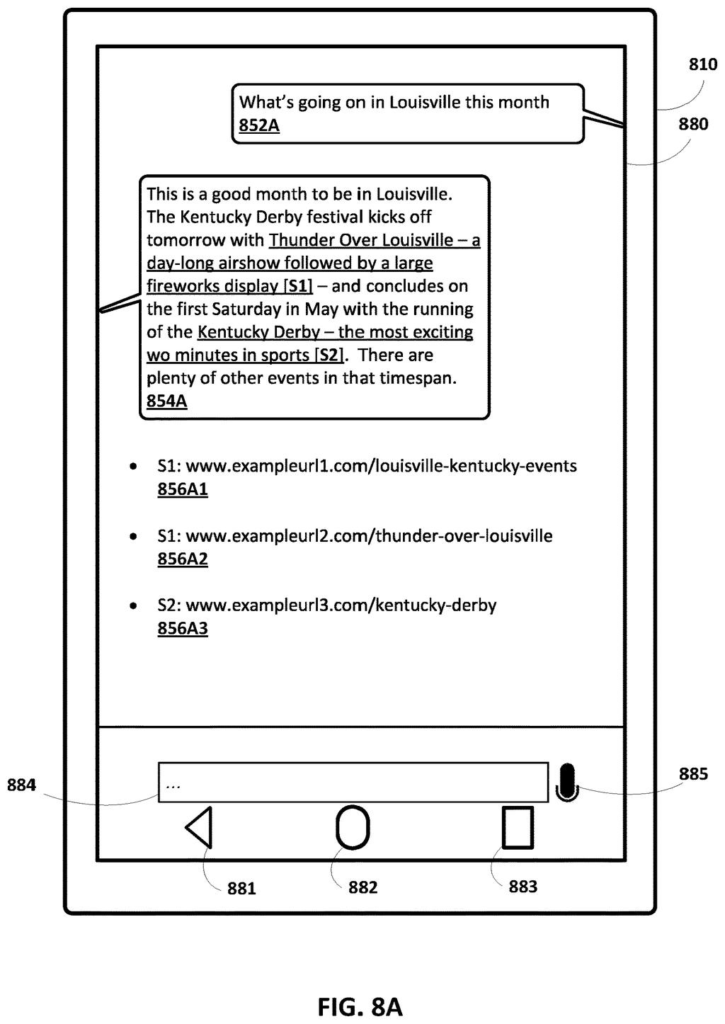
How Google's citation system catches borrowed AI text
Imagine you ask Google's AI a question and it gives you a polished, confident answer. Now imagine that answer borrowed a sentence or two almost word-for-word from a news article or a Wikipedia page. Right now, you'd have no way to know. Google's new patent describes a system designed to catch exactly that.
The system works by comparing the AI's response to the original text it was trained on. If a chunk of the AI's answer closely matches something in the training data, the system finds the source, then rewrites that chunk to include a clickable hyperlink back to the original. You end up with an answer that looks almost the same, but with citations you can actually follow.
Google also describes offering this as a service to other companies, meaning the same attribution layer could, in theory, be built into other products that use AI text generation.
How the system matches AI output to training data segments
The patent describes a pipeline with a few distinct steps. First, a large language model (LLM) generates a response to a user's question in the normal way. Then, a separate process scans that response looking for segments that closely match text from the LLM dataset (the body of text the model was trained on, or later fine-tuned with).
When a match is found, the system identifies the original source tied to that dataset segment, such as a webpage, article, or document. It then modifies the AI-generated response to embed a hyperlink pointing back to that source, while keeping the response readable and relevant.
The modified response, now containing inline citations, is what gets sent to the user's device. The key steps are:
- Generate an AI response to user input
- Compare response segments against the training dataset for matches
- Identify which original source each matching segment came from
- Rewrite those segments to include a hyperlink to the source
- Deliver the revised, cited response to the user
The patent also notes this attribution layer can be offered as a third-party service, meaning it isn't necessarily limited to Google's own products.
What automatic AI attribution means for publishers and users
The question of whether AI systems owe credit to the people whose writing they were trained on is one of the most contested issues in the technology industry right now. Dozens of news organizations and authors have filed lawsuits arguing that training on their content without compensation or credit is a form of infringement. A system that automatically identifies and links back to source material would at least make the borrowing visible, which is a meaningful step even if it doesn't resolve the underlying legal questions.
For readers and users, this matters in a practical way too. Clickable citations mean you can check the AI's work, verify context, and decide whether to trust a particular answer. That's a genuinely useful improvement over the current experience, where AI responses often arrive with no indication of where the information originated.
This patent is Google's most concrete public signal yet that it's taking AI attribution seriously as an engineering problem, not just a PR talking point. Whether it actually satisfies publishers and rights holders is a separate question, but a system that automatically inserts source links is far more honest than one that generates confident, uncited prose. The third-party service angle is worth watching: if Google builds this as an API, it becomes infrastructure that shapes how the whole industry handles AI citations.
There are more where this came from
We read every patent application Big Tech publishes and send you the ones worth knowing. Plain English, free, every week.
The drawings
11 drawing sheets from US 2026/0212135 A1 · click any drawing to enlarge


Want this weekly breakdown for a company we don't cover? Patentlyze Pro →