
Google's New Patent Teaches Smart Glasses to Feel Your Voice, Not Just Hear It
Your voice isn't just sound — it also makes your jaw and skull vibrate. Google wants wearables to capture those vibrations and ship them alongside microphone audio to make speech recognition work better in noisy environments.
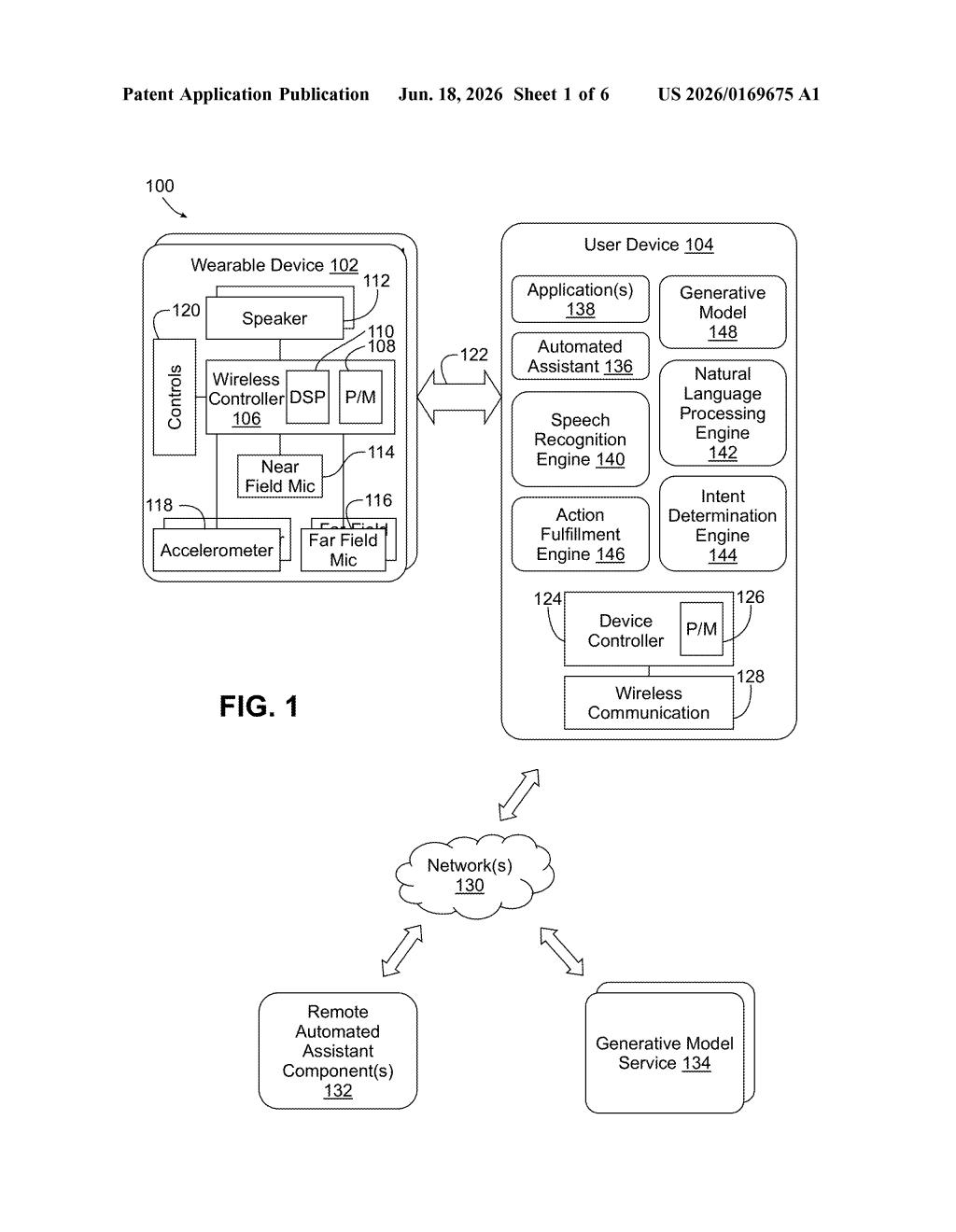
How Google's wearable speech trick actually works
Imagine you're at a crowded coffee shop trying to ask your smart glasses for directions. The microphone picks up your voice, but it also picks up espresso machines, conversations, and music — and the AI on the other end has to guess which sounds are you.
Google's patent takes a different approach: your wearable already has a motion sensor (an accelerometer, the same type that tracks your steps) that picks up the tiny physical vibrations caused by your voice — through your bones, jaw, and skull. That signal is much harder to fake with background noise. The patent describes packaging that vibration data as a hidden audio channel and sending both streams to a phone or cloud server at the same time.
By giving the speech recognition system two independent pictures of what you're saying — one through the air, one through your body — it can cross-reference them and filter out the noise much more effectively. The result is a voice assistant that understands you even when the world around you is loud.
How accelerometer data gets piggybacked onto audio channels
The patent describes a method for a wearable device — think smart glasses or earbuds — to capture two simultaneous data streams whenever a user speaks:
- A microphone signal: standard audio captured through the air, exactly like any voice assistant today.
- An accelerometer signal: motion sensor readings that capture the physical vibrations your speech creates in the device itself, transmitted through skin and bone contact.
The clever part is how those accelerometer readings get transmitted. Rather than requiring a separate high-bandwidth data channel, the patent describes converting the motion data into a narrowband audio signal — specifically one that fits within roughly a 2,000 Hz frequency range. That's a relatively small slice of the audible spectrum, which means it can ride alongside the regular microphone audio as a second channel in a standard stereo or multi-channel audio stream. No special wireless protocol needed.
That combined signal is then sent wirelessly to an external device — a paired smartphone or a cloud server — where speech recognition software can use both channels together. The accelerometer data acts as a kind of ground truth about when and how you're speaking, helping the system separate your voice from ambient noise. The patent also mentions alternatives like spread-spectrum encoding (a technique that spreads a signal across a wide frequency band to make it more resistant to interference) for added reliability.
What this means for Google's wearable voice assistants
Voice assistants on wearables have a fundamental problem: microphones on glasses or earbuds sit far from your mouth and close to the world's noise. Bone-conduction and accelerometer-based approaches to fixing this aren't new in research, but packaging the fix as a standard audio channel — rather than a custom data pipe — is a practical engineering choice that could make this easier to deploy across existing Bluetooth audio hardware.
Google has been investing heavily in wearable AI, from Pixel Buds to its recent Android XR glasses work with Samsung. A patent that specifically targets better voice recognition in wearables fits neatly into that direction. If this technique ships, you'd notice it most in situations where today's voice assistants already struggle: outdoors, in transit, or anywhere you'd rather not repeat yourself twice.
This is a genuinely practical patent — not a moonshot. The insight that accelerometer data can travel as an audio channel, bypassing the need for any new wireless infrastructure, is the kind of unglamorous engineering that actually makes it into products. It's worth tracking because it solves a real, daily frustration with wearable voice assistants.
There are more where this came from
We read every patent application Big Tech publishes and send you the ones worth knowing. Plain English, free, every week.
Want this weekly breakdown for a company we don't cover? Patentlyze Pro →