
Samsung Patents a Way to Run AI Image Upgrades Inside a GPU's Rendering Pipeline
Every frame your GPU draws has to go through a strict assembly line. Samsung's new patent inserts an AI processing step into that line without breaking the chain — and it does it by giving each processor a carefully timed green light.
What Samsung's AI-in-the-pipeline trick actually does
Imagine a car factory where robots pass parts down a conveyor belt in a fixed order. If one robot suddenly needs extra time, the whole belt stops. GPUs work the same way — they draw each frame through a rigid sequence, and anything that interrupts that sequence causes stutters or delays.
Samsung's patent describes a way to add an AI upgrade step — think upscaling a low-resolution image to a sharper one, or removing noise — right in the middle of that sequence, without halting the line. The trick is a clever signaling system: each processor sends a tiny "done" flag when it finishes its piece of work, and the next processor waits for that flag before it starts.
The result is that your GPU can keep drawing frames at its own pace while a separate AI chip quietly improves each one in the background, and a final post-processing pass applies finishing touches — all in sync, with no processor sitting idle waiting for the others.
How the three-processor handoff keeps frames moving
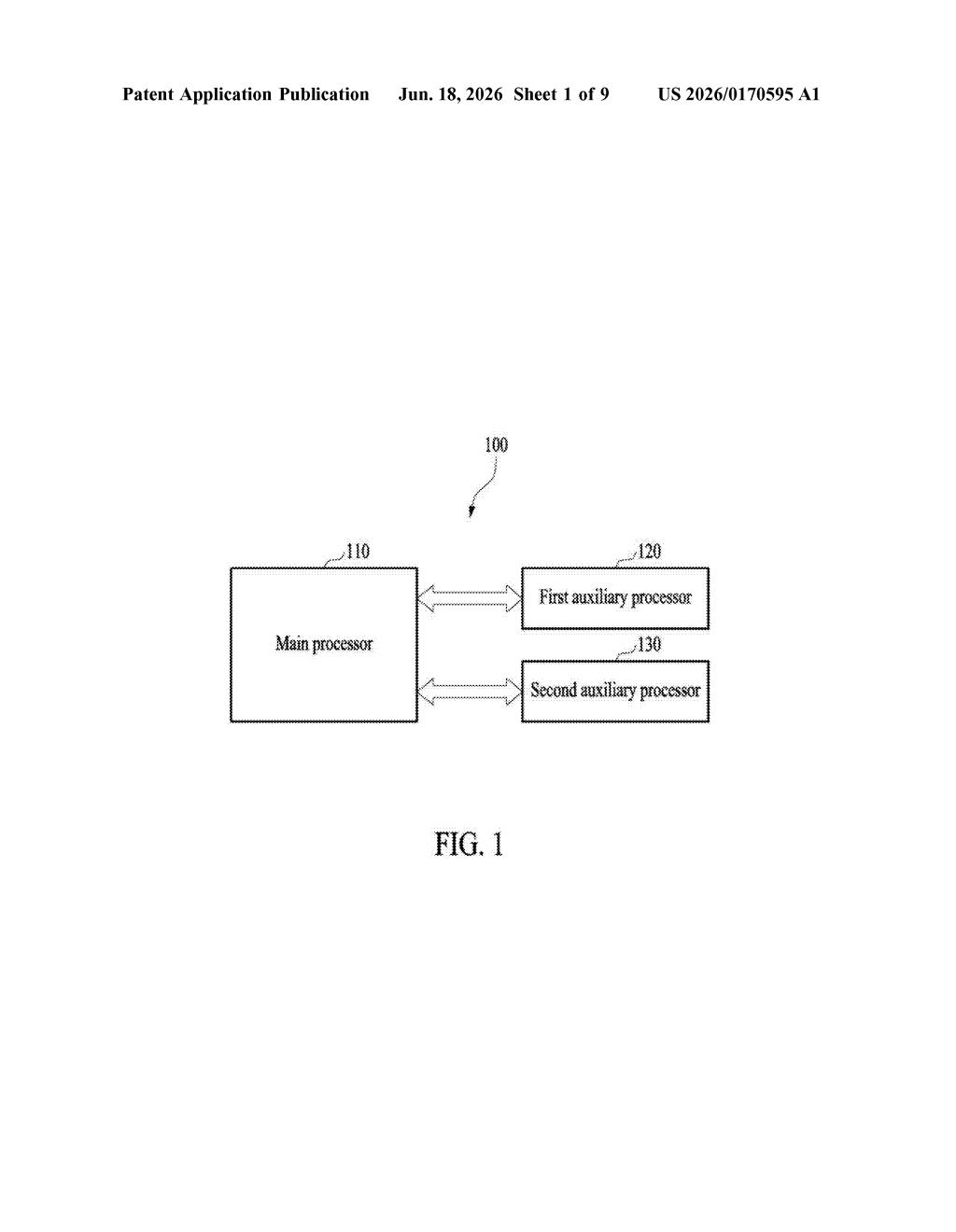
The patent describes a three-processor architecture managed by a main processor acting as a traffic controller.
- A first auxiliary processor (the GPU) renders a raw image frame and writes the result to a memory buffer. When it's done, it raises a synchronization signal — essentially a flag that says "my data is ready."
- A second auxiliary processor (a dedicated AI accelerator) watches for that flag. The moment it appears, the AI chip reads the raw frame and runs AI inference (a neural-network pass — for example, upscaling a 1080p frame to 4K, or improving low-light textures) and writes the enhanced result to a second memory buffer.
- When the AI step finishes, the main processor raises a second synchronization signal. The GPU reads that and applies post-processing — color grading, anti-aliasing, or similar final-touch effects — to the AI-enhanced frame.
The key engineering insight is the use of synchronization objects — lightweight coordination tokens that let each processor start exactly when the previous step's data is valid, rather than burning cycles polling a shared clock or waiting for an arbitrary timeout. This keeps the pipeline moving in lockstep without manual timing tuning.
What this means for AI-enhanced graphics on Samsung chips
AI-based image upscaling (similar to Nvidia's DLSS or AMD's FSR) is already common on desktop GPUs, but integrating it cleanly into a mobile or embedded graphics pipeline — where you have separate, specialized chips rather than one monolithic GPU — is harder. Samsung's Exynos chips pair a GPU with a dedicated neural processing unit (NPU), and this patent maps directly onto that kind of split-chip design.
If this approach ships in a future Exynos processor, it could mean Galaxy phones or tablets that run AI image enhancement on every rendered frame — games, video, even the camera viewfinder — without the frame-rate hit you'd normally expect from bolting AI onto a pipeline not designed for it. That's a meaningful difference for anyone who plays mobile games or cares about display quality.
This is solid, unsexy engineering work. The synchronization-object approach to multi-chip pipeline coordination is a real problem with no universally elegant solution, and Samsung's patent describes a clean answer for their specific GPU-plus-NPU chip architecture. It won't make headlines at a product launch, but it's the kind of foundational IP that makes AI-enhanced graphics actually practical on a phone.
There are more where this came from
We read every patent application Big Tech publishes and send you the ones worth knowing. Plain English, free, every week.
Want this weekly breakdown for a company we don't cover? Patentlyze Pro →