
IBM Patents a Physical Ball That Programs Quantum Computers by Rolling
IBM wants to let people program quantum computers by physically rolling a ball around — turning real-world movement into abstract quantum math.
What IBM's motion-capture quantum controller actually does
Quantum computers are notoriously hard to program. The building blocks — called quantum gates — require precise mathematical rotations that are nearly impossible to visualize, let alone set up intuitively. IBM's new patent tries to fix that with something much more tangible: a physical ball you can hold and move.
The idea is simple enough to explain at a dinner table. You pick up a sphere loaded with motion sensors (think the internals of a game controller), rotate or tilt it, and a regular computer reads those movements. It then translates them into the exact kind of rotation that a quantum circuit needs. No typing arcane math — just move the ball.
This is about giving physicists, students, or engineers a hands-on way to interact with quantum operations that are otherwise invisible and abstract. Whether it ever ships as a real product is an open question, but the core appeal is clear: make something inherently un-physical feel a little more physical.
How the sensors translate rolling into quantum gate operations
The patent describes a system built around three parts: a movable object (described as a sphere, like a physical ball), internal sensors that detect how the object moves, and a classical computing machine — meaning an ordinary computer — that acts as the translator.
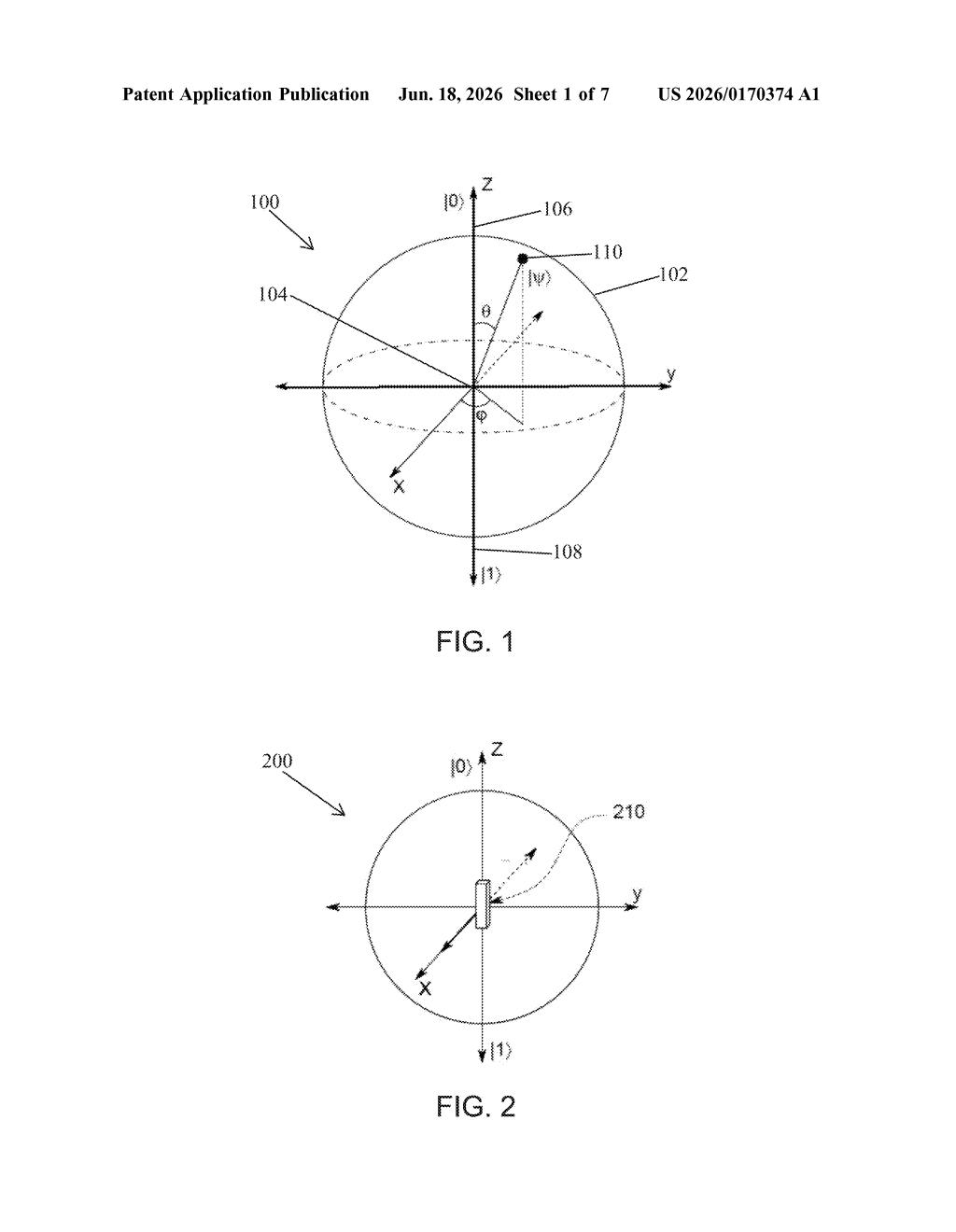
When you rotate the sphere, the sensors capture that motion in three-dimensional space. The classical computer then maps that physical rotation onto a mathematical representation used in quantum computing called a Bloch sphere — a standard way of depicting the state of a single quantum bit (qubit) as a point on the surface of an imaginary globe. Rotate the physical ball a certain way, and the corresponding point on the Bloch sphere moves accordingly.
That rotation is then pushed directly into a quantum circuit as a gate operation — the basic instruction set of a quantum program. The key operations here are called rotation gates (like Rx, Ry, or Rz — named for the axis they rotate around), which are fundamental to building any quantum algorithm.
- Physical sphere with embedded motion sensors detects orientation and movement
- Classical computer converts 3D motion into Bloch sphere rotation angles
- Those angles are written into a quantum circuit as gate parameters
What this means for making quantum computing more approachable
Quantum computing's biggest barrier right now isn't raw hardware — it's accessibility. Most people who could benefit from quantum algorithms don't have the mathematical background to program them directly. A physical interface like this could lower that barrier, at least for educational settings, research demonstrations, or rapid prototyping of simple circuits.
That said, this patent is still very conceptual. IBM doesn't describe a finished product, a specific sensor type, or how the system handles error or precision at the scale real quantum programs demand. For now, it reads more like a research direction than an imminent release — but it signals IBM's interest in making quantum computing tangible, not just theoretical.
This is a genuinely interesting idea dressed in fairly thin patent clothing. The core concept — using physical motion as a quantum programming interface — is creative and could be valuable in classrooms or as a visualization aid. But the patent is so high-level that it's hard to know if IBM has actually built anything like this or is simply staking a conceptual claim early. Worth keeping an eye on if you care about quantum education tools, but don't expect a product announcement soon.
There are more where this came from
We read every patent application Big Tech publishes and send you the ones worth knowing. Plain English, free, every week.
Want this weekly breakdown for a company we don't cover? Patentlyze Pro →