
IBM Patents Technology That Keeps AI Calculations Accurate Inside Memory Hardware
Analog AI chips are faster and more power-efficient than conventional digital ones — but they make math errors that traditional circuits can't easily fix. IBM may have a hardware-level answer.
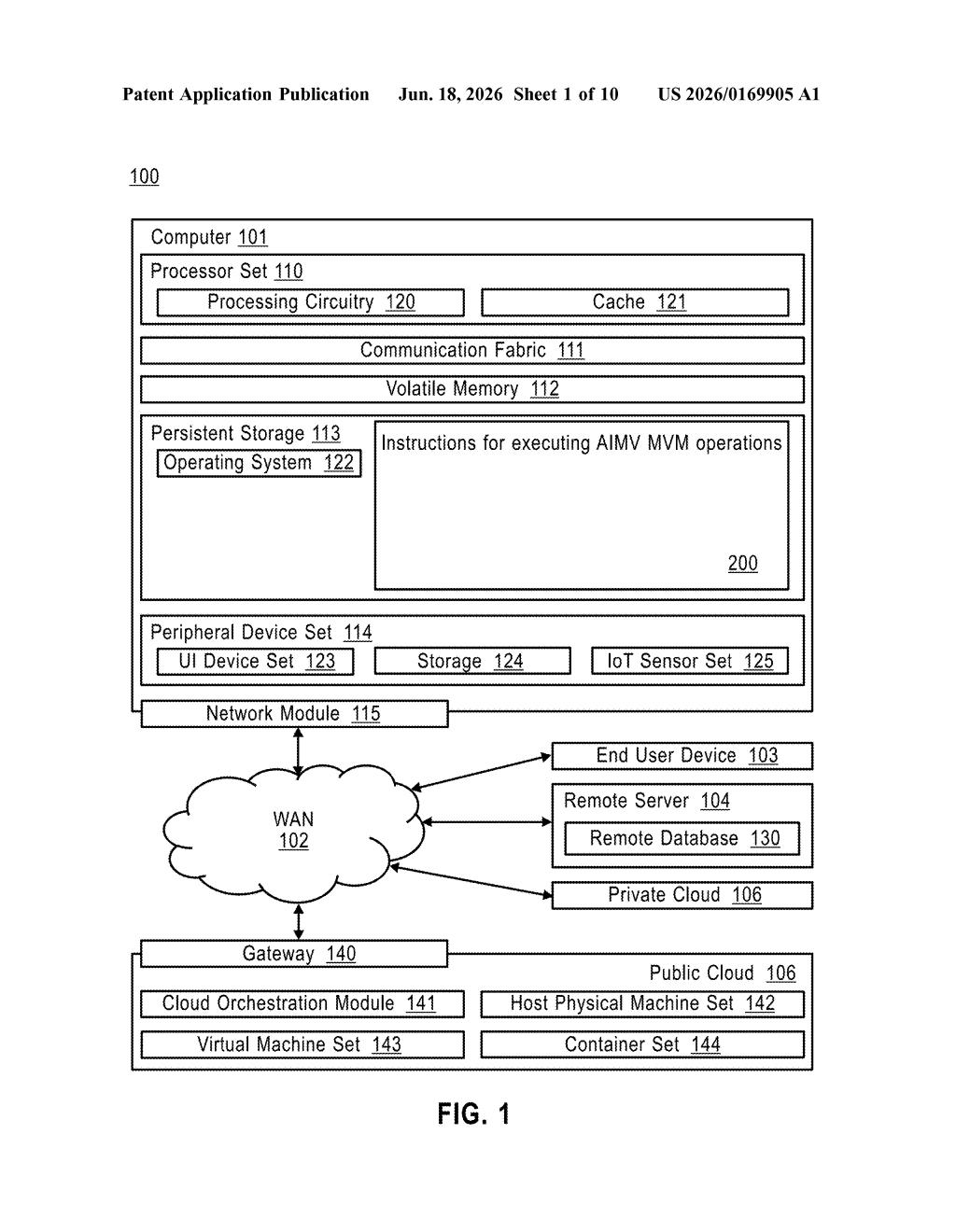
What IBM's analog chip error fix actually does
Imagine trying to do arithmetic on a calculator that gives you slightly wrong answers every time, but in a predictable way. That's roughly the problem with analog in-memory computing — a promising approach to running AI faster and cheaper. Instead of shuffling numbers around between memory and a processor, the math happens inside the memory chip itself using electrical signals. It's fast and efficient, but the physics of the components introduces distortion.
IBM's patent describes a circuit that generates a special corrective voltage signal — one that changes over time in a carefully controlled way — and uses it to undo that distortion on the fly. Think of it like a noise-canceling headphone, but for math errors instead of sound.
The corrected result is then converted to a clean digital number before it leaves the chip. That way, downstream AI calculations get accurate inputs without the system having to slow down or burn extra energy doing software-level corrections after the fact.
How the time-varying voltage linearizes the output
The patent describes a memory crossbar array — a grid of memory cells where each cell stores a number from a matrix as a conductance value (how easily electricity flows through it). When you push voltages representing another set of numbers (a vector) into the rows of that grid, the cells multiply and sum the values electrically, all at once. This is called analog matrix-vector multiplication, and it's at the heart of how neural networks do most of their heavy lifting.
The catch: memory cells based on phase-change or resistive materials don't behave perfectly linearly — meaning the output current isn't a clean, proportional response to the input. The relationship curves or distorts in ways that corrupt the result.
IBM's approach generates a separate set of time-varying voltage values — voltages that shift in a controlled pattern over the course of a computation — using the same crossbar array. These signals are fed into the analog-to-digital converters (the chips that translate analog electrical levels into digital numbers) in a way that mathematically cancels out the non-linearity before the number is finalized.
- Matrix values are encoded as electrical conductances in the memory grid
- Input vectors are applied as analog voltages across the grid's rows
- Non-linear output currents are generated at the columns
- A time-varying corrective signal linearizes those currents during analog-to-digital conversion
- Clean digital results exit the chip ready for use
What this means for low-power AI chip design
The push for analog in-memory computing is fundamentally about energy and speed — running AI inference without the constant back-and-forth between memory and processor that digital chips require. IBM has been a leader in this area for years, particularly with phase-change memory. But non-linearity has been one of the most stubborn barriers to making analog results accurate enough for real AI workloads. A hardware compensation scheme that works at the circuit level — not patched in software — would make these chips far more practical.
For you as a user, this is the kind of invisible infrastructure work that could eventually let your phone or a small edge device run AI models locally without draining the battery in minutes. It's not a consumer product — it's the plumbing that makes consumer products possible.
This is genuinely interesting chip-design work, not a flashy AI feature. IBM's analog computing research group has been publishing in this space for years, and this patent is a direct engineering response to one of the field's known hard problems. Whether it ever ships in a product is another question, but the technical approach is specific and credible.
There are more where this came from
We read every patent application Big Tech publishes and send you the ones worth knowing. Plain English, free, every week.
Want this weekly breakdown for a company we don't cover? Patentlyze Pro →