
Intel Patents Video Tool That Shrinks File Sizes Before Compression Begins
Before a video encoder ever touches a frame, Intel wants a neural network to quietly trim the color data — making the compression step faster and potentially smaller without the encoder having to do the heavy lifting itself.
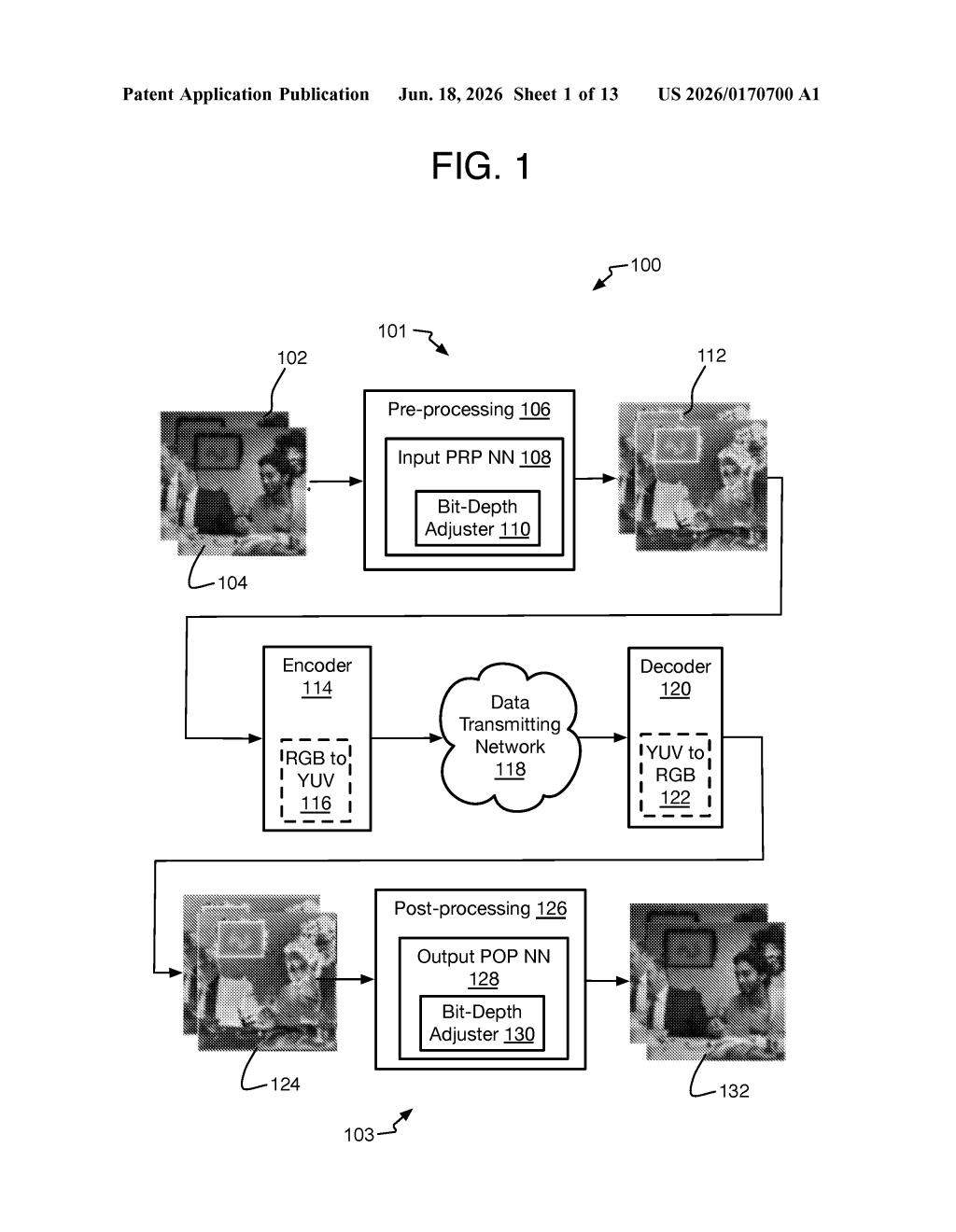
What Intel's bit-depth video trick actually does
Think of a video file like a package you're mailing. The heavier it is, the more it costs to ship. Video encoders (the software that shrinks video files) have traditionally done all the work of deciding what to keep and what to throw away. Intel's patent proposes adding a helper step before that process even starts.
That helper is a small neural network — a type of AI — that looks at each video frame and reduces the color precision of the image. This is called lowering the bit-depth: instead of storing, say, 256 shades of a color, it stores only 64. Done well, your eyes barely notice, but the encoder's job gets much easier.
The result could be video files that compress faster, take up less storage, or stream more smoothly — all because an AI did some prep work first. It's a bit like a chef pre-chopping vegetables before a busy dinner service: the cooking still happens, but it's quicker.
How the pre-processing neural network strips image data
The patent describes a system built around what Intel calls a Pre-Processing Neural Network (PRPNN). This network sits in front of a conventional video encoder — like the kind used in H.265 or AV1 compression — and transforms the raw frame data before the encoder sees it.
Specifically, the PRPNN takes video frames at their original bit-depth (the number of bits used to represent each color channel — higher bit-depth means more color detail and larger files). It then outputs a version of those frames with a reduced bit-depth. The encoder then compresses that already-simplified version.
The network takes multiple input channels, meaning it can look at different color components of a frame simultaneously and make intelligent decisions about where to reduce precision and where to preserve it. This is the key difference from simply applying a blunt mathematical filter: the neural network is trained to minimize visible quality loss while maximizing the reduction in data complexity.
- Raw video frames feed into the PRPNN
- The PRPNN reduces the bit-depth intelligently across color channels
- The simplified frames are handed off to a standard video encoder
- The encoder compresses the already-lightened data
What this means for video compression hardware
For Intel, this patent sits squarely in the space of hardware-accelerated video encoding — an area where the company competes through its Arc GPUs and integrated graphics on Core processors. If the pre-processing step can be handled efficiently by dedicated neural-network silicon, Intel's encoder hardware becomes more competitive against Nvidia and AMD on tasks like streaming, video conferencing, and content creation.
For everyday users, the downstream effect could show up as better video quality at the same file size, or the same quality at a smaller file — useful anywhere from YouTube uploads to security camera footage to video calls. Whether this approach outperforms existing encoder-side optimizations is the real open question.
This is a real engineering idea — using a learned pre-processor to ease the burden on downstream compression is a legitimate research direction — but the patent's abstract and claim language are thin enough that it reads more like a placeholder than a refined invention. The technique of reducing bit-depth before encoding is not new; what Intel is claiming is specifically doing it with a trained neural network in a multi-channel setup. That's a meaningful distinction, but the patent will need strong prior-art differentiation to stand out.
There are more where this came from
We read every patent application Big Tech publishes and send you the ones worth knowing. Plain English, free, every week.
Want this weekly breakdown for a company we don't cover? Patentlyze Pro →