
AMD Patents a Way to Make Broken Data Center Chips Point to Themselves
When a GPU fails inside a massive server rack stuffed with hundreds of identical chips, finding the right one without a map is genuinely painful. ATI's new patent bakes the physical location into each chip's ID number so the chip essentially labels itself.
What ATI's GPU location numbering actually does
Imagine a warehouse with hundreds of identical boxes stacked in rows and columns, and someone tells you 'Box 47 is broken.' Without a floor map, you'd have no idea where Box 47 actually sits. That's exactly the problem data centers face when a GPU fails — the chip has an ID, but nothing in that ID tells you where it physically lives in the rack.
ATI's patent fixes this by making the ID number do double duty. Instead of a generic serial-style number, each GPU gets an index that encodes its row and column position inside the server. So when a monitoring system flags a problem, the ID itself tells the technician exactly where to walk and which chip to pull.
The goal is faster repairs with fewer mistakes. Right now, technicians often have to cross-reference system diagrams just to locate a single bad chip. This patent would make the chip's ID its own address label, cutting out that lookup step entirely.
How index numbers encode a GPU's physical position
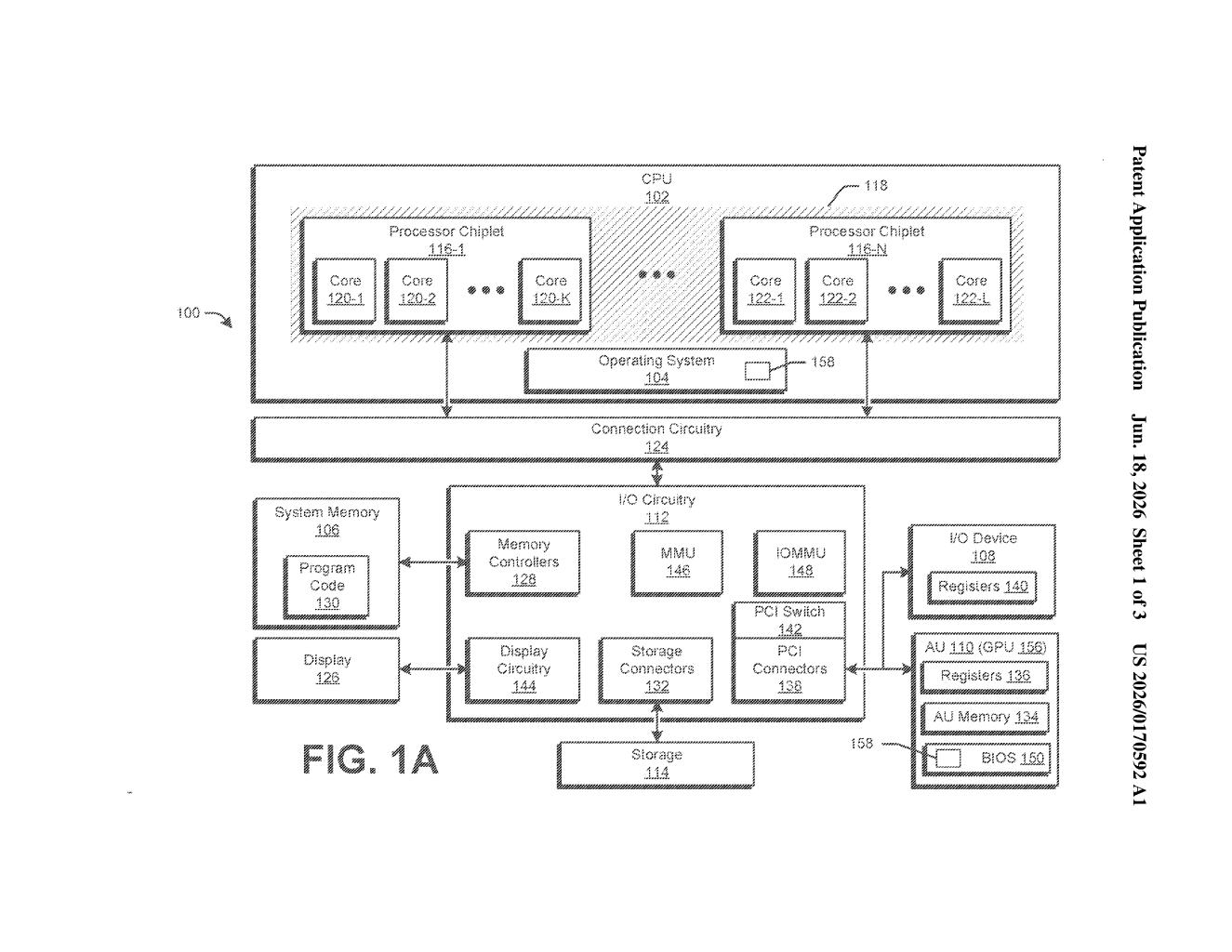
The patent describes a system where indexer circuitry (a dedicated hardware block) assigns each GPU in a server an index number that encodes its physical position — think of it like a grid coordinate baked into the chip's ID.
The GPUs are arranged in a two-dimensional grid inside the server. The indexer reads the physical layout and generates index numbers that reflect each unit's row and column in that grid. So instead of a flat list like GPU-0 through GPU-63, you might get IDs that tell you 'row 3, column 5' directly.
Key components described in the patent include:
- Multiple accelerator units (GPUs) arranged in a fixed physical configuration
- Indexer circuitry that enumerates each unit at system startup or configuration time
- Index identifiers structured to encode position, not just sequence order
When a monitoring system detects a failing GPU and reports its index, that index number alone tells the technician where to go — no schematics, no secondary lookup tools required.
What this means for data center repair times
Data centers — especially the AI training clusters that now pack thousands of GPUs into dense racks — spend real money on downtime caused by slow fault diagnosis. When a single GPU fails in a cluster of hundreds, every minute spent hunting for it is compute time lost. A system that makes the chip's ID its own address could meaningfully cut mean-time-to-repair.
For AMD and ATI, whose GPUs are increasingly deployed in large-scale AI infrastructure alongside Nvidia's, operational efficiency at the data center level is a real selling point. If ATI hardware is easier to service than a competitor's, that's a concrete advantage when a hyperscaler is evaluating which chips to fill a rack with.
This is unglamorous infrastructure work, but it's the kind of thing that actually moves purchasing decisions at enterprise scale. The idea is simple enough that it's surprising it isn't already standard — which either means there's a good reason competitors haven't done it, or ATI spotted a real gap. Either way, it's a practical, ship-it kind of patent rather than a speculative moonshot.
There are more where this came from
We read every patent application Big Tech publishes and send you the ones worth knowing. Plain English, free, every week.
Want this weekly breakdown for a company we don't cover? Patentlyze Pro →