
Salesforce Patents a System Where Digital Assistants Tag Each Other Into Work Chats
Instead of one AI assistant trying to do everything, Salesforce's patent describes a system where a whole bench of specialized AI agents can tag each other into a workplace chat — watching conversations, spotting tasks, and passing work to whoever is best suited for it.
What Salesforce's team-of-AI-agents system actually does
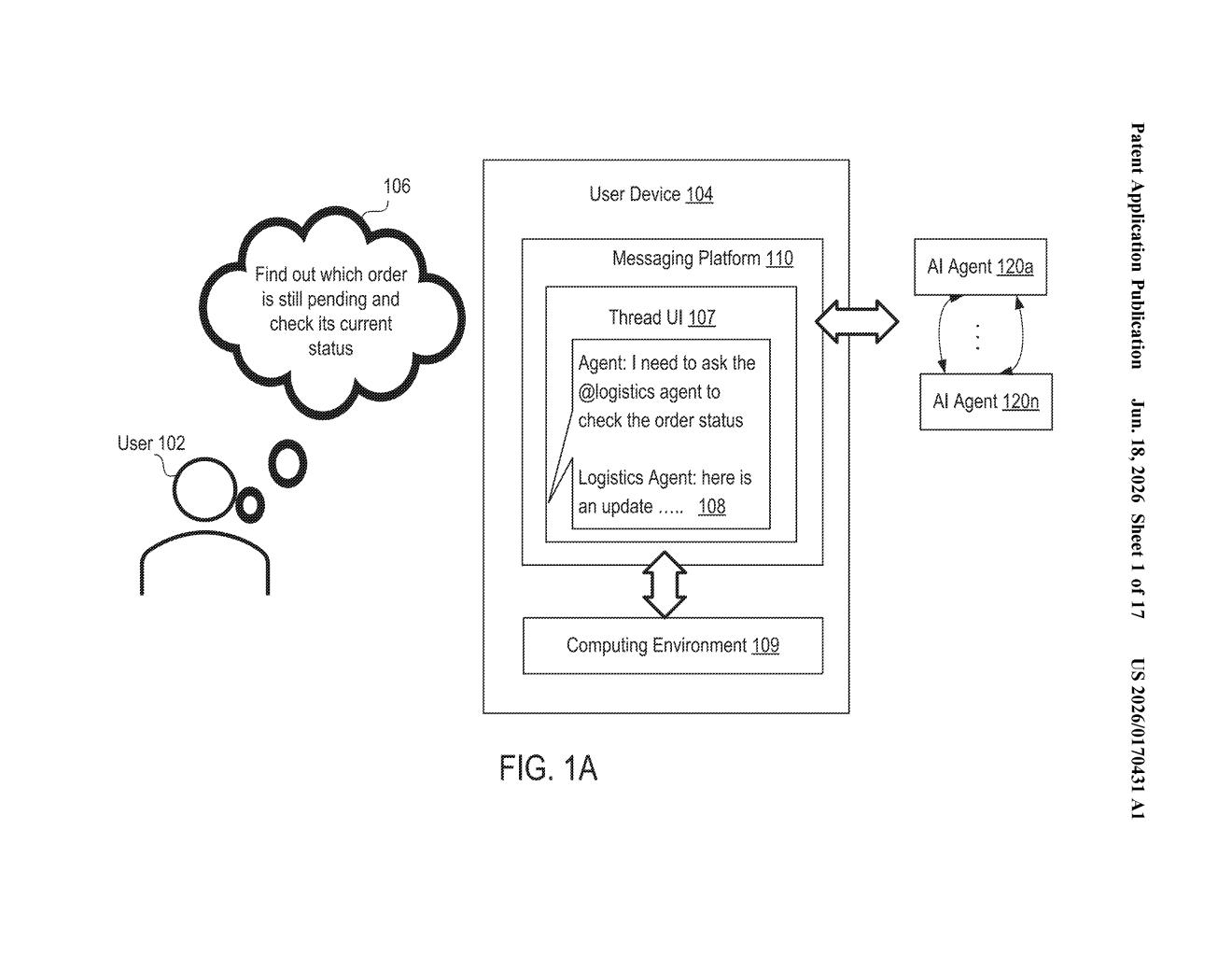
Imagine you're in a group Slack channel with your team. Someone asks a question about a project timeline, and instead of one overwhelmed AI assistant fumbling through it, a specialist AI for project management quietly picks it up, then tags in a second AI that knows your company's budget data — and both of their responses show up right in the chat thread, attributed to each of them.
That's roughly what Salesforce's patent describes. It's a library of different AI agents — each built for a specific job — that live inside a messaging platform. One might know your team's Scrum board inside out. Another might be your personal assistant that only you interact with. A third might handle decisions that need input from multiple angles.
The key detail is that these agents monitor ongoing conversations and can kick off new tasks without being directly asked. They watch, they hand off, and they keep watching — more like a group of coworkers who actually pay attention in meetings than a chatbot you have to prompt.
How the agents hand off tasks inside a conversation
The patent describes a multi-agent architecture embedded directly inside a messaging platform (think Slack or Microsoft Teams). Rather than routing every request through a single generalist AI, the system maintains a library of specialized AI agents, each with a defined role.
When a conversation is underway, a first AI agent monitors the thread, identifies a task worth acting on, and generates what the patent calls an intermediate input — essentially a visible handoff message that tells both the system and the user that a second, more specialized agent is being called in. That second agent then produces a response, and both the handoff and the answer appear in the chat interface.
The patent also outlines three flavors of agent:
- Collaborative specialist teams — groups of agents that tackle complex business workflows from multiple angles
- Proactive support specialists — agents tied to a specific channel (like a dev team's Scrum channel) who assist every member without being directly asked
- Personal assistants — private agents that know individual users and handle tasks on their behalf
Critically, the system keeps monitoring the conversation after it has already responded, looking for the next task — so it doesn't wait to be re-prompted.
What this means for workplace AI assistants
For anyone who uses workplace chat tools daily, this patent describes a direction where AI stops being a tool you summon and starts behaving more like a background team. The visible handoff — where one agent publicly tags in another — is a deliberate UX choice: it keeps users informed about which AI is doing what, which matters for trust and accountability in a work context.
For Salesforce, this fits squarely into its push to make its Agentforce platform the go-to layer for enterprise AI. Embedding these agents into messaging — rather than keeping them inside a separate CRM interface — is about being where employees already spend their day. If this ships, it could change expectations for what a workplace AI assistant is supposed to do.
This is a real directional bet from Salesforce, not a speculative curiosity. The idea of AI agents that publicly hand off to each other inside a chat thread — and keep watching after — is a concrete UX model that enterprise software companies are actively racing to define. Whether Salesforce's specific implementation wins out matters less than the fact that they're staking out this territory now.
There are more where this came from
We read every patent application Big Tech publishes and send you the ones worth knowing. Plain English, free, every week.
Want this weekly breakdown for a company we don't cover? Patentlyze Pro →