
Salesforce Patents Software That Lets Bots Collaborate on Tasks Inside Chat Apps
Salesforce wants to turn your company's messaging app into a control room where multiple AI agents hand tasks off to each other — automatically — without you having to babysit the process.
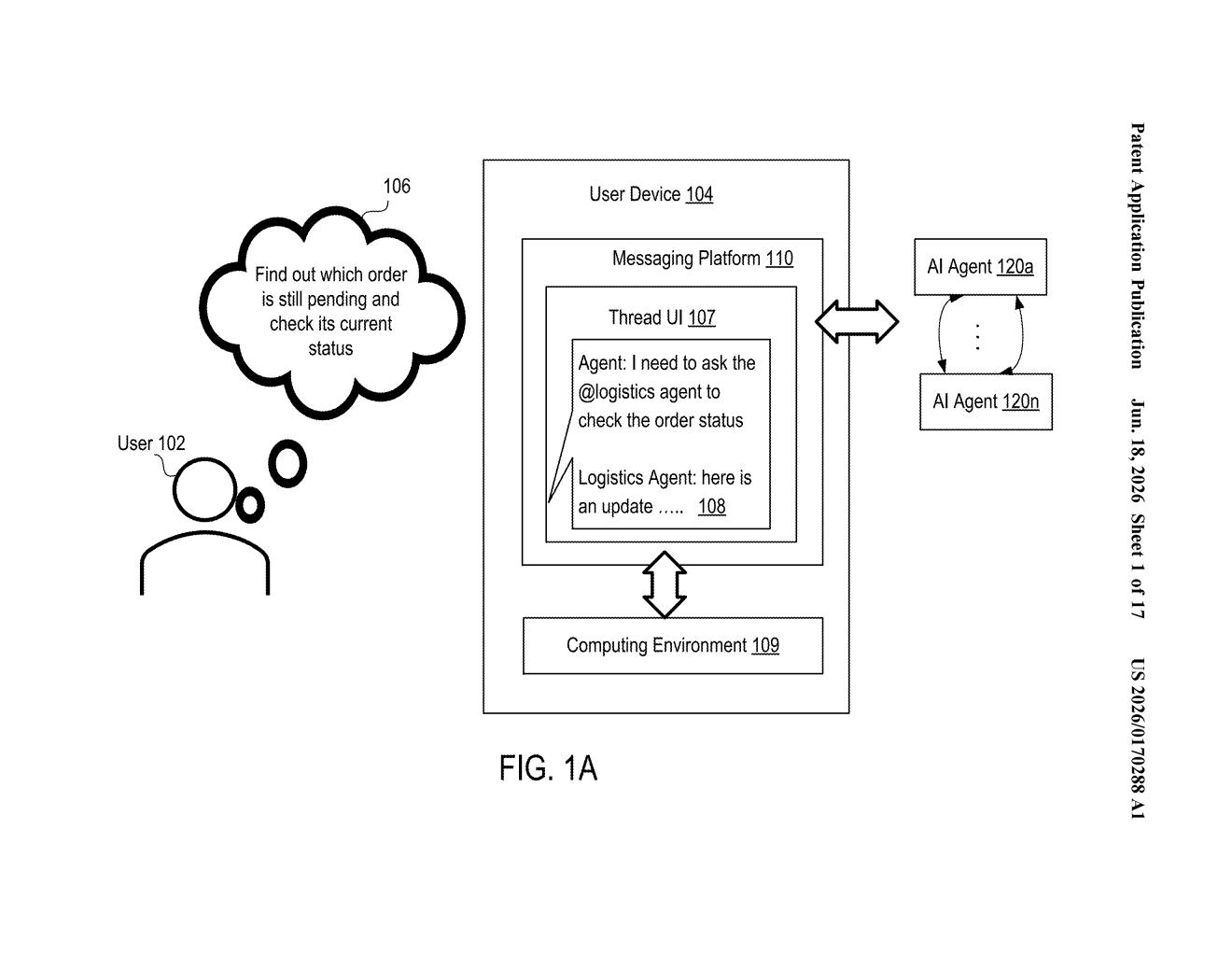
What Salesforce's multi-agent messaging system actually does
Imagine you need a report that requires pulling sales data, summarizing customer feedback, and drafting a follow-up email. Today, you'd bounce between different tools — or ask a single AI assistant that tries to do everything itself, often badly. Salesforce's patent describes a different approach: a team of AI specialists, each trained for a specific job, working together inside the same messaging window you already use.
The key idea is that these agents aren't just sitting in a list. They're wired together in a map that defines who hands off work to whom, and in what order. When you send a message to kick off a task, the system figures out the right sequence — like a relay race — and routes the work through each agent automatically.
The whole thing is designed to look and feel like a normal conversation to you, even though a small network of AI workers is running behind the scenes. Developers can build and configure these agent teams using standard tools, and companies can deploy them without rebuilding their messaging infrastructure.
How the workflow graph routes tasks between AI agents
The patent describes a multi-agent system — software that coordinates several distinct AI models, each fine-tuned for a narrow task, rather than relying on one general-purpose model to handle everything.
At the center of the design is a workflow graph: a visual map (in the software sense) where each node is an AI agent and each connecting edge defines how agents communicate or pass work to each other. Given a task objective, the system generates an execution path — essentially a step-by-step routing plan that determines which agents fire, and in what sequence.
Developers configure agents through a builder submodule, setting attributes like:
- Which underlying language model the agent uses
- A system instruction that defines the agent's persona and rules
- External tools the agent can call — defined via functions, Pydantic models (a Python data-validation format), or OpenAPI specifications (a standard way to describe web APIs)
Once configured, the agents and their workflow graph are packaged into a unified agent framework that sits inside a messaging platform. A session management layer keeps context alive across messages, so agents remember earlier parts of a conversation rather than starting fresh each time.
What this means for Salesforce's Slack and Agentforce strategy
Salesforce already owns Slack and has been pushing its Agentforce platform — a bet that AI agents, not just chatbots, are the future of enterprise software. This patent gives legal scaffolding to the core architectural idea: multiple specialized agents, coordinated inside a messaging channel, acting as a single coherent assistant to the end user.
For you as a Slack user, the practical upshot could be AI workflows that actually complete multi-step business tasks — booking, reporting, escalating — without requiring you to hop between apps or re-explain context at every step. That's a meaningful shift from today's one-agent-does-everything approach, which tends to degrade quickly on complex work.
This is a real architectural patent, not a vague concept grab. The specifics — workflow graphs, session persistence, OpenAPI tool integration — reflect engineering decisions Salesforce has almost certainly already built into Agentforce. The patent matters less as a legal weapon and more as a signal that Salesforce is serious about making Slack the operating layer for enterprise AI, not just a chat window.
There are more where this came from
We read every patent application Big Tech publishes and send you the ones worth knowing. Plain English, free, every week.
Want this weekly breakdown for a company we don't cover? Patentlyze Pro →