
Google Patents a Speed-Sensitive Rotary Crown for Smartwatches
Spin the crown on Google's hypothetical smartwatch slowly, and it scrolls carefully. Spin it fast, and it leaps — because the software multiplies your input based on how quickly you're turning.
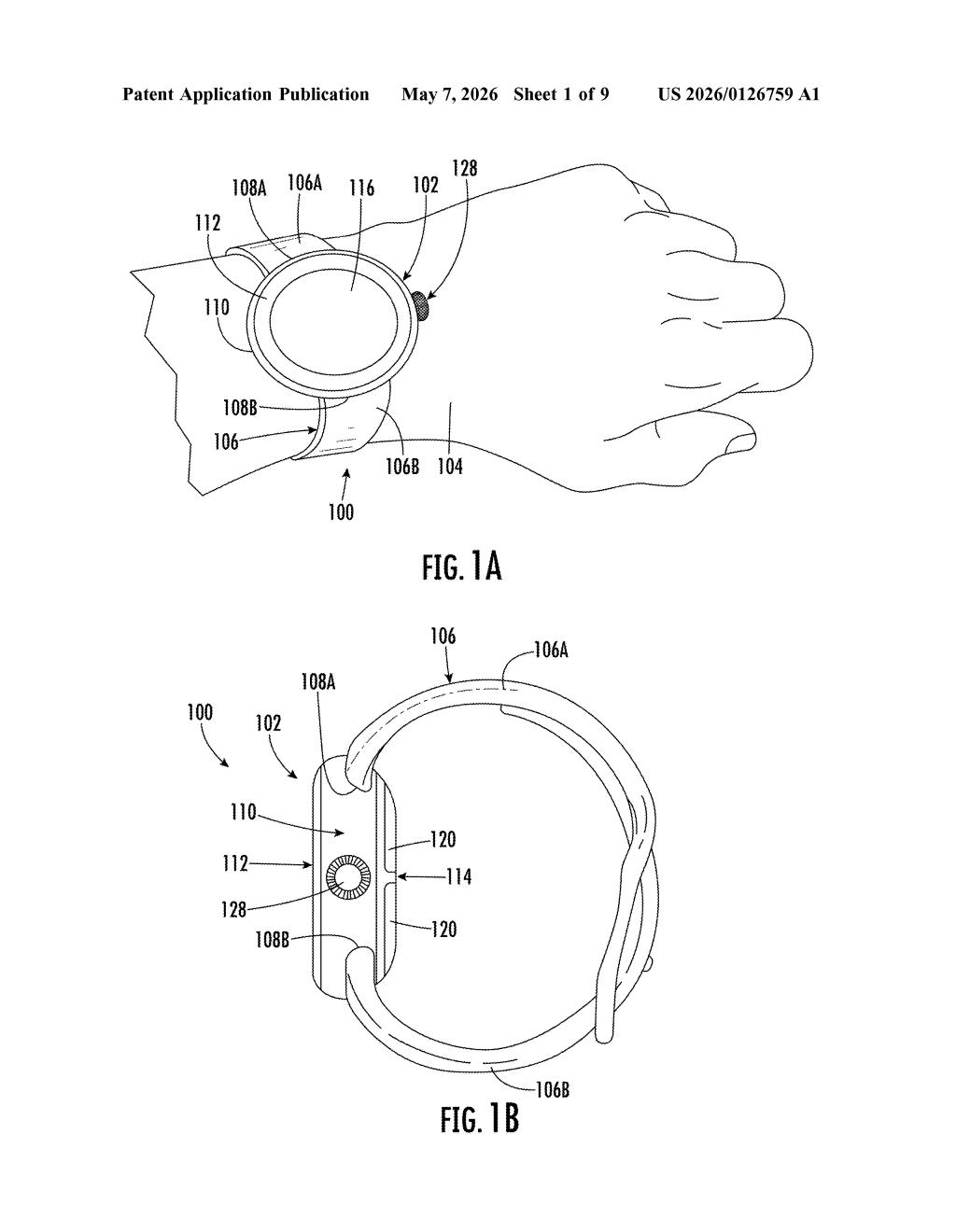
What Google's speed-sensitive crown actually does
Imagine trying to scroll through a long contacts list on your smartwatch by turning a tiny dial on the side. If every degree of rotation always moves the list by the same amount, fast navigation feels sluggish and precise selection feels impossible — you're constantly over- or under-shooting.
Google's patent describes a fix: a rotary crown (the dial on the side of a watch) that adjusts how sensitive it is based on how fast you're spinning it. Turn it slowly and each degree of rotation makes a small, controlled move. Spin it quickly and the screen content jumps further, letting you cover more ground fast.
This is the same idea behind how a mouse cursor behaves on your laptop — move the mouse slowly and the pointer creeps; flick it across the desk and it flies. Google wants to bring that same intuitive feel to wearable device controls.
How the gain factor scales with angular velocity
The patent describes a wearable device — almost certainly a smartwatch — with a rotary crown (a physical dial, like the kind on the Apple Watch or Pixel Watch) mounted on the side of the display housing.
When you rotate the crown, the device's controller doesn't just map raw rotation angle directly to screen output. Instead, it applies a gain factor — essentially a multiplier — before generating the on-screen response. The key detail: that gain factor is proportional to the angular velocity of the input (meaning the faster you spin, the larger the multiplier becomes).
In practical terms:
- Slow rotation → low gain factor → small, precise on-screen movement
- Fast rotation → high gain factor → large, rapid on-screen movement
This is a well-understood interaction design concept called pointer acceleration or velocity-based scaling, long used in mice and trackpads. The novelty here is its specific application to a rotary crown on a wearable computing device with a small display, where the trade-off between precision and range is especially acute.
What this means for Google's Pixel Watch crown control
Small watch displays create a real tension: you need fine-grained control for selecting items, but you also want to scroll through long lists quickly without spinning the crown forever. Velocity-based gain is a clean solution to that problem, and it's the kind of subtle interaction detail that separates a frustrating UI from a fluid one.
For Google's Pixel Watch lineup, this could meaningfully improve the crown's usability — a feature area where Apple Watch's Digital Crown has historically felt more polished. It's also worth noting that Apple holds similar patents in this space, so Google filing its own gives it room to implement the technique independently.
This is a focused, practical UX patent rather than a moonshot — it solves a real and specific annoyance with watch crown input. The underlying concept (velocity-sensitive pointer acceleration) is decades old in other contexts, so the patent's novelty hangs on its specific application to wearable rotary crowns. Worth watching if you care about Pixel Watch's input feel, but don't expect headlines.
There are more where this came from
We read every patent application Big Tech publishes and send you the ones worth knowing. Plain English, free, every week.
Want this weekly breakdown for a company we don't cover? Patentlyze Pro →