
Apple Patents a System That Keeps Two Screens Aligned by Watching You
Two monitors sitting next to each other on a desk sounds simple, but getting them to act like one continuous screen, adjusted for exactly where your head is, turns out to be a surprisingly hard problem. Apple thinks cameras can solve it.
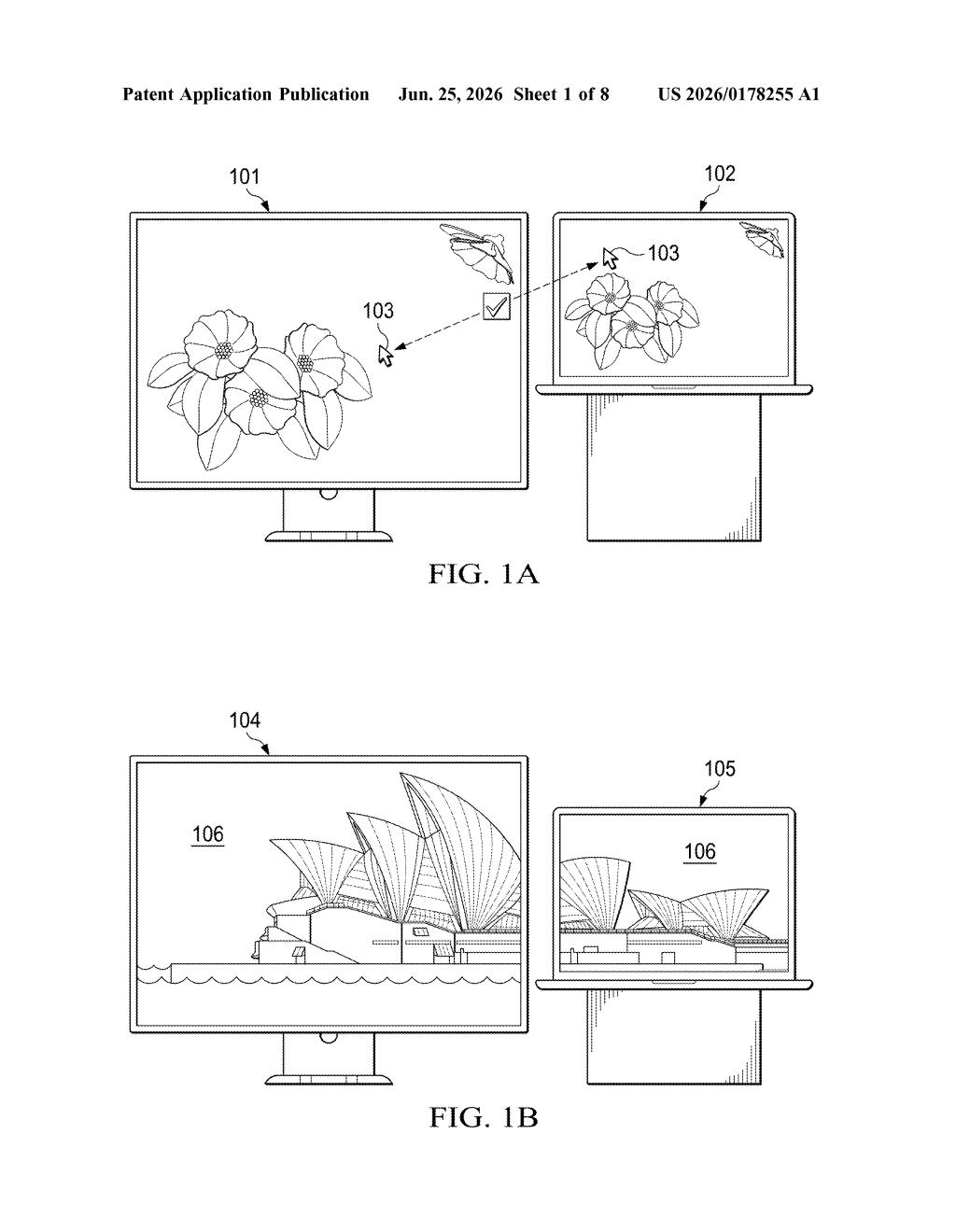
What Apple's two-screen head-tracking setup actually does
Imagine you're sitting in front of two monitors. Right now, the images on each screen are set up independently, they don't know where your eyes actually are. So the perspective, brightness, and alignment can feel slightly off, especially if you move your chair or tilt your head.
Apple's patent describes a system where each display has its own camera, and those cameras watch the same scene (including you). By comparing what both cameras see, the system figures out exactly where your head is relative to each screen, then adjusts what's shown on both displays so the whole thing looks like one coherent visual space.
The end result is a dual-display environment that updates in real time as you shift around. Whether this is for a traditional two-monitor desk setup, a pair of augmented reality glasses, or something else entirely, the goal is the same: two screens that behave as one.
How each display's camera builds a shared spatial picture
Each display in the system is equipped with a camera. The two cameras are positioned so their fields of view overlap, meaning they can both see some of the same space (most likely the area in front of both screens, where the user is sitting).
From the images those cameras capture, the system determines your head pose (the technical term for your head's exact position and orientation in 3D space). That head pose is then converted into each display's own reference frame, essentially translating your position into coordinates that make sense for screen one, and separately for screen two.
- Camera 1 captures an image and helps determine head pose relative to Display 1.
- Camera 2 captures an image and helps determine head pose relative to Display 2.
- Both pose measurements are fed into a processor that generates a unified dual-display environment.
- Each screen then receives and renders its own slice of that shared environment.
The key insight is that both displays share a common spatial model. Rather than each screen working in isolation, they collaborate through overlapping camera views to agree on where you are and split up the rendering accordingly.
What this means for multi-monitor and spatial computing setups
For anyone who works with two monitors, this kind of automatic spatial alignment could make the experience feel far more natural. Today, multi-monitor setups require manual calibration in software settings, and they don't adjust when you move. A camera-driven system that updates continuously would remove that friction entirely.
The patent also fits neatly into Apple's broader interest in spatial computing. The Vision Pro already tracks head position within a single headset. A system like this one could extend that logic to external displays, or potentially to a future multi-device spatial setup where two separate screens (or two headsets used together) need to share a single coordinated view.
This is a genuinely interesting patent because it solves a real problem that most people have accepted as unfixable: two monitors never truly feel like one. The head-tracking angle is clever, and the overlapping-camera architecture is a practical way to build shared spatial awareness without requiring a third centralized sensor. Whether this lands in a Mac display, a Vision Pro accessory, or something else, it's worth watching.
There are more where this came from
We read every patent application Big Tech publishes and send you the ones worth knowing. Plain English, free, every week.
Want this weekly breakdown for a company we don't cover? Patentlyze Pro →