
Meta Files Patent for Prescription Lenses That Project Virtual Screens Into Your Vision
Millions of people who need glasses face an awkward tradeoff with AR headsets: wear your prescription inserts or squint at a blurry display. Meta's new patent tries to eliminate that choice entirely by baking the holographic display and your vision correction into the same lens.
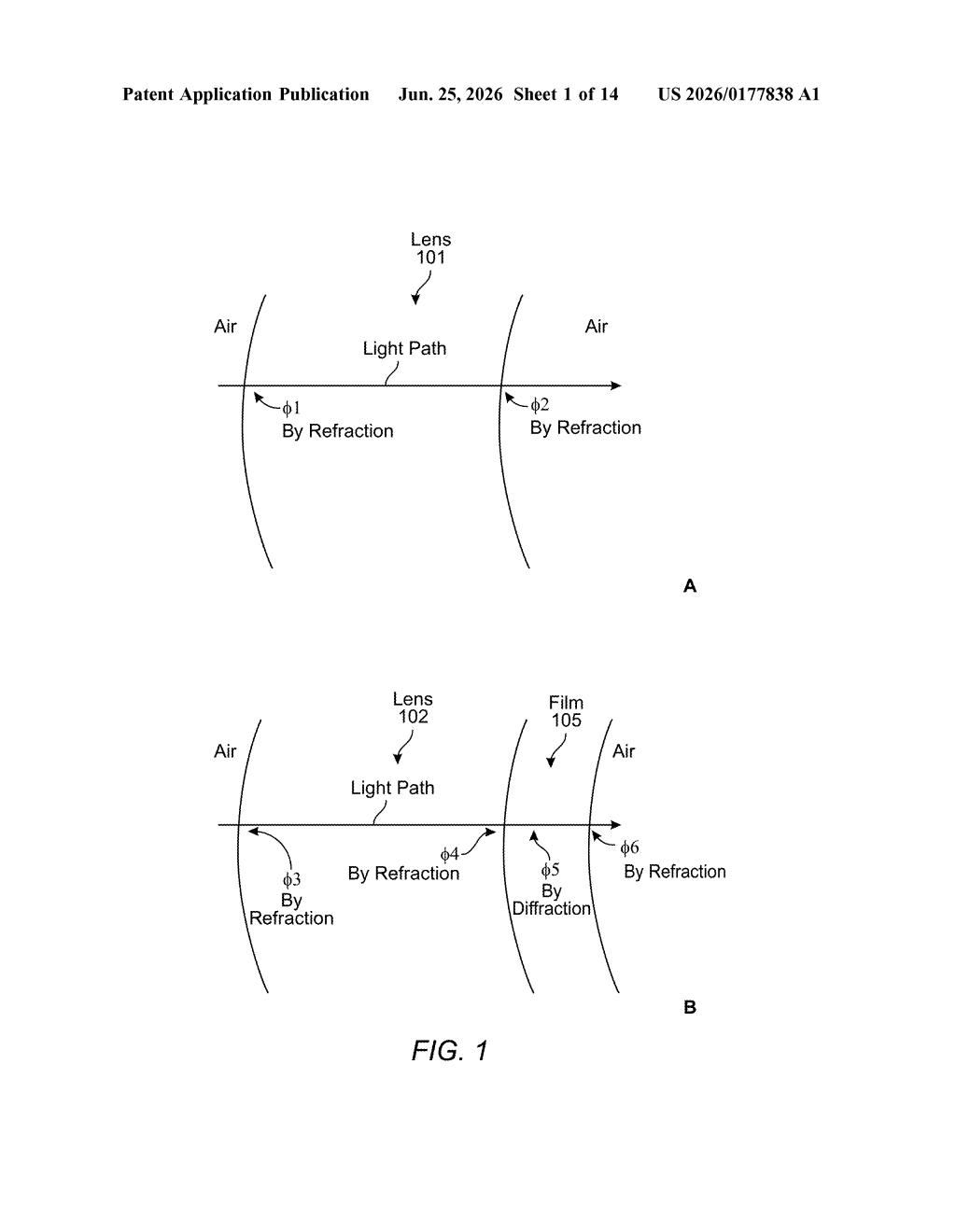
What Meta's prescription AR lens actually does
Imagine you wear glasses, and someone hands you a pair of AR smart glasses. Right now, you'd need a custom insert, or you'd just deal with a blurry picture. Meta's new patent describes a way to skip that whole problem.
The idea is to fuse a holographic layer directly onto a prescription lens. That single lens does two jobs at once: it corrects your vision the way a normal glasses lens does, and it redirects light from a tiny projector to put a virtual image right in front of your eye.
For you, that means AR glasses that could look and feel like a normal pair of prescription frames, with no bulky insert, no separate optics module, and no compromise between seeing the real world clearly and seeing the AR overlay clearly.
How the diffractive-refractive surface bends light twice
The patent describes a display system with three main parts: an illumination source (a small light projector), a curved prescription lens, and a holographic optical element (HOE) layered onto that lens.
The HOE is a thin film that has been recorded with a specific interference pattern. When light from the projector hits it, the pattern diffracts (bends) that light in a precisely controlled way. Because the HOE sits on top of a curved refractive lens, the two surfaces work together as a diffractive-refractive surface, meaning light gets shaped by both the physical curve of the lens and the holographic pattern at the same time.
The key claim is that the HOE encodes the user's vision correction prescription directly into its holographic pattern. So when the projector sends out light to form a virtual image, that light is automatically corrected for the wearer's nearsightedness, farsightedness, or astigmatism before it reaches the eye.
- Illumination source emits display light
- HOE diffracts that light while simultaneously applying the prescription correction
- The curved lens provides additional refractive correction for real-world viewing
- The eye receives both the virtual image and a corrected view of the real world
What this means for AR glasses and vision correction
AR glasses have had a persistent prescription problem: optics designed for a generic eye do not work well for the roughly half of adults who need vision correction. Current solutions add bulk, cost, and calibration headaches. A lens that handles both jobs in one layer is a real engineering goal, not just a convenience.
For Meta specifically, this fits a clear pattern of trying to make AR glasses look like ordinary eyewear. If a holographic element can carry your prescription, the glasses don't need to be thicker or heavier to accommodate a separate corrective insert. That matters a lot for mainstream adoption, where most people will not wear something that looks medical or conspicuous.
This is one of the more practically motivated AR optics patents Meta has filed. The prescription compatibility problem is real and widely acknowledged, and a single-layer solution that merges holographic display optics with vision correction would remove one of the biggest friction points for everyday AR glasses adoption. Whether the manufacturing tolerances required to encode a custom prescription into a holographic film at scale are achievable is the hard question the patent does not answer.
There are more where this came from
We read every patent application Big Tech publishes and send you the ones worth knowing. Plain English, free, every week.
Want this weekly breakdown for a company we don't cover? Patentlyze Pro →