
Meta Files Patent to Improve Light Simulation Accuracy in See-Through Headset Displays
Building AR glasses means solving one of optics' nastiest problems: figuring out exactly how light behaves inside a tiny glass waveguide. Meta's new patent describes a smarter calculation method that could make those simulations far faster and more accurate at the same time.
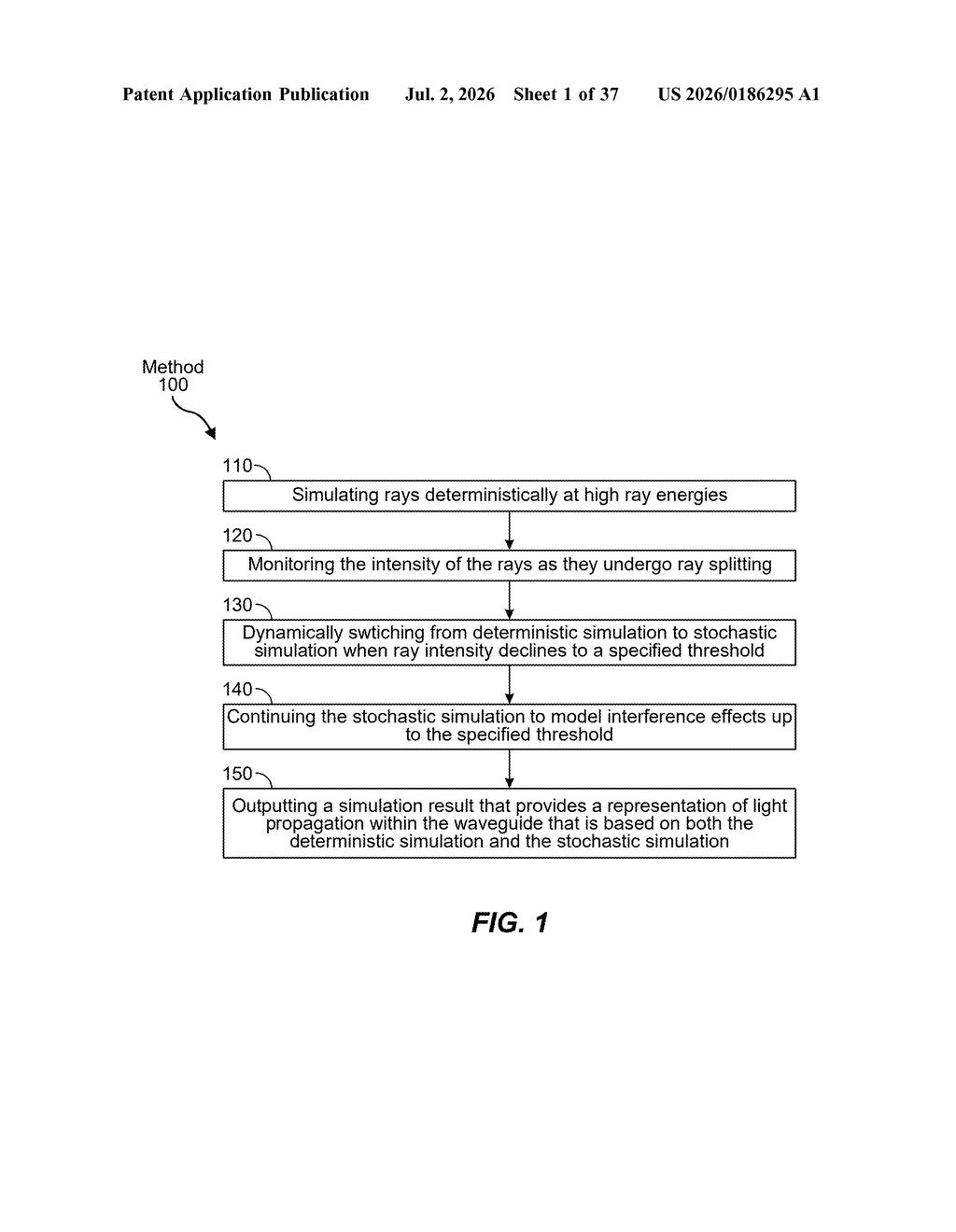
What Meta's hybrid light simulator actually does for AR
Imagine trying to trace every ball in a pool break, not just the first few collisions, but every ball bouncing off every wall until they all stop. That's roughly what happens when engineers simulate light traveling through the waveguide (the thin, clear layer inside AR glasses that guides images to your eyes). There are quickly too many paths to track.
Meta's patent describes a method that starts by tracking light rays carefully and precisely, then automatically switches to a statistical approach once the rays get too faint and numerous to follow individually. Think of it like switching from plotting every raindrop in a storm to measuring rainfall with a gauge once the drops are too many to count.
The payoff is a simulation that's both detailed where it counts and fast enough to actually use in engineering work. Better simulations mean engineers can design waveguide optics with fewer physical prototypes, which could ultimately help Meta build AR headsets that look better and cost less.
How the simulation switches modes mid-calculation
The patent covers a computer simulation method for modeling light inside optical waveguides, the thin glass or plastic slabs that carry projected images across the lens of an AR headset.
When light enters a waveguide, it bounces around and splits at each interaction point, creating an exponentially growing tree of ray paths. The method handles this in two phases:
- Deterministic simulation: Each ray is traced individually and exactly, capturing precise positions and intensities. This is accurate but gets expensive fast as rays multiply.
- Dynamic threshold switching: The system watches ray intensity in real time. When a ray's brightness drops below a set cutoff, individual tracking is no longer worth the compute cost.
- Stochastic simulation: Below the threshold, the method switches to probabilistic sampling (think statistical modeling rather than exact accounting) to capture interference effects, the way overlapping light waves reinforce or cancel each other, which determines visible patterns like rainbow artifacts or brightness uniformity.
The two phases feed into a single output that represents light propagation across the full waveguide. The key engineering insight is that the expensive exact-tracing work is applied only where it produces meaningful accuracy gains, and the cheaper statistical work handles the rest.
What this means for the future of Meta's AR glasses
For Meta, the practical stakes are high. The quality of AR glasses images depends almost entirely on how well engineers can design and test waveguide optics before manufacturing. Simulations that are too slow force shortcuts; simulations that miss interference effects produce designs with visible flaws. A faster, more accurate simulation pipeline means more design iterations in the same engineering schedule, which compounds into better products.
More broadly, waveguide optics are one of the hardest unsolved problems in consumer AR. Every major player, including Apple, Google, and startups like Lumus, is wrestling with the same physics. A better simulation tool doesn't just help Meta's engineers, it signals that Meta is investing seriously in the foundational optics work that would be needed before a mass-market AR product could ship.
This is unglamorous but genuinely important infrastructure work. Simulation software sits entirely behind the scenes, so no one will ever see 'powered by this patent' on a product box. But the quality of Meta's AR optics in products like the Quest and any future glasses depends directly on how well they can model light before committing to a hardware design. A team of 35+ inventors on what is essentially a math optimization tells you how seriously Meta is taking this layer of the stack.
There are more where this came from
We read every patent application Big Tech publishes and send you the ones worth knowing. Plain English, free, every week.
Want this weekly breakdown for a company we don't cover? Patentlyze Pro →