
Nvidia Patents a Camera Chip Circuit That Rewires Itself for Different AI Tasks
Camera chips are normally fixed at the factory, doing the same image cleanup steps every time. Nvidia has patented a way to drop a reprogrammable AI block right into that pipeline, swapping its behavior depending on the task.
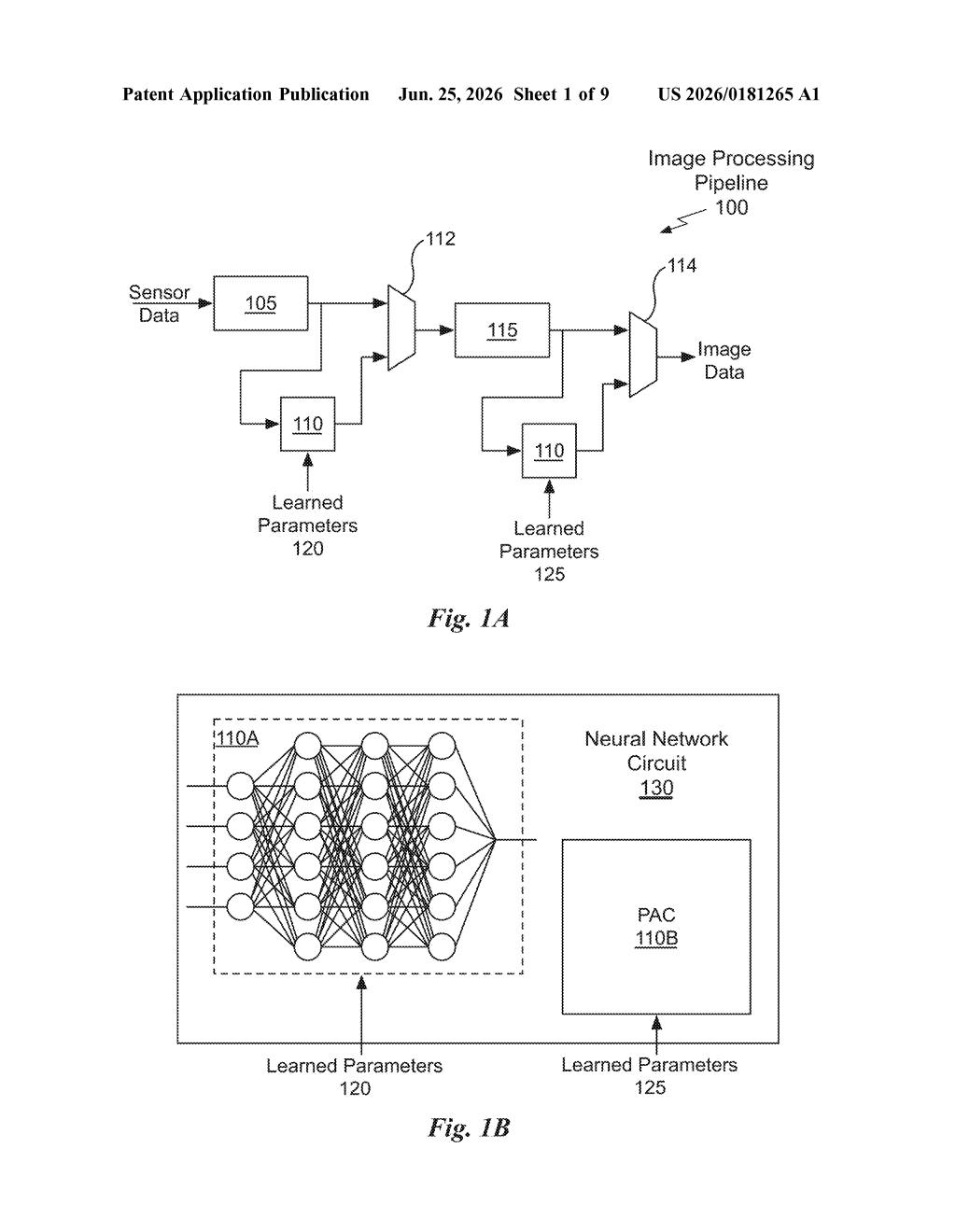
What Nvidia's reprogrammable camera chip actually does
Imagine the chip inside a camera as an assembly line. Each station on that line does a specific job: correct the colors, reduce the noise, sharpen the edges. Normally those stations are hardwired and can't change. Nvidia's patent describes a special station on that line that can change, because it's driven by a set of numbers learned through AI training rather than fixed instructions.
Think of it like a multi-tool. You plug in the same physical slot, but depending on which set of learned parameters you load in, it becomes a noise reducer, a color corrector, or something else entirely. The chip can receive updated parameter sets on the fly, reconfiguring what that station does without any hardware swap.
This is particularly useful in cameras that need to handle very different conditions, like a self-driving car switching between bright daylight and a dim parking garage. Instead of building separate chips for each scenario, one programmable block adapts to all of them.
How the PAC slots into Nvidia's image pipeline
The patent centers on a component Nvidia calls a Programmable Algorithm Circuit (PAC). It sits inside an Image Signal Processor (ISP), which is the dedicated chip that turns raw sensor data into a usable image.
The key design choice is flexibility in placement. The PAC can be connected at different points in the image pipeline:
- Right at the front, processing raw sensor data before any other logic touches it
- After the standard image processing stages, to refine the already-processed color image
- Or at multiple locations simultaneously for more complex tasks
What defines the PAC's behavior is a set of learned parameters, meaning numbers produced by training a neural network on specific tasks (think noise reduction or white balance correction). Those parameters are loaded into the PAC at runtime and can be swapped out dynamically as conditions change.
The result is a single piece of hardware that can behave like many different purpose-built image processing blocks, configured through software rather than silicon. The patent also describes the parameters being updated remotely, which means the chip's behavior could be improved after it ships.
What this means for AI cameras in cars and robots
For Nvidia, whose chips power many autonomous vehicles, robots, and industrial cameras, a reprogrammable image pipeline is a practical engineering win. A self-driving car's camera needs to perform very differently in rain versus sunlight, and doing that today often means either multiple specialized hardware paths or compromises in image quality. A PAC that can be retrained and reloaded for each condition shrinks that problem to a software update.
More broadly, this points toward a camera architecture where the same chip ships across different product lines, with behavior tuned per device through parameter sets. That's cheaper to manufacture, easier to upgrade, and means image quality improvements can reach existing hardware after the fact rather than requiring a new chip revision.
This is a quiet but genuinely useful patent. The idea of making part of a camera's image pipeline reconfigurable through AI-trained parameters is a natural step for a company that sells chips into wildly varied environments. It won't make headlines, but it's the kind of foundational architecture work that shows up in products years later.
There are more where this came from
We read every patent application Big Tech publishes and send you the ones worth knowing. Plain English, free, every week.
Want this weekly breakdown for a company we don't cover? Patentlyze Pro →