
Samsung Patents a More Accurate Way for AR Glasses to Track Your Hands
Getting AR glasses to understand exactly where your fingers are in 3D space is one of the hardest unsolved problems in wearable computing. Samsung's latest patent takes a multi-camera approach that picks the camera pair with the lowest error rather than blindly trusting all of them equally.
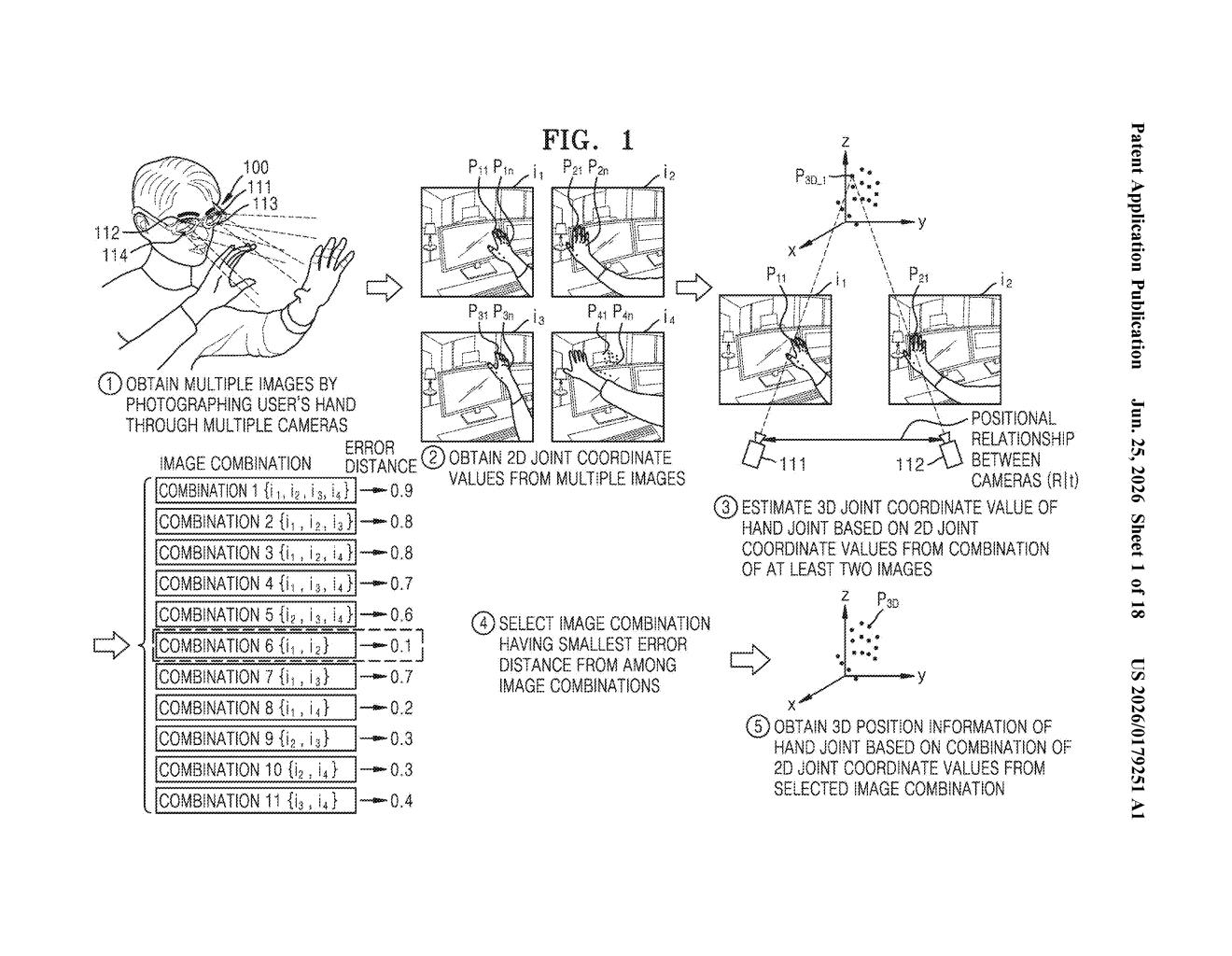
How Samsung's AR device reads your hand position in 3D
Imagine trying to point at a virtual button floating in mid-air while wearing AR glasses. For that to work, the glasses need to know precisely where each knuckle and fingertip is in three dimensions, not just on a flat screen. Getting that wrong by even a centimeter means you miss the button entirely.
Samsung's patent describes a system where several cameras on the AR device photograph your hand at the same time. Each possible pair of camera images produces its own estimate of where your joints are in 3D space. The device then compares all those estimates, measures which pairing has the smallest error, and uses that winning pair to calculate your final hand position.
The idea is that not every camera angle is equally useful at any given moment. One camera might be partially blocked, or the lighting on that side might be poor. By automatically picking the best-performing pair rather than averaging everything together, the device gets a cleaner read on where your hand actually is.
How the camera-pair selection cuts tracking error
The system starts by using multiple onboard cameras to capture images of the user's hand simultaneously. From each image, it identifies 2D joint coordinates (flat, pixel-level positions) for up to 21 standard hand-joint feature points, the knuckles, fingertips, and wrist landmarks that hand-tracking models commonly use.
Next, the device forms image combinations, every possible pairing (or larger grouping) of those camera images. For each combination, it applies triangulation (the same geometry a surveyor uses: if you know the position of two observation points and the angle to a target from each, you can calculate the target's distance) to lift those flat 2D coordinates into 3D joint coordinate estimates.
The critical step is the error check. For each combination's 3D estimate, the system reprojects those 3D points back onto the 2D images and measures how far the reprojected points land from the originally detected joint positions. This gap is the error distance, a signal of how geometrically consistent that camera pair's estimate actually is.
The combination with the smallest error distance wins. The device then uses only that winning combination's 2D coordinates to produce the final, published 3D hand-joint positions that the AR experience acts on.
What this means for hand-controlled AR and mixed reality
Hand tracking is the input method AR and mixed-reality headsets are betting on as a replacement for physical controllers. If the tracking is slightly off, interactions feel broken and users give up. A self-correcting system that picks the most reliable camera view on the fly is a practical engineering step toward making that interaction feel dependable.
Samsung is actively building AR and extended-reality hardware, and patents like this one point to the low-level sensing work happening beneath any future headset product. Accurate joint tracking also feeds downstream features like gesture recognition, virtual keyboard input, and precise object manipulation, so getting the geometry right at this stage has a wide ripple effect on what the device can actually do.
This is solid, unglamorous engineering work. The core insight, that picking the best-performing camera pair beats blindly combining all of them, is simple but genuinely useful. It won't make headlines on its own, but it's exactly the kind of foundation that separates AR devices that feel precise from ones that feel frustrating.
There are more where this came from
We read every patent application Big Tech publishes and send you the ones worth knowing. Plain English, free, every week.
Want this weekly breakdown for a company we don't cover? Patentlyze Pro →