
Samsung Patents a Self-Correcting AI for Simulating How Atoms Interact
Training an AI to predict how atoms and molecules behave is expensive, slow, and error-prone. Samsung's new patent describes a system that finds its own mistakes and fixes the training data automatically.
What Samsung's atom-simulation AI actually does
Imagine you're teaching a student by giving them practice problems, but some of those problems are weird edge cases the student has never seen before. Without catching those gaps, the student will confidently get those questions wrong on the real exam. That's a real problem in chemistry simulations.
Samsung is building an AI model that predicts how atoms push and pull on each other (called a "force field"). The tricky part is getting the training data right. Their system starts by feeding the AI chemistry data, then runs the AI on a separate test set and watches for cases where it struggles. Those problem cases get flagged and folded back into the training data.
The result is a training pipeline that gets better over time without a human having to manually hunt for gaps. For Samsung, which makes chips and researches new materials, an AI that accurately models atomic behavior could speed up the search for better semiconductors or battery materials.
How the MLFF training loop catches its own blind spots
The patent describes a pipeline for building and improving a machine-learning force field (MLFF) model, which is an AI trained to predict the physical forces between atoms in a molecule or material. Conventional physics simulations use density functional theory (DFT), a quantum-chemistry calculation method that is highly accurate but extremely slow and computationally expensive. MLFF models are meant to approximate DFT at a fraction of the cost.
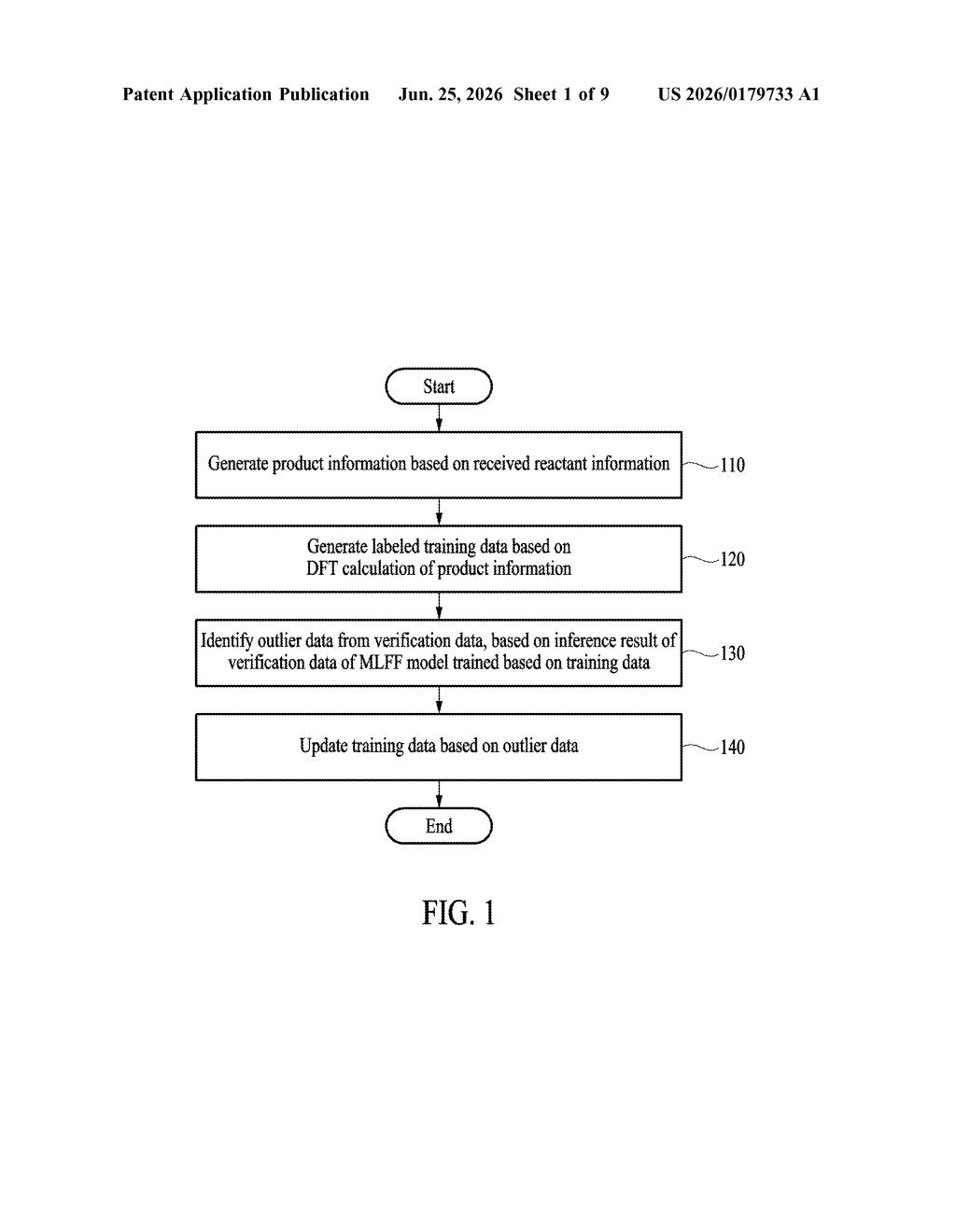
The system works in four steps:
- Take reactant information (descriptions of starting chemicals or materials) and generate product information (what they could turn into after a reaction).
- Run DFT calculations on that product data to produce labeled training data, essentially ground-truth answers about atomic forces.
- Train the MLFF model on that data, then test it against a separate verification dataset and find outlier data (cases where the model's predictions are significantly off).
- Add those outlier cases back into the training set and repeat, so the model keeps improving on the situations it handles worst.
This loop is a form of active learning, where the model itself helps identify which new data points will be most valuable for its own training. The key insight is that cases the model struggles with are exactly the cases it needs to practice on.
What this means for chip materials and drug discovery
For Samsung, accurate atomic simulations matter a great deal. Designing new semiconductor materials, battery chemistries, or display compounds all benefit from being able to predict how materials will behave without running thousands of physical experiments. A faster, self-improving simulation AI could compress years of materials research into months.
More broadly, MLFF models are a hot area of research right now, with companies like DeepMind and startups across pharma and materials science all competing to build better ones. Samsung staking out IP here signals that it wants to control its own simulation tools rather than rely on outside providers, which makes sense given how central materials science is to its core chip and display businesses.
This is quiet but meaningful infrastructure work. It's not a consumer product, and it won't make headlines at a launch event. But Samsung's semiconductor and display divisions live and die on materials innovation, and owning a proprietary self-improving simulation AI is a real competitive asset. The active-learning loop at the heart of this patent is well-established in research, so the novelty here is in the specific pipeline design, not the concept itself.
There are more where this came from
We read every patent application Big Tech publishes and send you the ones worth knowing. Plain English, free, every week.
Want this weekly breakdown for a company we don't cover? Patentlyze Pro →