
Adobe Patents a System That Fills In Animation Frames Designers Don't Draw
Animating something used to mean drawing every frame, or at least every keyframe. Adobe is patenting a way to take a single piece of artwork and a motion instruction and let the software figure out the rest.
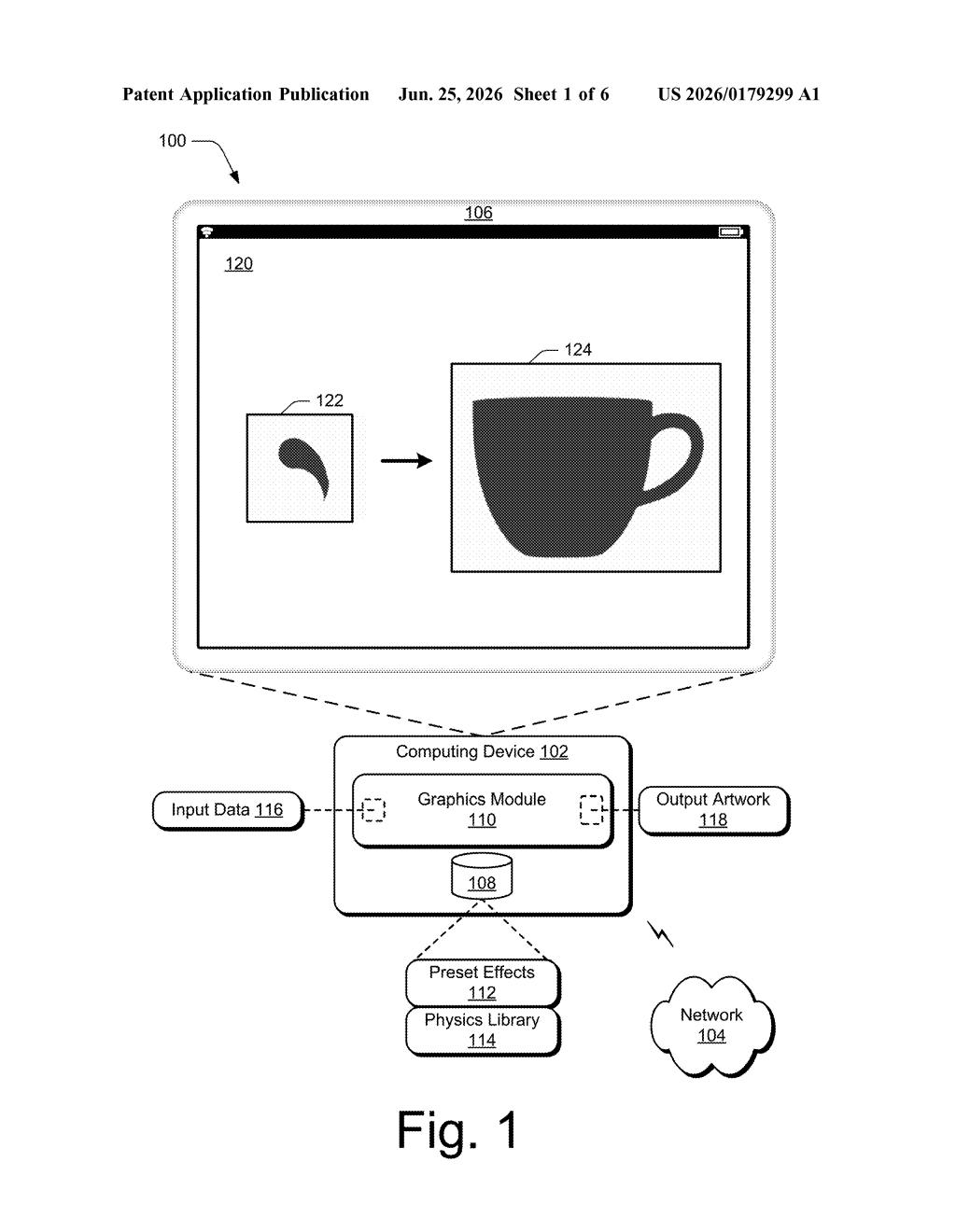
What Adobe's automatic frame-filling actually does
Imagine you've designed a logo in Illustrator and you want it to fly across the screen. Normally you'd need to either draw several positions yourself or manually set keyframes and tweak timing curves until it looks right. This patent describes a system where you just hand the software your artwork and tell it what kind of motion you want, and it builds the full animation automatically.
The system takes your image, figures out a path for the movement, and generates all the in-between frames needed to make the animation flow. You'd see the result play back in a preview panel without having to touch a timeline.
This is the kind of thing that could save a graphic designer a lot of clicking. Instead of spending 20 minutes getting a bounce or a fade to feel natural, you'd describe the effect and let the tool handle the frame-by-frame work.
How the system builds frames from a motion path
The patent describes a graphics module inside a computing application that accepts two main inputs: a motion effect (a description of how something should move, like "drift left" or "bounce in") and a description of a digital artwork that contains at least one object.
From those inputs, the system does three things:
- It determines a path for the motion effect, calculating the trajectory the object should follow across the screen.
- It generates an animation sequence, meaning it creates the object's position and appearance across every frame along that path, not just the start and end points.
- It outputs a digital animation through a user interface, so you see the finished result directly.
The key phrase in the claim is "frame interpolation" (filling in the frames between known positions). Rather than requiring a designer to define every keyframe manually, the system infers the in-between states from the motion effect description. The patent is fairly broad in scope, covering both the method and the system that performs it.
What this means for Adobe's motion design tools
Adobe's motion design tools, particularly After Effects and Adobe Express, already have varying levels of animation automation. A patent like this points toward a tighter loop where static designs get animated with minimal manual work, which is increasingly important as short-form video content demands constant output from smaller teams.
For everyday users, this could show up as a one-click animation feature for social media graphics or presentations. For professionals, it might cut down the grunt work of setting up basic animation rigs. The broader picture is Adobe trying to close the gap between "I made a graphic" and "I made a video," which is where a lot of the industry's attention is right now.
This is a competent but fairly incremental patent covering territory that tools like Rive, Jitter, and even Adobe's own Express have been approaching for a while. The implementation details in the claim are broad enough to cover a lot of ground, but the core idea isn't surprising coming from Adobe in 2024. Worth watching to see where it lands in the product lineup, but not a signal of anything dramatically new.
There are more where this came from
We read every patent application Big Tech publishes and send you the ones worth knowing. Plain English, free, every week.
Want this weekly breakdown for a company we don't cover? Patentlyze Pro →