
AMD Patents an AI Malware Detector That Runs Outside Your Main Processor
What if your PC's security scanner couldn't be fooled by malware because it lives on a completely separate chip that malware can never reach? That's the idea behind AMD's latest patent.
What AMD's isolated malware-watcher actually does
Imagine a burglar who also knows how to disable your home alarm system. That's roughly the problem with most antivirus software today: it runs on the same processor your malware is attacking, so sophisticated attacks can blind or bypass the very tool trying to catch them.
AMD's patent describes a different approach. A dedicated neural processing chip, kept completely isolated from your main CPU, watches what your computer is doing by monitoring things like power consumption and how busy different parts of the hardware are. Because that secondary chip never runs normal software, malware running on your main processor has no way to touch it or hide from it.
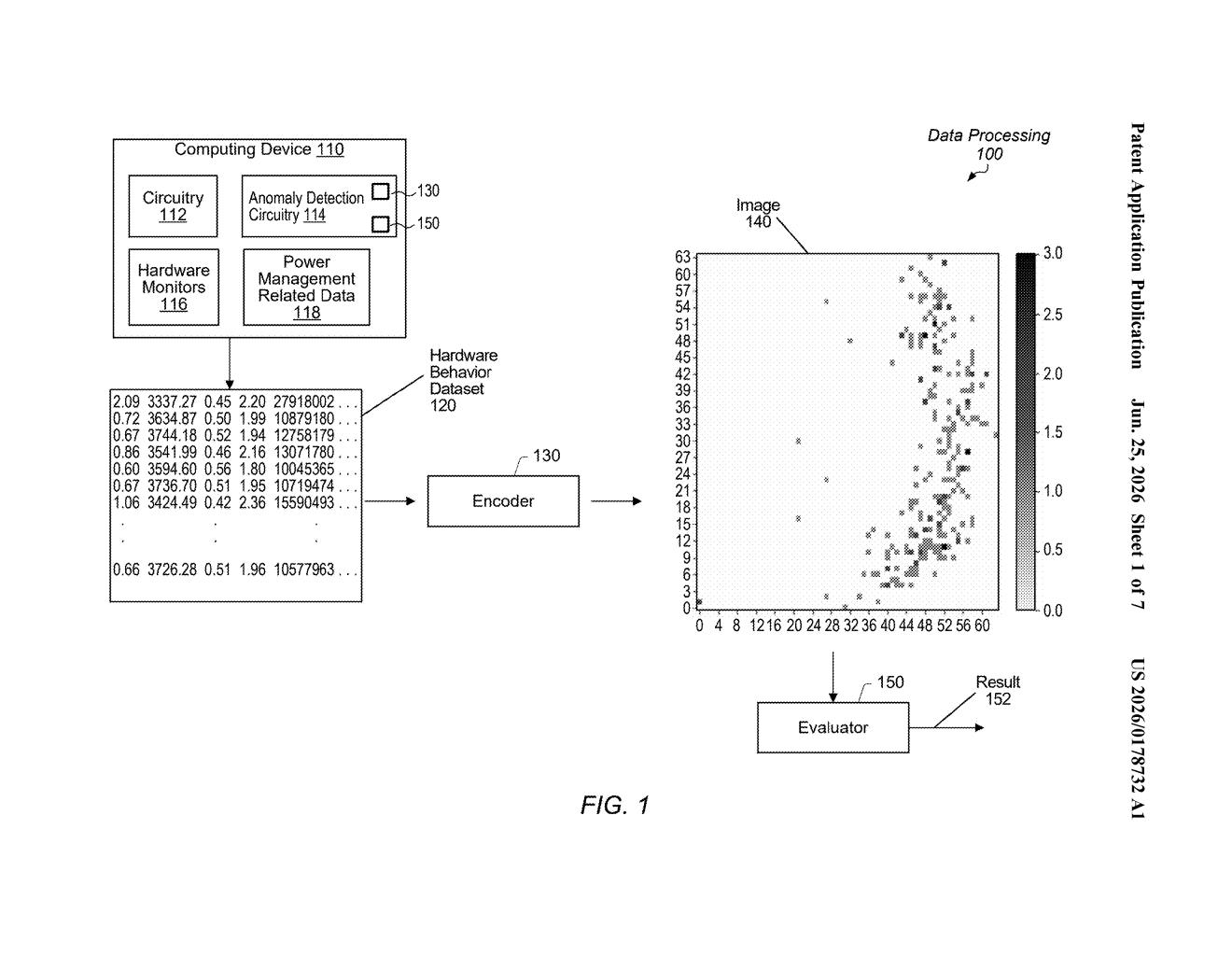
The isolated chip converts all that activity data into a kind of image, then feeds it to an AI model trained to recognize the telltale patterns that malware leaves behind, even when the malware itself is trying to stay invisible. If something looks wrong, it flags an anomaly.
How power data becomes an image a neural network can read
The system has two distinct hardware zones. First circuitry is your normal CPU, running your operating system and apps, and potentially vulnerable to infection. Second circuitry is a separate, isolated unit (described as a neural processing unit, or NPU) that runs only its own firmware and an anomaly-detection driver, completely walled off from anything the OS can touch.
The isolated chip continuously collects telemetry data (measurements of power draw and hardware-level events like cache accesses and instruction counts) as the main processor runs tasks. This is hardware-level snooping that software can't spoof.
That raw telemetry is then encoded into an image using a spatial voting algorithm (a technique that maps numerical measurements onto a 2D grid so that related data points land near each other, turning patterns into visual structure). Think of it like turning a stock ticker into a heatmap chart rather than a scrolling list of numbers.
The resulting image goes into a neural network trained on examples of normal and malware-infected behavior. The model outputs a prediction: is this pattern consistent with malware executing on the main chip? Because the detection engine never touches the main OS, even a fully compromised system can't disable or deceive it.
Why running security outside the main chip is a big deal
Most endpoint security tools today run as software on the same processor they're trying to protect. Advanced malware can exploit that by targeting security processes directly or by hiding its footprints at the OS level. An AI detector that lives on physically separate silicon and reads only raw hardware signals is much harder to fool because there's no shared software surface to attack.
For AMD, this patent fits neatly into the push toward on-device AI chips in laptops and desktops. If AMD's NPUs already sit inside client processors for AI workloads, repurposing some of that capacity for continuous, isolated security monitoring would cost little in added hardware while offering meaningful protection against the kinds of firmware and kernel-level attacks that traditional antivirus consistently struggles with.
This is a genuinely interesting architectural idea, not a routine filing. Moving malware detection off the main CPU and onto isolated silicon addresses a real weakness in how endpoint security works today. Whether AMD can train a neural network to be accurate enough to avoid false-positive nightmares in production is the real open question, but the direction is sound.
There are more where this came from
We read every patent application Big Tech publishes and send you the ones worth knowing. Plain English, free, every week.
Want this weekly breakdown for a company we don't cover? Patentlyze Pro →