
AMD Patent Reveals How Borrowed Math Hardware Could Cut Ray Tracing Costs
Ray tracing is one of the most demanding things a GPU can do, and AMD thinks it found a way to speed it up by borrowing hardware that was already sitting idle nearby.
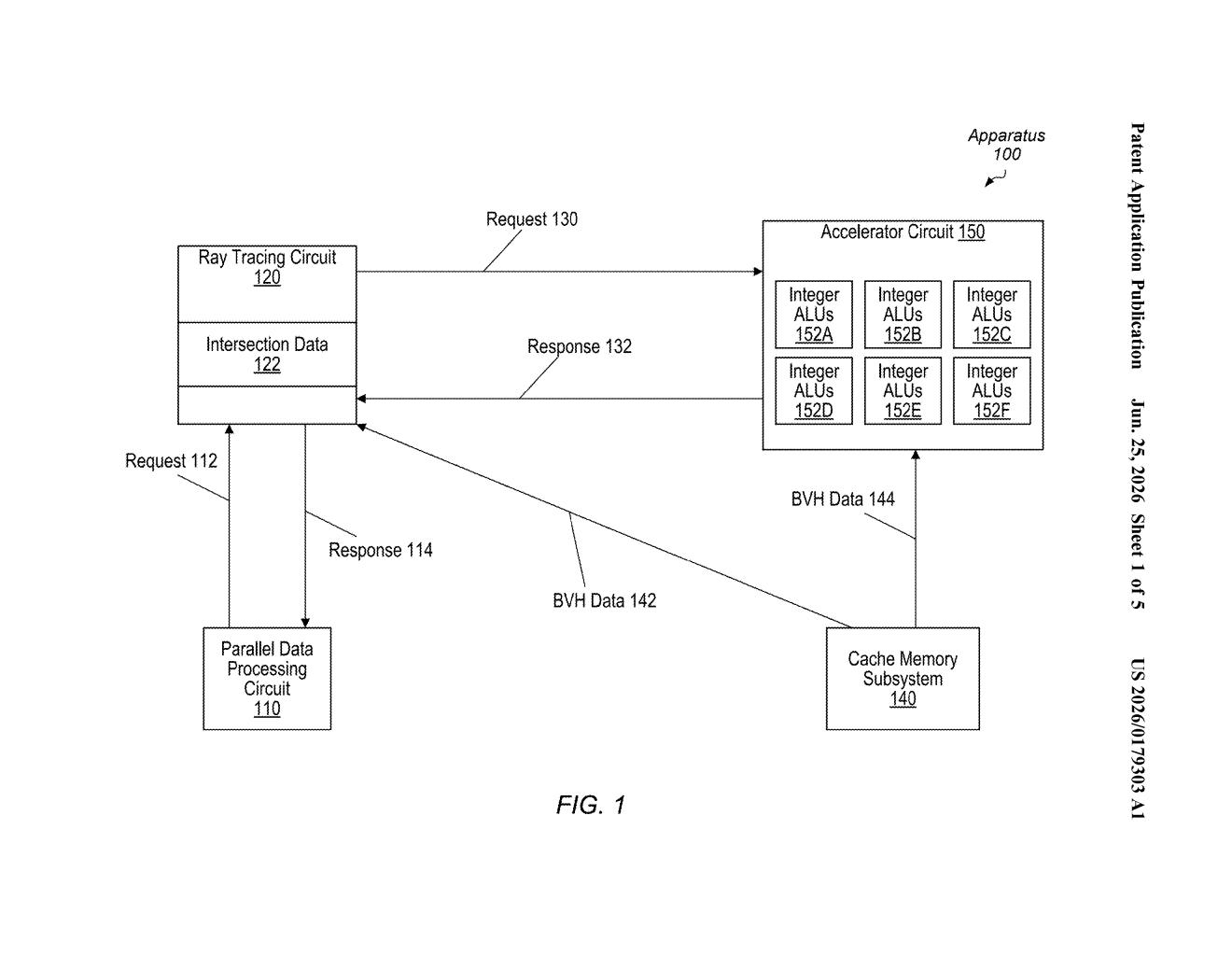
What AMD's ray tracing shortcut actually does
Imagine a game that needs to figure out exactly how light bounces off thousands of triangles on screen at once. That calculation is expensive, and GPUs often slow down waiting for it to finish.
AMD's patent describes a shortcut: before doing the full, precise ray tracing math, the GPU runs a quick pre-filter pass using low-precision, compressed triangle data. This pass throws out most triangles that clearly won't affect the final image, so the expensive full calculation only runs on the few triangles that actually matter.
The clever part is where that pre-filter runs. Instead of dedicated ray tracing hardware, AMD routes the work to its matrix cores, the same units normally used for AI and machine-learning math. Those cores have a lot of integer arithmetic power that often sits unused during regular gaming. This patent proposes putting that spare capacity to work.
How the matrix core handles triangle pre-filtering
The patent describes a system where a ray tracing circuit watches a queue of pending operations. When it spots a pre-filtering job, instead of handling it internally, it packages up the request and ships it to an accelerator circuit (specifically the matrix core units, which contain integer ALUs, or arithmetic logic units, the transistors that do integer math).
The request bundle includes:
- The ray's origin point and direction
- The current closest intersection found so far
- A pointer to the BVH tree (a spatial index that organizes 3D geometry so the GPU can quickly skip large chunks of the scene)
- A frame identifier
- A pointer to quantized pre-filter data (compressed, lower-precision triangle geometry stored separately)
The matrix cores run through the compressed triangle data quickly using their integer math units and return a short list of triangles that might intersect the ray. The ray tracing hardware then performs full-precision intersection tests only on that reduced set.
The key insight is that quantized (compressed-integer) geometry is imprecise enough that pre-filtering may produce a few false positives, but it never misses a real intersection, making it safe to discard the rest.
What this means for GPU ray tracing performance
Ray tracing is the main reason modern GPUs need so much dedicated silicon. Any technique that reduces the number of full-precision triangle tests directly translates to faster frame rates or better image quality at the same performance level. Pre-filtering is not a new idea, but offloading it to matrix cores means the dedicated ray tracing units stay free for the tests that actually require full precision.
For you as a gamer or developer, this kind of hardware reuse is how GPU makers squeeze more performance out of a fixed chip area without adding more transistors. If AMD ships this in a future GPU architecture, it could improve ray tracing throughput without requiring a bigger or more expensive chip.
This is a genuinely interesting piece of low-level GPU engineering. Borrowing integer ALUs from matrix cores for pre-filtering is a practical form of hardware reuse that addresses a real bottleneck. It won't appear on a spec sheet, but it's exactly the kind of micro-architectural work that separates fast GPUs from very fast ones.
There are more where this came from
We read every patent application Big Tech publishes and send you the ones worth knowing. Plain English, free, every week.
Want this weekly breakdown for a company we don't cover? Patentlyze Pro →