
Apple Patents a Cross-Link Wi-Fi System That Signals Sleep Mode in Advance
Your phone is connected to Wi-Fi on two bands at once — and Apple wants it to politely warn the router before going quiet on either one. That advance heads-up is surprisingly consequential for battery life.
How Apple's advance Wi-Fi sleep signal saves battery
Imagine your phone is connected to your home router on both the 2.4 GHz and 5 GHz bands simultaneously — that's what modern Wi-Fi 7 (and Wi-Fi 6 Multi-Link Operation) devices do. Normally, when your phone wants to doze one of those connections to save power, the router doesn't find out until it tries to send data and gets no response. That back-and-forth wastes energy on both ends.
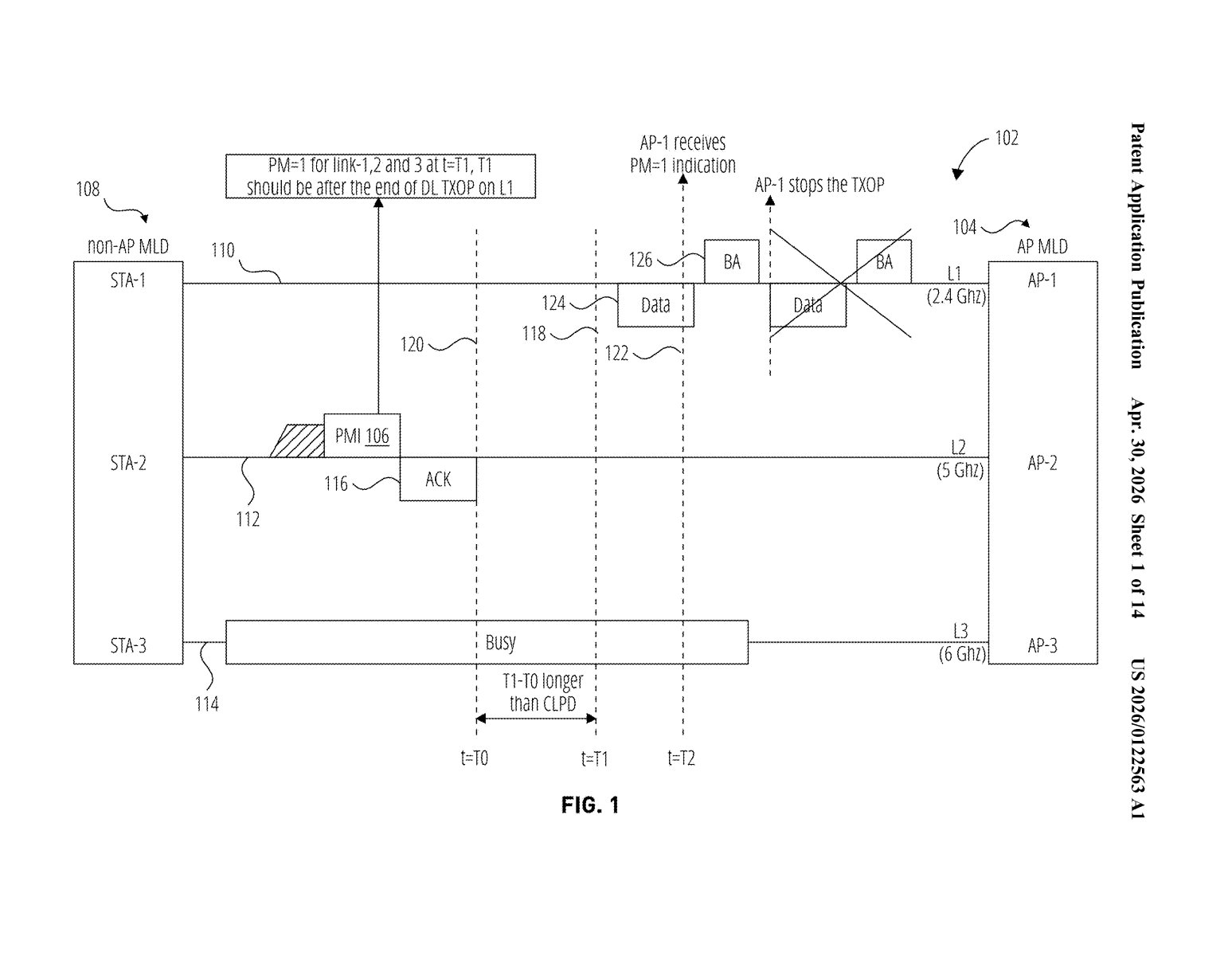
Apple's patent describes a smarter handshake: your device sends an advance power management notice to the router on one link, telling it that a different link is about to go to sleep at a specific future time. The router can then wrap up any pending transmissions cleanly before the radio powers down.
The result is less wasted airtime, fewer retransmissions, and a device that can nap its radios more aggressively — all of which adds up to a meaningful battery gain during the hours your phone is just sitting connected to Wi-Fi but not actively streaming anything.
How the MLD sends power state across a second link
The patent centers on a non-AP Multilink Device (MLD) — think your iPhone or MacBook — that maintains simultaneous Wi-Fi connections across multiple frequency bands or channels with a Multilink Access Point (your router, when it supports Wi-Fi 7's Multi-Link Operation).
The core invention is an Advance Power Management (PM) Indication: a control message the device sends to the router before it actually powers down a given link. Crucially, this warning travels over a second, still-active link — so the router gets the notice even though the link going quiet hasn't gone quiet yet.
The indication specifies:
- Which link is entering a power-save mode
- What mode it's entering (full sleep, light sleep, etc.)
- A target time at or after which the transition happens
Once the router receives the advance notice, it can stop queuing new transmissions for that link and finish or redirect any in-flight TXOPs (Transmission Opportunity windows — essentially the router's reserved time slots to push data). This prevents the classic problem where a router wastes a scheduled transmission on a radio that has already gone dark, then has to wait for a timeout before trying another path.
What this means for Wi-Fi 7 device battery life
Wi-Fi 7's Multi-Link Operation is one of the most significant changes to the Wi-Fi standard in years, letting devices bond multiple bands for speed and reliability. But that same feature creates a new power-management headache: more active radios means more battery drain, and the existing sleep-signaling spec wasn't designed with multi-link in mind. Apple's advance-notice mechanism is a targeted fix for that gap.
For you as a user, this is the kind of under-the-hood work that shows up as a few extra hours of standby battery life on a future iPhone or MacBook. It's also a signal that Apple is investing seriously in the protocol-level plumbing of Wi-Fi 7 — the sort of work that typically precedes shipping hardware that depends on it.
This is quiet, unglamorous infrastructure work — exactly the kind of patent that doesn't make headlines but ships in every device within a few years. The advance power-state signaling approach is a genuinely clean solution to a real multi-link coordination problem, and the fact that six named inventors span Apple's wireless silicon and standards teams suggests this came out of serious protocol engineering, not a defensive filing.
There are more where this came from
We read every patent application Big Tech publishes and send you the ones worth knowing. Plain English, free, every week.
Want this weekly breakdown for a company we don't cover? Patentlyze Pro →