
Apple Patents Antenna Array Design That Fixes Short-Range Wireless Misalignment
Imagine snapping two Apple devices together to share data at blazing speeds — but a tiny physical misalignment quietly kills the connection. This patent is Apple's engineered answer to that problem.
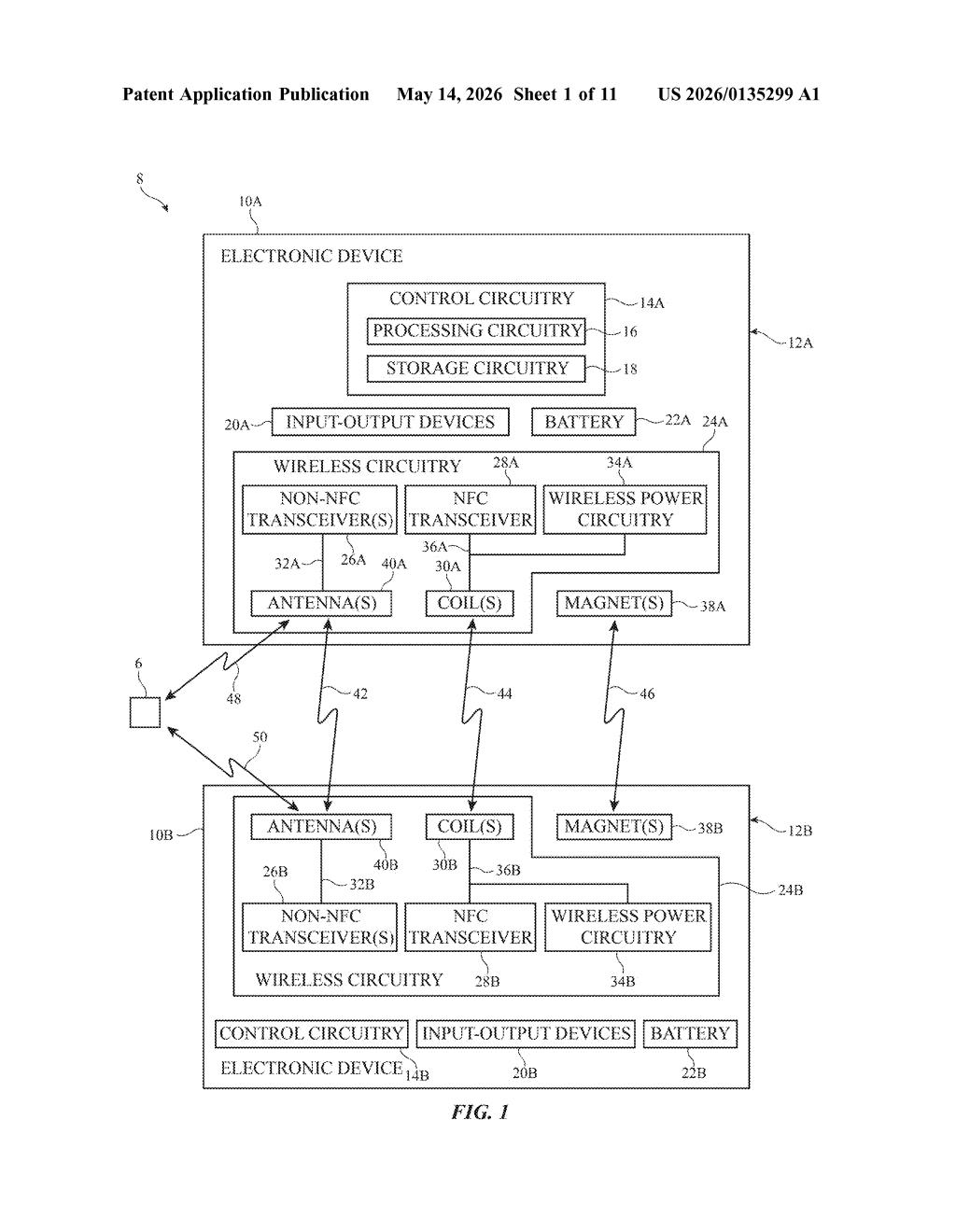
What Apple's antenna offset fix actually does
Picture two devices — say, a laptop and an external module — held close together so they can pass data wirelessly at very high speeds, almost like a cable but without the plug. The catch is that if the two devices aren't perfectly lined up with each other, the wireless link degrades. Even a small offset can seriously hurt performance.
Apple's patent describes a smarter antenna design that makes the link much more forgiving of that kind of physical misalignment. Instead of a single antenna pointing straight ahead, each side of the connection uses a cluster of antenna elements arranged in a symmetrical pattern, each radiating at a slightly different timing (phase). Together, they create a signal that stays strong even when the two devices aren't perfectly centered on each other.
Think of it like a flashlight that's been swapped for a lantern: instead of one narrow beam you have to aim exactly, you get broader, more reliable coverage. You don't have to be perfectly precise — the system compensates for you.
How the phased antenna elements cancel misalignment
The core idea is a phased antenna array — a group of antenna elements that all transmit (or receive) the same radio-frequency signal, but each one shifted in time relative to the others. This phase shifting steers and shapes the overall radiation pattern without any moving parts.
In Apple's design, the antenna elements are arranged in a pattern that is symmetric about four axes (think of a shape that looks the same if you flip it horizontally, vertically, or diagonally). Two elements transmit at opposite phases — one at a given phase, one at exactly 180 degrees behind it — simultaneously. This creates a signal profile with peak gain off of boresight (meaning the strongest point of the signal is not straight ahead, but tilted outward at an angle), which turns out to be exactly what you want when two antennas might be slightly offset from each other.
The first independent claim pins down the simplest version of this: just two antenna elements, one transmitting at phase X and one transmitting at phase X-minus-180, both going at the same time. The fuller embodiment in the abstract scales this up to four elements at four different phases, creating an even more robust offset-tolerant beam.
- Four-axis symmetry: ensures the offset tolerance works in any lateral direction, not just left-right or up-down
- Tilted radiation pattern: each element's peak gain angle is engineered to point slightly outward from center
- Concurrent multi-phase transmission: all elements fire simultaneously, their signals combining in free space to produce the desired coverage shape
What this means for high-speed device-to-device links
Short-range, high-bandwidth wireless connectors are a real direction the industry is exploring — the idea of replacing physical ports with near-field wireless links that can move data as fast as a cable. The fragility of such a link to physical misalignment has always been a practical hurdle, and this patent directly addresses that engineering problem.
For Apple specifically, this fits neatly into a broader strategy of reducing or eliminating physical ports on devices. If a device-to-device wireless data link is going to be reliable enough to replace a cable in real-world use — where users don't carefully center things by hand — the antenna design has to be tolerant of imprecision. This patent is a specific, concrete step toward making that viable.
This is quiet but genuinely useful engineering work. It doesn't hint at a flashy new product category on its own, but it solves a real and underappreciated problem that stands in the way of port-free device designs. If Apple is serious about removing the last physical connectors from its devices, patents like this are the unglamorous foundation that has to exist first.
Get our take in your Top Stories
Liked this breakdown? Add Patentlyze as a preferred source on Google, and our plain-English take shows up more often in your Top Stories the next time Apple patent news breaks.
There are more where this came from
We read every patent application Big Tech publishes and send you the ones worth knowing. Plain English, free, every week.
Want this weekly breakdown for a company we don't cover? Patentlyze Pro →