
Apple Patents Smarter Iterative Decoding for 5G Control Channels
Your iPhone has to decode a flood of tiny control messages from cell towers thousands of times per second — and Apple thinks it can do that more reliably by teaching the decoder to rank which bits it trusts most before passing guesses forward.
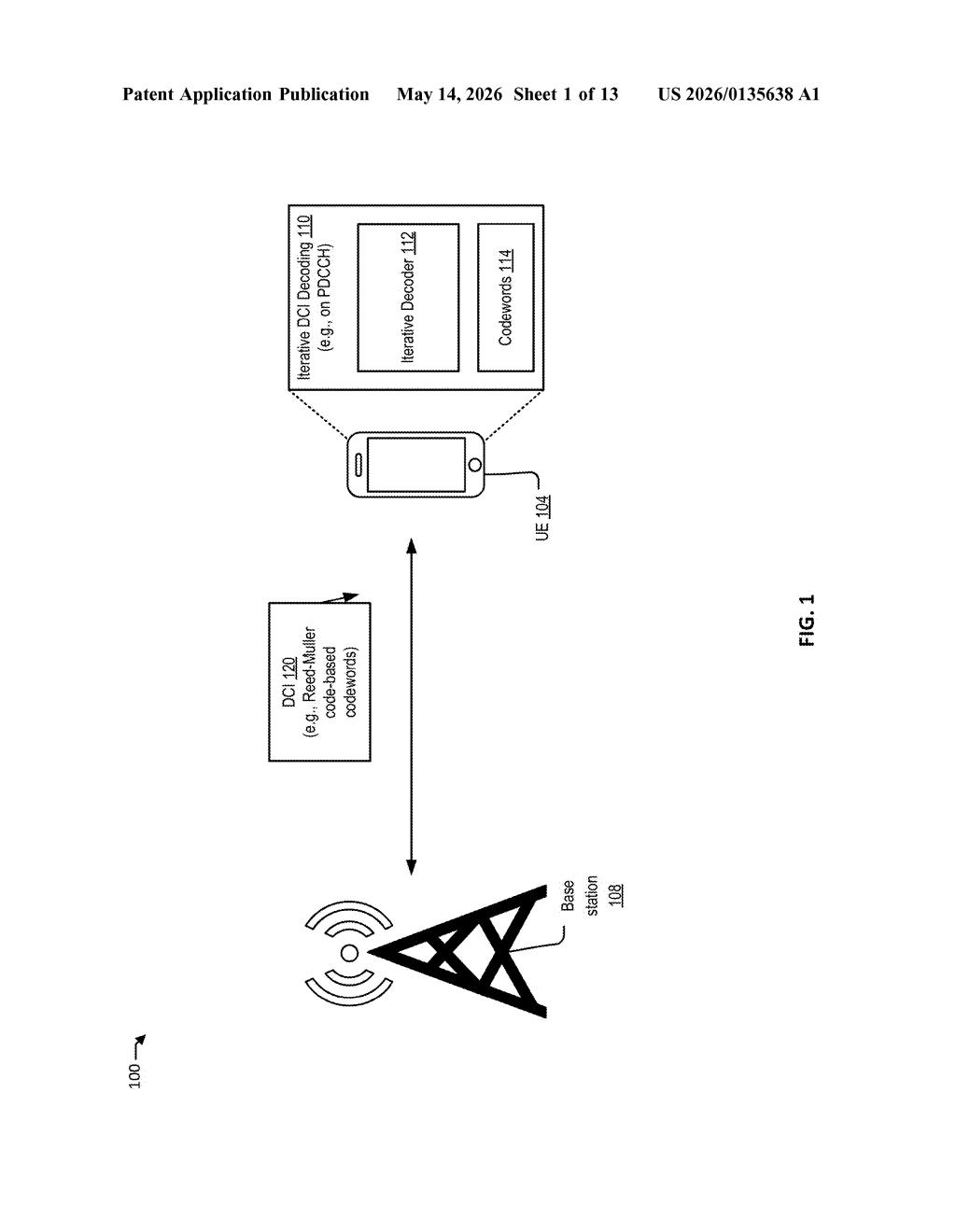
What Apple's soft-decision decoder actually does
Imagine you're trying to read a note that got wet and some of the ink smeared. Instead of guessing each blurry letter in isolation, you'd probably start with the letters you're most confident about and use those to inform your guesses on the harder ones. Apple's patent applies exactly that logic to wireless decoding.
In 5G, your phone constantly receives small packets called Downlink Control Information (DCI) on a channel called the PDCCH. These packets tell your phone when and how to receive data. Decoding them accurately — and quickly — is critical to connection speed and battery life.
Apple's approach runs the decoder in multiple passes. Each pass scores how confident it is about each bit, sorts those confidence scores, and uses the sorted ranking to sharpen the next pass. The result is a decoder that homes in on the right answer faster, even when the signal is noisy.
How belief propagation and sorted reliability values interact
The patent describes an iterative decoder for Reed-Muller codes — an error-correction scheme that 5G uses for control signaling on the PDCCH channel. Reed-Muller codes are known for their structure, which makes them amenable to clever algebraic decoding tricks, but soft-decision decoding (where you work with probabilities rather than hard 0/1 guesses) can squeeze out better performance.
Each decoding iteration k starts by computing soft channel reliability information — essentially a confidence score for every bit in the codeword (think of it as: 'I'm 90% sure this bit is a 1, but only 55% sure about that one'). The decoder then sorts those reliability values, so the most trustworthy bits are ranked first.
With that sorted list in hand, the decoder runs a belief-propagation algorithm (a well-established technique where bits 'vote' on each other's values by passing messages along a graph structure) to generate soft extrinsic information — updated probability estimates that incorporate information from neighboring bits. Crucially, because the computation is guided by the sorted reliability ranking, the most confident bits anchor the process.
That extrinsic information is then fed into iteration k+1, updating the reliability scores and starting the cycle again. Decoding stops when a success criterion is met — or a maximum iteration count is reached.
What this means for iPhone 5G reception and power
The PDCCH is one of the most latency-sensitive parts of 5G — your phone has to decode it correctly in fractions of a millisecond to stay in sync with the network. Better decoding means fewer missed or corrupted control messages, which translates to fewer retransmissions, faster effective throughput, and less time the modem spends burning power trying to recover a signal.
For Apple specifically, this lands squarely in the domain of its in-house modem program. Apple shipped its first proprietary modem — the C1 — in early 2025, and tighter control over decoding algorithms is exactly the kind of low-level optimization that separates a custom modem from an off-the-shelf one. Better decoder efficiency at the silicon level means longer battery life, which has been a marquee selling point for Apple's modem ambitions.
This is unglamorous but genuinely important modem engineering — the kind of detail work that compounds into real-world battery and reception wins. It's not a flashy AI feature, but for Apple's in-house modem roadmap, patents like this are the actual substance of what makes a competitive chip. Worth tracking as a signal of how deep Apple's modem team is going.
There are more where this came from
We read every patent application Big Tech publishes and send you the ones worth knowing. Plain English, free, every week.
Want this weekly breakdown for a company we don't cover? Patentlyze Pro →