
Head-Mounted Display Device With Vision Correction
Millions of people who wear glasses or contacts have to jump through hoops to use VR headsets — Apple's latest patent wants to fix that by measuring your eyes and correcting your vision automatically, no prescription lenses required.
What Apple's in-headset eye correction actually does
Imagine slipping on a VR headset and having it figure out your prescription on the spot — no swapping in corrective lens inserts, no wearing contacts underneath. That's the core idea behind this Apple patent.
The headset uses a built-in sensor to measure refractive errors in your eyes (the same thing an eye doctor is checking when they ask 'better one, or better two?'). It then adjusts tunable liquid crystal lenses to compensate, so what you see on the displays looks sharp even if your vision isn't perfect.
On top of that, the displays themselves can physically shift position to align with exactly where your eyes are sitting. Apple's system also adjusts these settings based on what content is being shown, so a fast-moving 3D scene might get different treatment than a still reading interface. The goal is maximum visual comfort without ever touching an optometrist's office.
How Apple's tunable lenses and retinal sensor work together
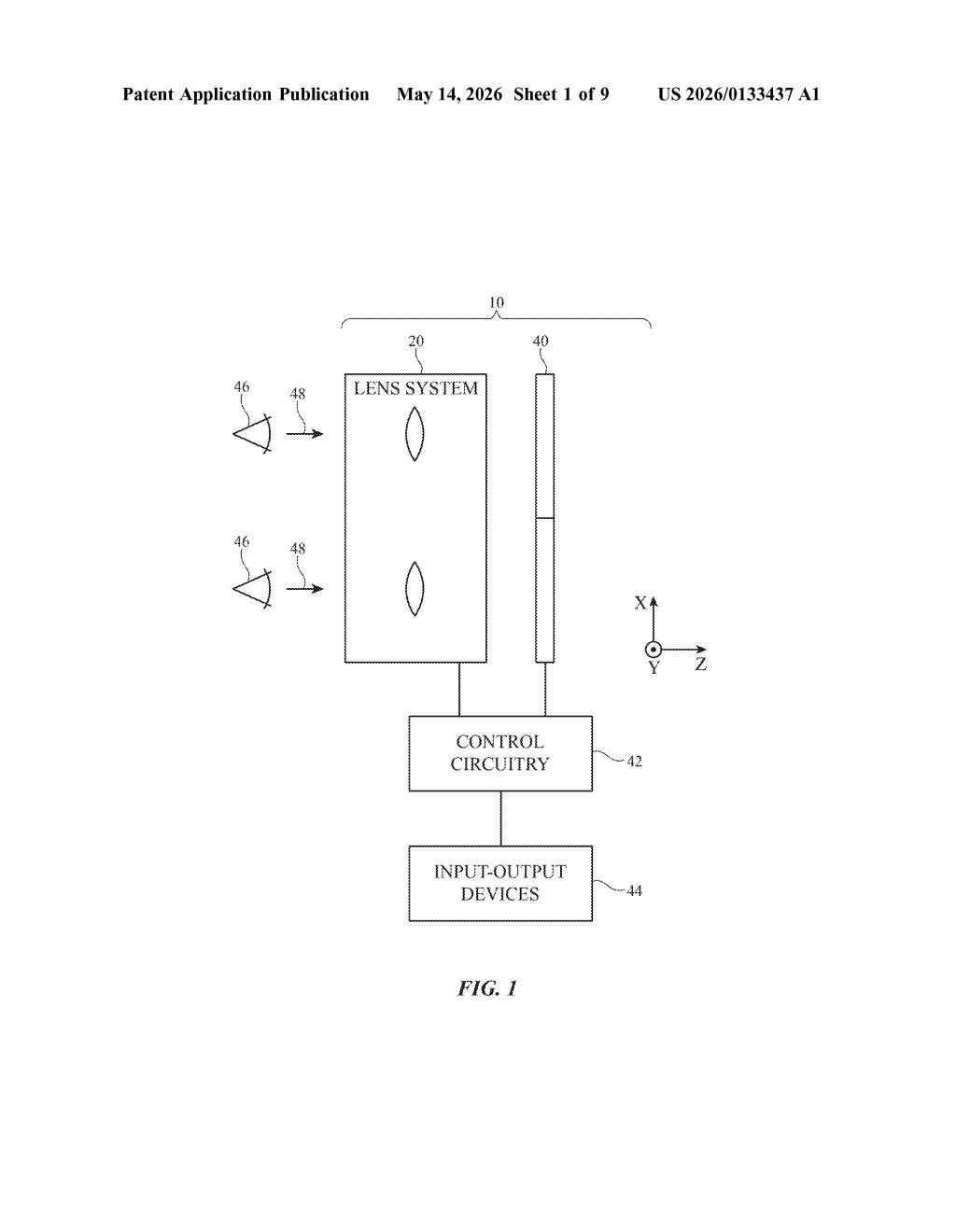
At a hardware level, the patent describes a head-mounted display (HMD) housing that contains both a display system and an adjustable optical system. The displays can be physically repositioned using motorized positioners to align with the precise location of each eye — important because even small misalignments cause strain.
The optical system centers on tunable cylindrical liquid crystal lenses — lenses whose focal properties can be changed electronically by applying voltage, similar in concept to how electrowetting lenses work in some cameras. These sit between the display and your eye, bending light in ways that counteract nearsightedness, farsightedness, or astigmatism.
The sensor that figures out how much correction you need is notably sophisticated. It uses:
- Waveguides (thin optical slabs that guide light along a surface) to direct light into the eye
- Volume holograms (3D diffraction gratings recorded in a photosensitive material) to shape and redirect that light
- A camera that captures light reflected back from the retina — a technique called wavefront sensing or aberrometry, the same principle used in LASIK pre-screening
Once the system has a refractive error measurement, it feeds that data into the lens tuning algorithm. Critically, Apple also ties lens and display adjustments to content type — the system can optimize differently depending on whether you're reading text, watching video, or navigating 3D space.
What this means for Vision Pro and glasses-free computing
Roughly 75% of adults use some form of vision correction. For spatial computing to go mainstream, headsets need to work comfortably for that majority — and right now, most headsets force users into awkward workarounds like clip-in prescription inserts or wearing contacts. A system that handles this automatically, and adapts in real time, removes one of the most cited friction points for new headset users.
For Apple specifically, this fits directly into the Vision Pro's positioning as a premium, personalized device. If a future version of Vision Pro can scan your eyes on first setup and dial in your vision correction automatically, that's a meaningful differentiator over competitors — and it deepens the case for the headset as a device you wear for hours, not just minutes.
This is one of the more practically meaningful headset patents Apple has filed — it tackles a real barrier to adoption rather than a speculative future feature. The combination of retinal wavefront sensing and electronically tunable lenses in a single compact system is genuinely non-trivial engineering, and the content-aware adjustment angle suggests Apple is thinking about long wear sessions, not just demos.
There are more where this came from
We read every patent application Big Tech publishes and send you the ones worth knowing. Plain English, free, every week.
Want this weekly breakdown for a company we don't cover? Patentlyze Pro →