
Google Patents a System for Counting User Trends Without Seeing Individual Data
Google wants to answer questions like 'how many users spent more than $50?' without ever actually looking at what any single user spent. This patent describes the math that makes that possible.
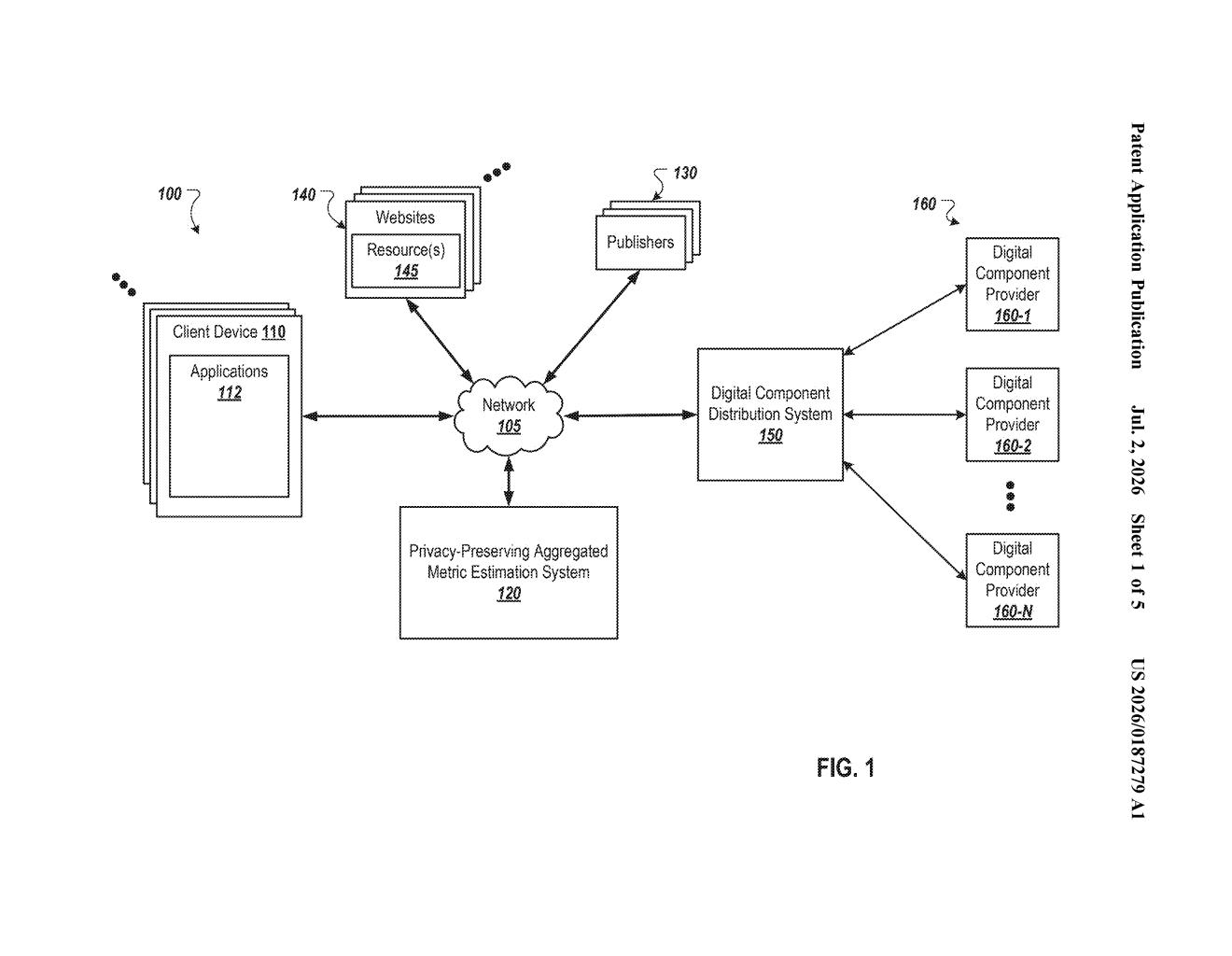
What Google's privacy-preserving counting actually does
Imagine a company wants to know how many of its customers made more than five purchases last month. Normally, answering that question means inspecting everyone's individual records, which creates privacy risks. Google's patent describes a way to get a good enough answer without ever pinpointing what any one person did.
The system works by adding a small amount of controlled random noise to any count it produces. That noise is carefully sized so it blurs individual contributions but still leaves the group total accurate enough to be useful. Think of it like a blurry photo: you can tell there are roughly 200 people in the crowd, but you can't pick out any individual face.
The key ingredient is something called a privacy budget, a mathematical limit on how much information the system is allowed to reveal. Once that budget is spent, the system stops refining its estimate, so no amount of repeated queries can squeeze out enough detail to identify a specific person.
How the threshold loop adds noise to protect each person
The patent describes a method for computing aggregated metrics (totals, counts, averages across a group) while satisfying differential privacy, a formal mathematical guarantee that adding or removing any single person's data changes the output by only a tiny, bounded amount.
The algorithm works by iterating through a series of ascending threshold values. At each step it asks: how many entities have a value at or above this threshold? That count gets calibrated noise added to it (random perturbation sized to the privacy budget) before it is used to update the running estimate. The loop continues until either the threshold reaches its maximum or a stopping condition fires, which prevents the system from burning through the privacy budget on thresholds that no longer add useful information.
The privacy budget acts like a finite fuel tank. Each noisy query consumes a slice of it. The stopping condition is the system's way of conserving fuel: if the cumulative count has dropped so low that further iterations would mostly just add noise, it halts early.
- Input: one numeric value per entity (a user's spend, click count, etc.)
- Process: ascending threshold sweep with differentially private noise at each step
- Output: a single estimated aggregate that meets the privacy guarantee
What this means for Google's ads and analytics business
For Google, this is practical infrastructure. Its advertising measurement products constantly need to answer questions like 'how many users in this cohort converted?' without exposing any individual's browsing or purchase history. Differential privacy lets Google give advertisers useful aggregate numbers while maintaining legally and technically defensible privacy protections, something regulators in Europe and the U.S. are increasingly demanding.
For you as a user, a deployed version of this system would mean that even if someone subpoenaed Google's measurement pipeline, the data it holds is mathematically blurred enough that your specific contribution cannot be reconstructed. It does not prevent Google from collecting data in the first place, but it does limit what can be inferred about any individual from the outputs.
This is unglamorous but genuinely important work. Differential privacy has been a research topic for nearly two decades, and the hard part has always been making it fast and accurate enough to use in production at Google's scale. A patent on the specific iterative threshold algorithm suggests Google has found an implementation worth protecting, which usually means it's close to shipping.
Get our take in your Top Stories
Liked this breakdown? Add Patentlyze as a preferred source on Google, and our plain-English take shows up more often in your Top Stories the next time Google patent news breaks.
There are more where this came from
We read every patent application Big Tech publishes and send you the ones worth knowing. Plain English, free, every week.
Want this weekly breakdown for a company we don't cover? Patentlyze Pro →