
Meta Patent Reveals How Smart Glasses Decide When to Activate Their AI
Running a powerful AI assistant on your face all day would drain a battery in hours. Meta's new patent describes a two-stage system that keeps smart glasses mostly asleep, then snaps them awake only when something in the real world actually needs AI help.
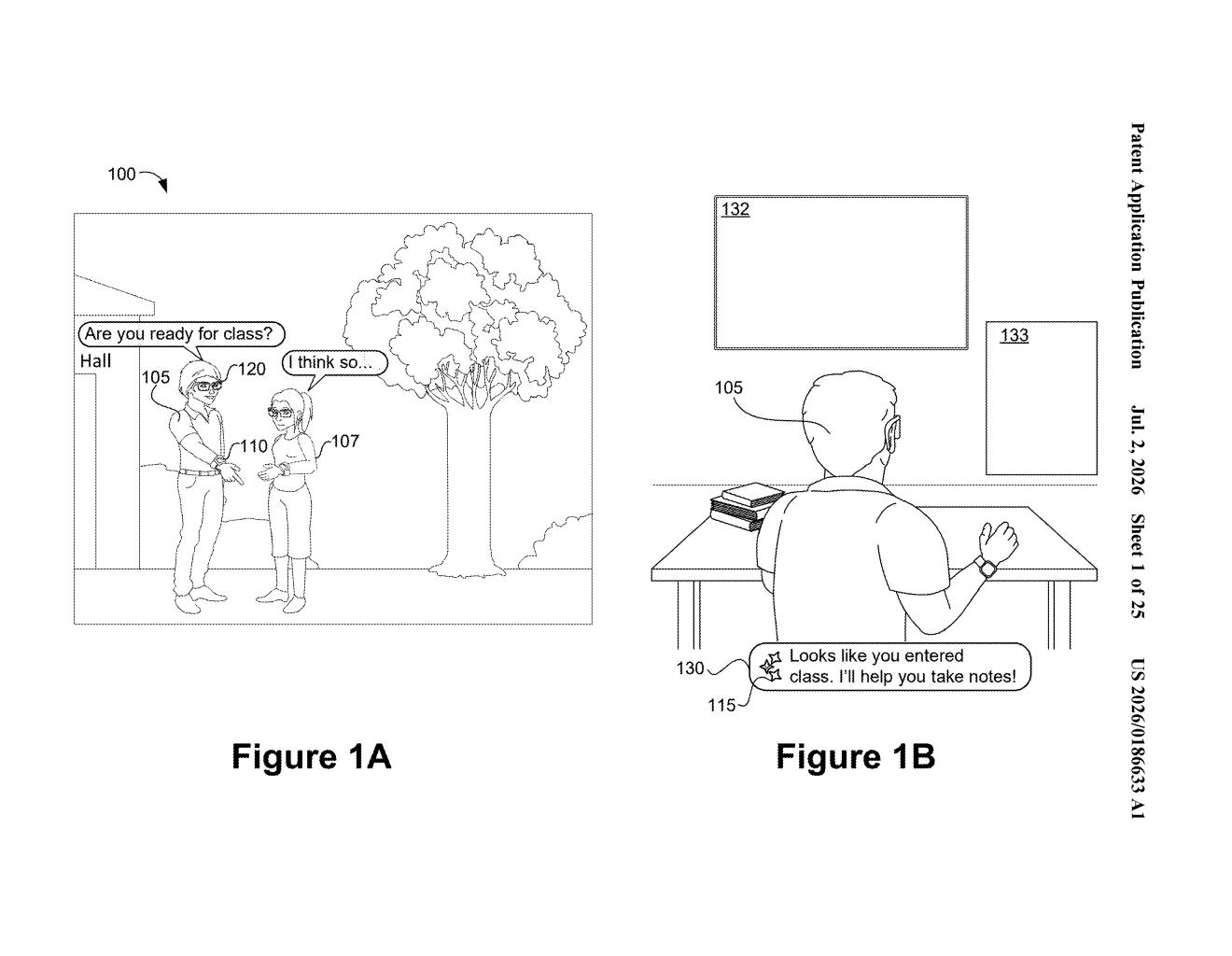
How Meta's glasses decide when to call in the AI
Imagine wearing glasses that are watching the world around you, but only spending serious energy when they spot something worth paying attention to. That's the core idea here. Most of the time, the glasses run lean, using minimal power while their cameras, microphones, and sensors take in low-fidelity data about your surroundings.
When that lightweight monitoring detects a potential trigger, like you pausing in front of a menu, or someone saying something that sounds like a question, the glasses shift into high-power mode. Now the AI gets a richer, higher-quality feed and decides whether it can actually help. If it can, it puts a set of suggested actions in front of you, and you pick the one you want.
The whole point is avoiding the trade-off between battery life and usefulness. Instead of forcing you to manually summon the AI every time, the glasses do the ambient surveillance themselves and only escalate when there's a real reason to.
How the two-stage sensing and trigger system works
The patent describes a head-worn device, think smart glasses, that operates across two distinct power states and uses a gating process to move between them.
Stage one (low-power mode): The glasses continuously gather first real-world data, a lightweight stream from the camera, microphone, and onboard sensors. A lightweight detection layer (something cheaper to run than a full AI model) watches this stream for an AI agent invocation trigger, a condition or pattern that suggests the AI might be needed.
Stage two (high-power mode): Once the trigger fires, the device powers up fully and captures second real-world data, higher-quality input that the full AI agent can actually work with. The AI then checks whether AI assistance criteria are satisfied, essentially confirming this situation is worth acting on, not just a false alarm.
If the criteria are met, the AI generates a set of assistive operations (options the user can take), displays them on the glasses, and waits for the user to select one before carrying it out. The two-stage gating prevents the AI from running constantly, which would be both battery-draining and potentially intrusive.
What this means for all-day wearable AI battery life
Battery life is the most stubborn obstacle in wearable AI. Running a capable AI model continuously on a device you wear on your face is simply not practical today. This patent describes a real architectural answer to that problem: keep the expensive computation off until context actually warrants it.
For Meta, which already sells Ray-Ban Meta smart glasses and is building toward more capable AR hardware, this kind of power management is infrastructure work that has to exist before ambitious AI features can ship. If the trigger detection is accurate, users get a responsive AI assistant without burning through a battery pack by noon. If it misfires a lot, the experience feels buggy and invasive. The patent doesn't specify how the trigger is trained or what counts as a valid invocation, which is where most of the real engineering challenge lives.
This is thoughtful, unsexy engineering that matters a lot. The two-stage power gating idea is not new in principle, phones have done something similar with wake words for years, but applying it to a full ambient-sensing wearable with a visual AI layer is meaningfully harder. Meta filing this in late 2025 is a signal that battery-constrained AI wearables are a live engineering priority, not just a roadmap slide.
There are more where this came from
We read every patent application Big Tech publishes and send you the ones worth knowing. Plain English, free, every week.
Want this weekly breakdown for a company we don't cover? Patentlyze Pro →