
Nvidia Patents a Parallel Method for Collapsing Redundant Curve Segments in Graphics
Drawing smooth curves on a computer sounds simple, but underneath every logo or font glyph are dozens of tiny math-defined segments that GPUs have to process one by one. Nvidia wants to collapse those segments in bulk, in parallel, rather than one at a time.
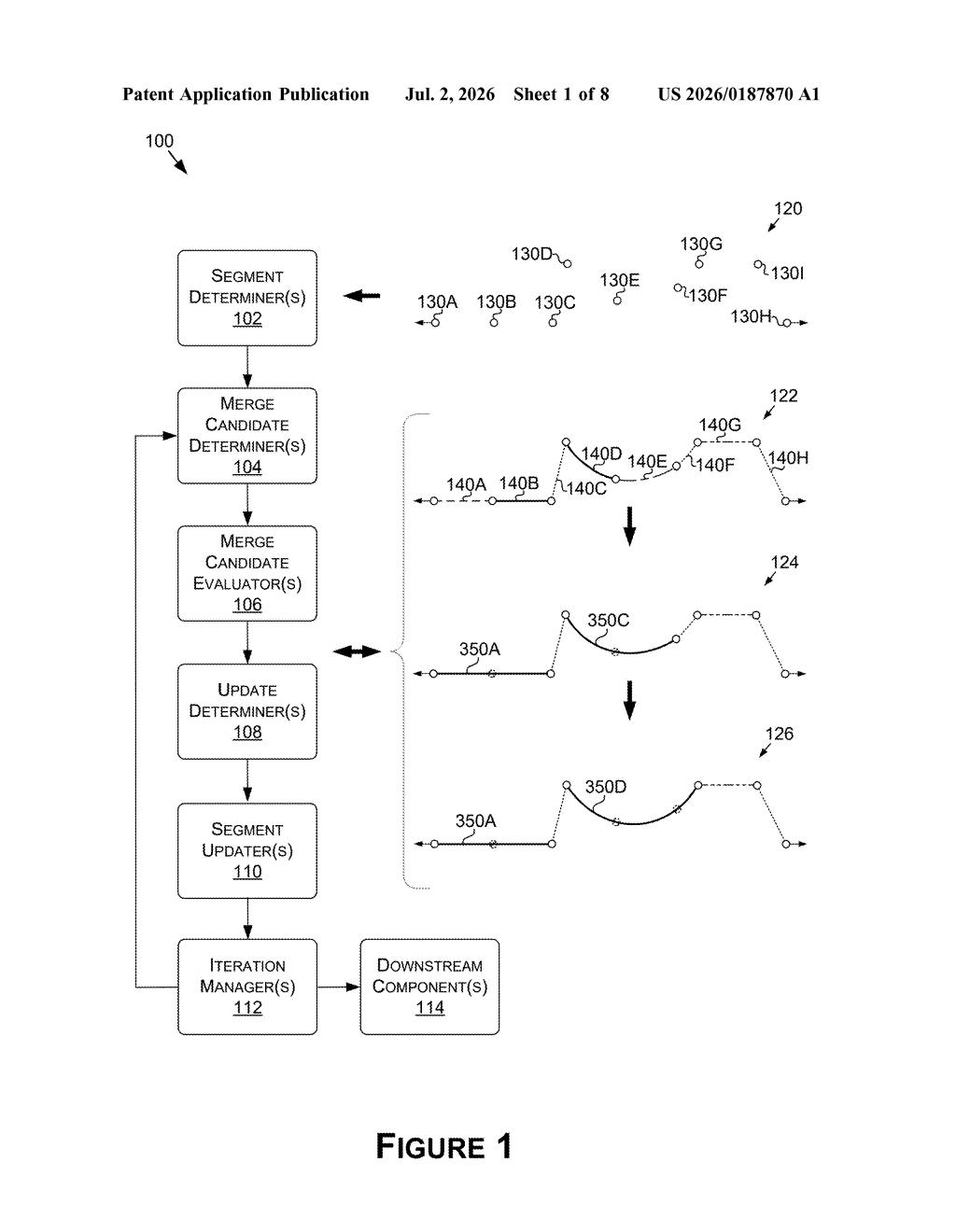
What Nvidia's curve-merging patent actually does
Imagine a graphic designer's smooth curved line: it's actually stitched together from many small curve pieces, each described by a set of math coordinates. The more pieces there are, the more work a computer has to do to render, animate, or process that shape.
Nvidia's patent describes a system that automatically looks at neighboring curve pieces and asks: can these two (or more) be combined into one without the shape looking noticeably different? Instead of checking each pair one at a time, the system evaluates many potential combinations at the same time, using the parallel processing power that GPUs were built for.
The key trick is a compatibility check: if two different evaluations both agree that a merge is a good idea, the merge goes through. If even one evaluation objects, the merge is rejected. This keeps the resulting shape accurate while dramatically reducing the number of segments a machine needs to work with downstream.
How the parallel merge evaluation and rejection works
The patent describes a method for geometric segment fitting on parallel processors, specifically targeting sequences of cubic Bézier curves (the standard math tool used to represent smooth curves in fonts, vector graphics, and CAD models).
The core loop works like this:
- The system identifies merge candidates: single replacement curves that could stand in for two or more adjacent segments in the sequence.
- Each candidate is evaluated against the original data points the curve is supposed to pass near, measuring how far off the merged version would be (proximity error).
- The same candidate is evaluated independently from the perspective of each of the segments it would replace. If both evaluations agree the merge is acceptable, it is accepted. If either disagrees, it is rejected.
- A mapping between segments and base points tracks which original data points belong to which segment, so the sequence can be updated cleanly after merges.
The compatibility requirement is what makes parallel execution safe: because each merge decision is self-consistent, many candidates across the curve sequence can be evaluated simultaneously on GPU threads without one decision corrupting another.
What this means for GPU-driven vector graphics
Vector graphics, fonts, and 3D model outlines all rely on Bézier curve sequences. Any pipeline that has to process, transmit, or render those shapes benefits from having fewer segments to handle, as long as visual quality is preserved. Nvidia's approach is specifically designed to run efficiently on its own GPU architectures, which could make real-time curve simplification practical in tools that previously had to do this work slowly on a CPU.
For you as an end user, this kind of work sits deep in the plumbing of software like design tools, game engines, and machine-learning systems that process geometric data. It's not a feature you'd see named in a product menu, but faster, parallel curve processing could translate to quicker font rendering, more responsive vector editing, and leaner data fed into AI models that work with shape data.
This is a focused, well-scoped engineering patent rather than a broad strategic claim. It solves a real bottleneck in parallel curve processing with a clear mechanism. It won't make headlines, but it's exactly the kind of foundational GPU-pipeline work Nvidia files routinely to protect its graphics and compute toolchain.
Get our take in your Top Stories
Liked this breakdown? Add Patentlyze as a preferred source on Google, and our plain-English take shows up more often in your Top Stories the next time Nvidia patent news breaks.
There are more where this came from
We read every patent application Big Tech publishes and send you the ones worth knowing. Plain English, free, every week.
Want this weekly breakdown for a company we don't cover? Patentlyze Pro →