
Samsung Patents a Camera Chip That Stops Erratic Signals From Corrupting Photo Data
Every time a camera sensor reads a pixel, a tiny circuit races to compare a sliding reference voltage against the light signal coming off that pixel. Samsung's new patent targets exactly that race, clamping how far the circuit's output swings to make the whole process faster and less power-hungry.
What Samsung's voltage-swing trick does for your camera
Imagine your camera's sensor as a giant grid of light buckets. After each shot, the chip has to read every single bucket, one column at a time, by sliding a reference voltage up or down and checking when it matches what the pixel collected. That comparison step happens millions of times per frame, and the electronics involved can waste energy if they're allowed to swing wildly between their high and low states.
Samsung's patent describes a comparator circuit that deliberately restricts how far those output signals are allowed to swing. Think of it like a volume limiter on a speaker: instead of letting the signal blast from zero to maximum every time, the circuit keeps the swing within a tighter range. A special shared control point inside the output stage governs that limit.
The practical payoff is a comparator that can potentially switch faster, generate less electrical noise, and draw less current, all of which matter when you're reading tens of millions of pixels as quickly as possible.
How the common gate node limits the output swing
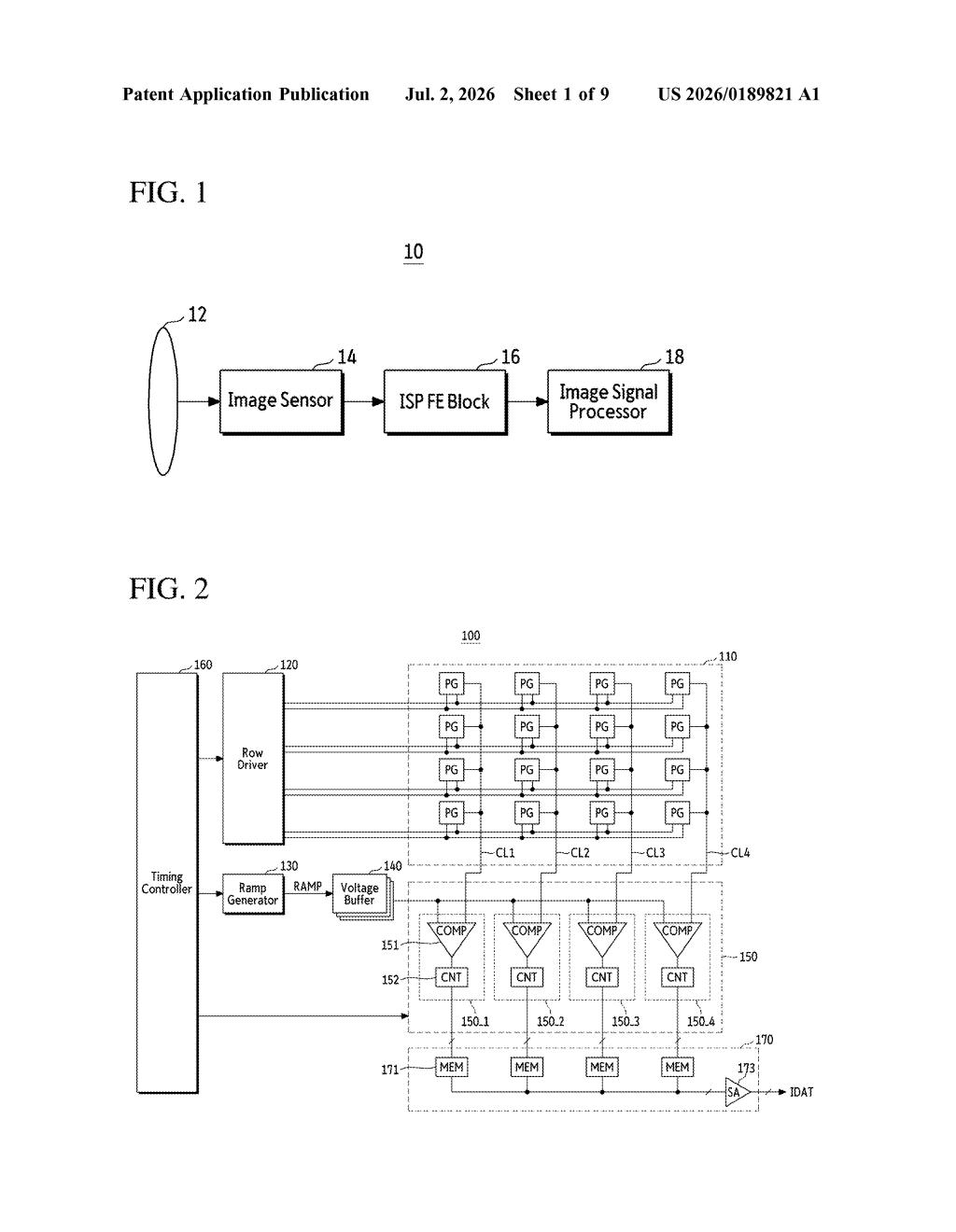
The patent describes an image sensor built around three main building blocks: a set of ramp voltage buffers, a pixel array, and a bank of comparators, one per column of pixels.
The ramp voltage buffers take a steadily rising (or falling) reference signal and isolate it so that connecting many comparators to it doesn't drag the signal down. Each comparator then receives that buffered ramp on one input and the live pixel voltage on the other, looking for the moment the two match.
The novel piece is how the comparator's output stage is controlled. The circuit includes output transistors whose gates share a common gate node. By actively managing the voltage at that shared node, the design restricts the voltage level swing width at the output, meaning the output doesn't have to travel all the way from a full logic-high to a full logic-low on every comparison cycle. A smaller swing means:
- Less charge that has to move through the transistors each cycle
- Lower current draw across the entire column readout
- Potentially faster settling, which helps at high frame rates
The architecture scales across a whole array: every column gets its own comparator with the same swing-restriction mechanism, so the power and speed benefits multiply across the full sensor width.
What this means for fast, low-power image sensors
Image sensor readout speed is one of the main bottlenecks between a camera and truly fast continuous shooting or high-frame-rate video. Comparators that settle faster and draw less current per column let the sensor read pixels more quickly without overheating the chip or draining a phone battery.
For Samsung, which makes image sensors used in its own Galaxy phones and sold to other manufacturers, incremental improvements to comparator design are how you stay competitive at the silicon level. This patent sits squarely in that category: not a new sensor format or a new pixel technology, but a circuit-level refinement that could translate into measurable gains in readout speed or power efficiency in a future sensor generation.
This is a low-glamour, high-value circuit patent. It won't make headlines at a product launch, but comparator efficiency is exactly the kind of foundational work that separates a market-leading image sensor from a merely adequate one. Samsung files a lot of sensor IP; this one is specific in its mechanism, which suggests it reflects real silicon work rather than a speculative placeholder.
Get our take in your Top Stories
Liked this breakdown? Add Patentlyze as a preferred source on Google, and our plain-English take shows up more often in your Top Stories the next time Samsung patent news breaks.
There are more where this came from
We read every patent application Big Tech publishes and send you the ones worth knowing. Plain English, free, every week.
Want this weekly breakdown for a company we don't cover? Patentlyze Pro →