
Sony Patents a Car Display That Adjusts Its Picture to Prevent Motion Sickness
Watching a video in the back seat while the car turns corners is a recipe for nausea. Sony is patenting a display system that detects when a passenger is getting sick and reshapes what they see on screen to ease the discomfort.
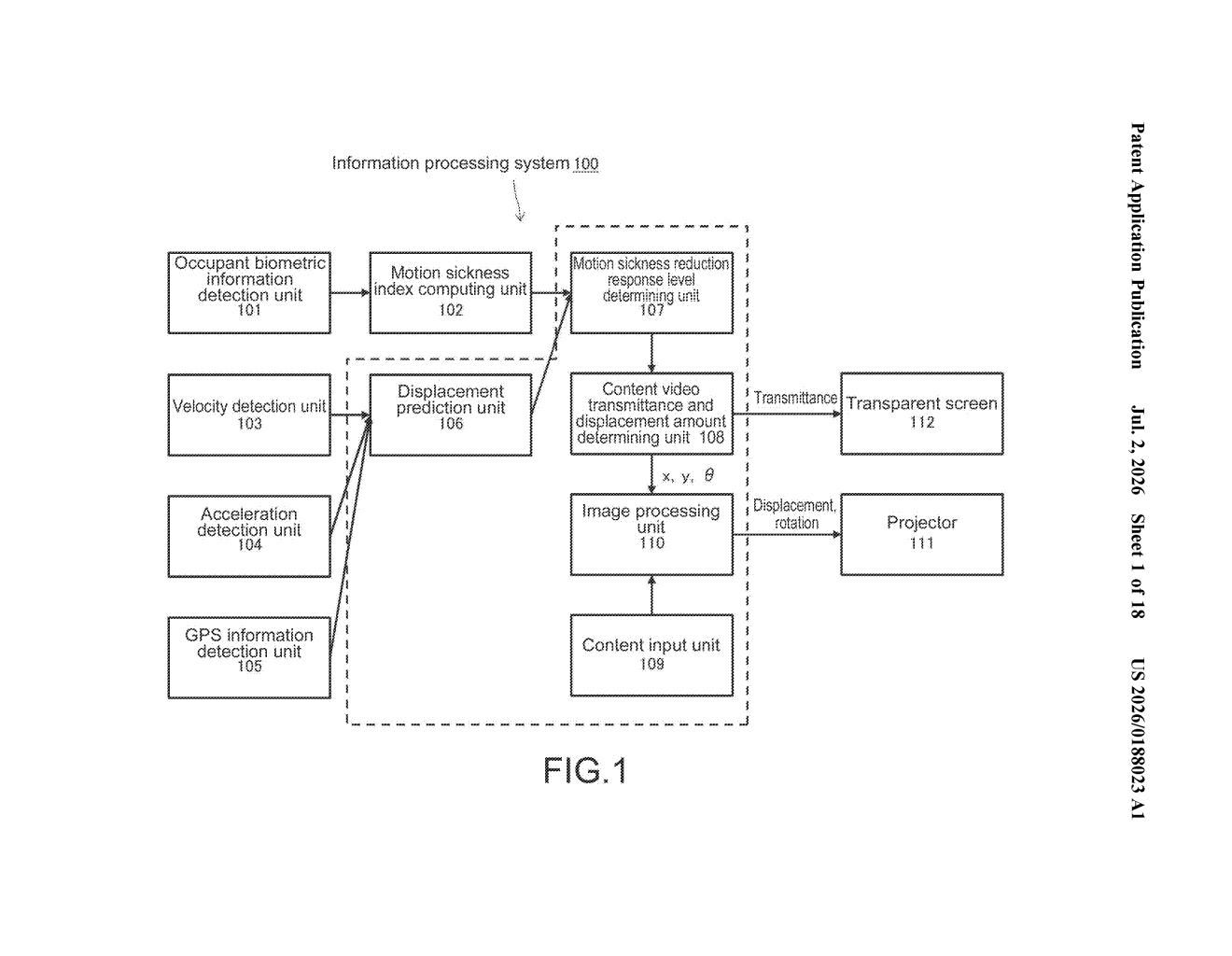
How Sony's motion-sickness display fix actually works
Imagine you're in the back seat of a car, watching a movie on a built-in display. The car hits a winding road, and your stomach starts to turn. That queasy feeling happens because your eyes and your inner ear are getting conflicting signals: the screen says you're sitting still, but your body knows you're moving.
Sony's patent describes a display system that monitors an occupant's motion sickness risk in real time. When the system senses that someone is starting to feel unwell, it adjusts the screen to help. Specifically, it can change how transparent parts of the display are, and it can shift the position or angle of the video being shown.
The idea is that by making the screen content match the vehicle's actual movement more closely, or by blending the outside world into what you see, the brain gets less confused. The system is designed for any vehicle with a mounted display, from cars to buses to planes.
How the system measures risk and shifts the on-screen image
The patent centers on a display system with a transmittance variable region (a section of the screen that can be made more or less transparent, like a smart glass panel that shifts between clear and opaque).
A determining unit continuously assesses the passenger's motion sickness risk. This could draw on vehicle movement data, passenger-facing cameras, or physiological signals, though the patent focuses on the output rather than specifying every input sensor.
Based on that risk assessment, the system's processing unit makes two kinds of adjustments:
- Transmittance changes: It decides how transparent the video region of the display should be, potentially letting the real outside world show through to anchor the viewer's sense of place.
- Display position and angle shifts: It moves or tilts the video on screen so that what the eye sees better matches the physical motion the body is feeling.
The underlying logic is that motion sickness is driven by a mismatch between visual input and vestibular (inner-ear) input. By making the screen's content more consistent with actual vehicle motion, the system tries to close that gap before nausea sets in.
What this means for in-car screens and passenger comfort
As more vehicles add large passenger displays and as interest in autonomous vehicles grows, in-cabin entertainment is a real design challenge. Passengers who would normally avoid looking at screens in moving vehicles could become a much larger audience if the technology can reduce motion sickness reliably.
Sony already makes displays, image sensors, and in-vehicle entertainment systems, so this patent fits neatly into that existing business. For everyday passengers, the practical question is whether a screen that subtly shifts and changes opacity is comfortable or distracting in its own right. That tension will define whether this concept moves from patent to product.
This is a genuinely practical idea tackling a real problem: motion sickness is one of the biggest barriers to passengers using in-vehicle screens. The transmittance angle is clever because it sidesteps the need to model every possible road condition, instead giving the visual system a more direct connection to the real world. Whether Sony can make the adjustments subtle enough that they help rather than annoy is the engineering question worth watching.
Get our take in your Top Stories
Liked this breakdown? Add Patentlyze as a preferred source on Google, and our plain-English take shows up more often in your Top Stories the next time Sony patent news breaks.
There are more where this came from
We read every patent application Big Tech publishes and send you the ones worth knowing. Plain English, free, every week.
Want this weekly breakdown for a company we don't cover? Patentlyze Pro →