
Google Patents Car Software Where No Single Computer Is in Charge
Google has filed a patent for a car operating system where every software module runs independently and finds what it needs on its own, with no single controller in charge. It's an architectural bet that the cars of the future should look less like a single computer and more like a small internet.
What Google's vehicle software coordination patent actually does
A car's dashboard refuses to show a map because the navigation service crashed, and the whole system needs a restart to fix it. That's the kind of fragility Google's new patent is designed to prevent.
The patent describes a way of building car software where each function (navigation, climate control, audio, driver assistance) runs as a fully independent piece that can find and talk to the others on its own. There's no single master program calling the shots. If one piece fails or needs an update, the rest keep running, and the system figures out what's available and routes around any gaps.
The approach also bakes in security from the start. Every software service gets a verified identity, and messages between services are checked to make sure they actually came from who they claim to be. Your car's systems can talk to each other and to outside services without any one weak point being able to compromise the whole vehicle.
The independent systems may be members of a leaderless group of trusted independent systems that provides a consistent record of service identities, service registrations, and runtime interfaces across the distributed system.
Translation: Computers in the car form a team of equals rather than relying on one central boss.
How the leaderless group and service-discovery layer work
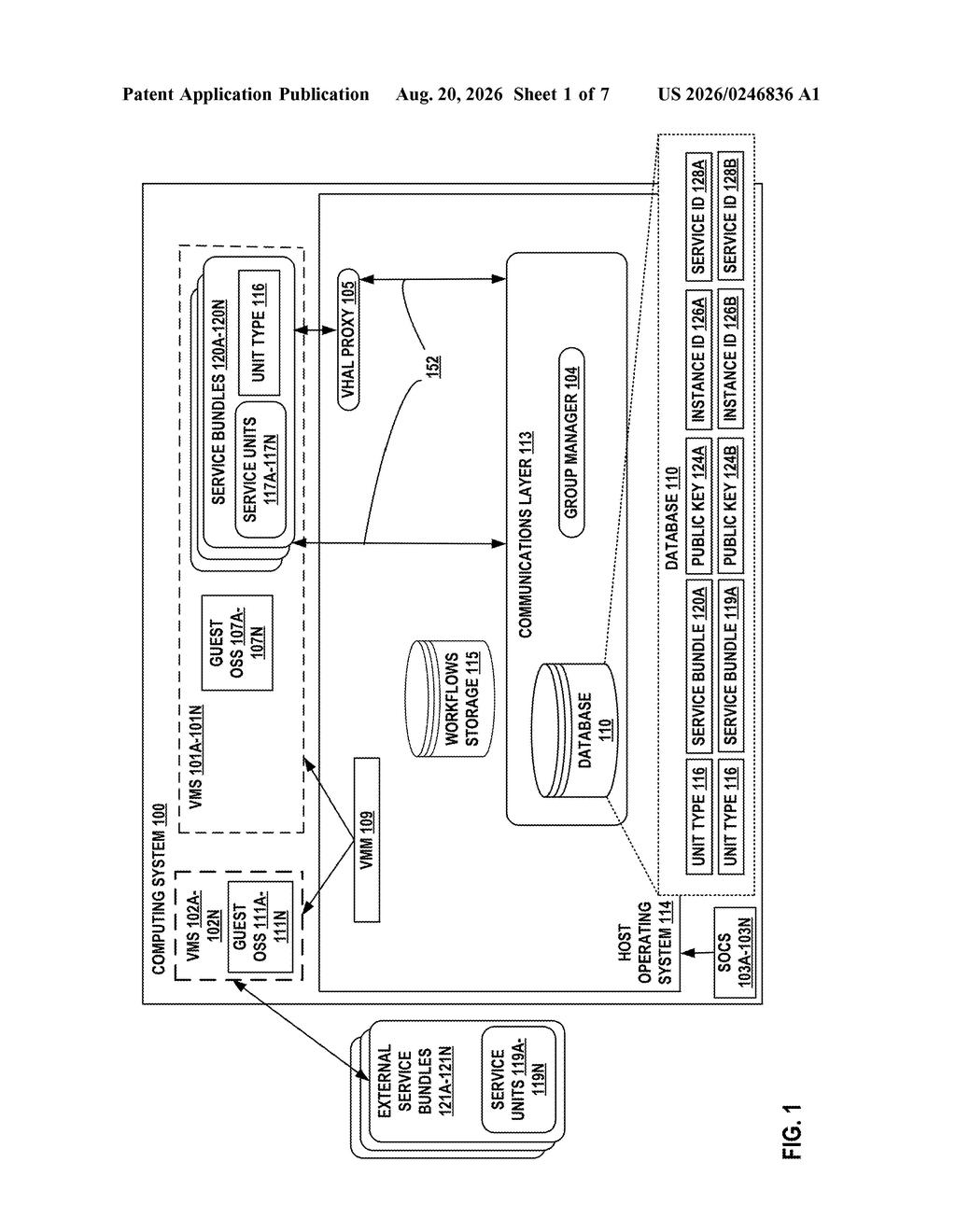
The patent describes a software-defined vehicle (SDV) architecture built around a leaderless group of trusted independent systems. Unlike a traditional car computer where one master controller tells everything else what to do, each module here is a peer. Every member of the group maintains its own authoritative record of what services it provides, and there is no central server that could go down and take everything else with it.
When the car needs to execute a task, say, combining sensor data with mapping to plan a route, it follows a workflow defined as a directed acyclic graph (think of it as a flowchart where each step depends on previous ones but never loops back). Each step in the flowchart corresponds to a unit type, a category of service rather than one specific program.
Instead of hard-wiring which program handles each step, the system uses service discovery: it broadcasts a query at runtime (meaning: while the car is actually running) asking, 'Is there anything available that can do this job?' Whatever module responds gets assigned the task. This makes the system adaptive to software updates, hardware changes, or partial failures.
Security works through a network tap and packet filter (a lightweight monitor that watches all network traffic inside the car and checks message origins). The system maps each operating system process to a verified SDV service identity, so a rogue or compromised module cannot impersonate a trusted one. Communication between services is only permitted after that identity check passes.
… providing, by the operating system, and to a communications layer, and based on a first unit type from the plurality of unit types, a query, wherein the first unit type is associated with a first node from the plurality of nodes, and wherein the query includes a request to discover at least one available implementation of the first unit type; …
Translation: The car software searches the network in real time to find which computer is currently available to handle a specific job.
What this means for software-defined vehicles and car security
For drivers, the practical promise here is a car that degrades gracefully instead of crashing hard. Today's vehicle software is often tightly coupled, meaning a bug in one module can lock up unrelated systems. Google's architecture treats each service as replaceable at runtime, which is how cloud software has worked for years but has rarely made it into vehicles in a formal, patented form.
The security angle is equally important. As cars connect to more external services, the attack surface grows. Tying every internal message to a verified process identity is a real countermeasure, not just a design philosophy. Google's automotive software ambitions are a recurring topic in Big Tech patent news, and this filing shows the company thinking carefully about how vehicle software infrastructure should be built from the ground up, not retrofitted.
Google's 591st filing we've tracked since May joins earlier applications like shrinking AI model data and recreating street views from new angles in our Google coverage.
Car software recalls cost automakers billions every year. The root cause is that most cars today run on one central computer, and when that system breaks, the failure spreads everywhere and is a nightmare to fix.
This patent proposes splitting control across many small computers that vote and agree with each other, the same way servers in big internet companies do. No single unit is in charge, so one failure does not take down the whole car.
Whether technology built for office server rooms can handle the split-second timing a moving vehicle demands is a real and open question. But the problem is large enough that the ambition is justified.
Get our take in your Top Stories
Liked this breakdown? Add Patentlyze as a preferred source on Google, and our plain-English take shows up more often in your Top Stories the next time Google patent news breaks.
There are more where this came from
We read every patent application Big Tech publishes and send you the ones worth knowing. Plain English, free, every week.
The drawings
7 drawing sheets from US 2026/0246836 A1 · click any drawing to enlarge


Want this weekly breakdown for a company we don't cover? Patentlyze Pro →
Be the first to weigh in