
Apple Patents Location-Aware Power Control for Air-to-Ground Cellular Networks
When your phone is cruising at 35,000 feet, it faces a completely different radio environment than on the ground — and Apple has a patent for making that handshake smarter from the very first transmission.
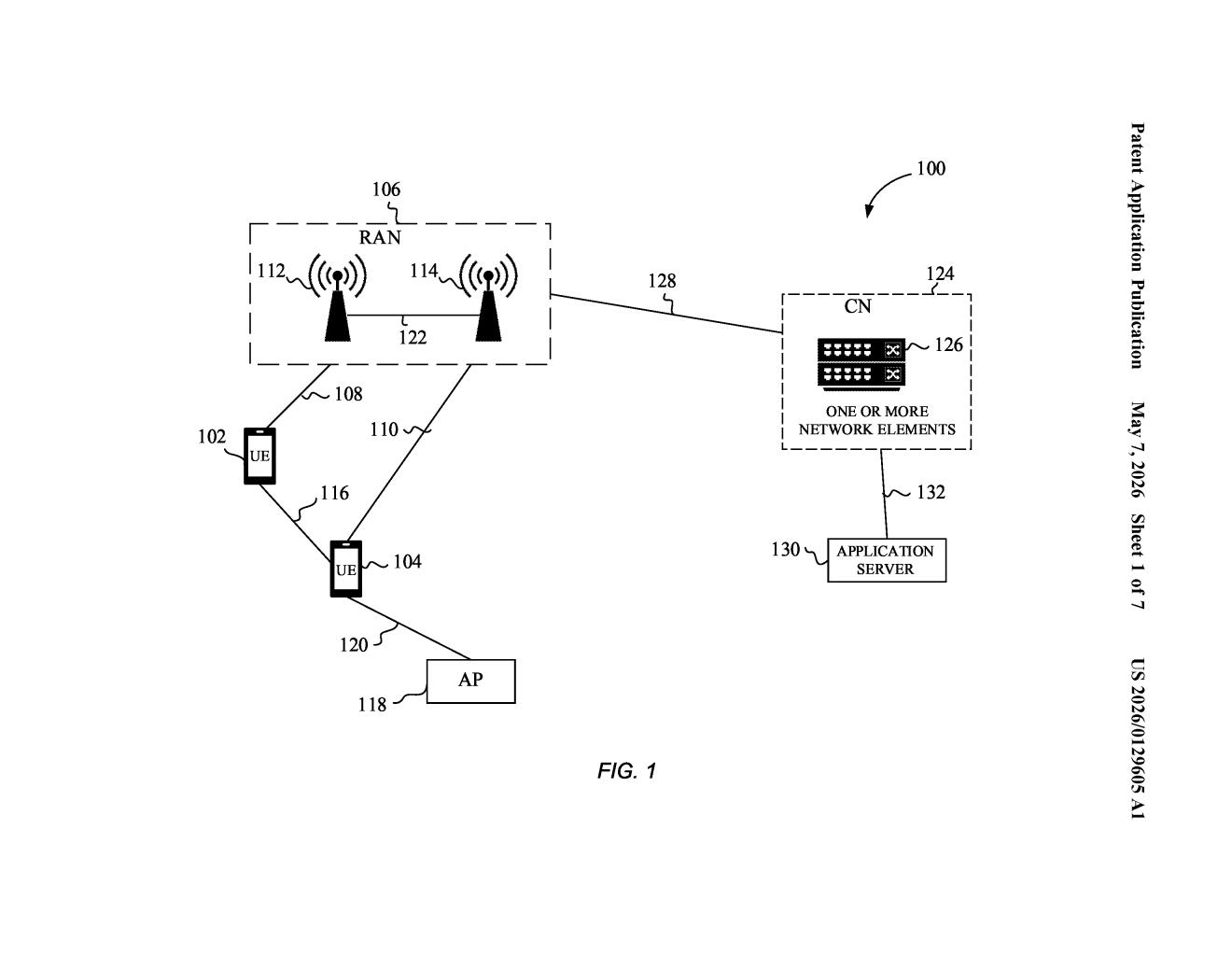
What Apple's ATG power control patent actually does
Imagine you're on a flight and your iPhone tries to connect to a cell tower on the ground below. Unlike a phone on a street corner, you're miles away, moving fast, and at a steep angle relative to the tower. If your phone just guesses how loud to transmit, it either wastes battery blasting too hard or fails to connect because it started too quiet.
Apple's patent describes a system where the base station tells your device where it is and, crucially, how its antenna beam is shaped. Your phone then uses its own GPS position, the tower's location, and that beam shape to calculate a smart starting power level before it even sends its first signal.
This process is called open loop power control — it's the phone's best initial guess before any feedback comes back from the network. By baking in real geometry, the phone can make a much better first guess, which speeds up connection and reduces unnecessary radio emissions.
How location and antenna patterns set transmit power
The patent targets ATG (Air-to-Ground) UEs — that is, user equipment like iPhones or cellular modems operating aboard aircraft and connecting to ground-based towers rather than satellites.
Open loop power control (the "open loop" means the device sets power without waiting for real-time feedback from the network) is the standard starting point for any uplink transmission. Normally it relies on generic path-loss estimates, but those models assume roughly flat, isotropic antenna patterns — a terrible assumption for a tower pointing mostly upward to catch aircraft at shallow approach angles.
The system works in three steps:
- The base station broadcasts its GPS coordinates and its antenna gain pattern (a map of how much signal strength the antenna radiates in each direction)
- The UE determines its own position, most likely via onboard GPS
- The UE computes the geometric relationship — angle, distance, and which part of the tower's beam pattern it falls into — then derives the correct initial transmit power
The key insight is that a ground tower's antenna gain varies dramatically with elevation angle. A device almost directly overhead gets hit with a very different signal than one at the horizon, and the uplink power needs to account for that asymmetry precisely.
What this means for in-flight iPhone connectivity
In-flight cellular connectivity via ATG networks (think Gogo 5G or similar ground-based aviation services) is a growing market, and Apple's iPhones and iPads are the dominant passenger devices. Smarter open loop power control means faster initial attach times, less interference to neighboring cells on the ground, and better battery efficiency during flight — all of which matter when the radio environment is as unusual as a fast-moving aircraft several miles up.
For Apple specifically, this kind of low-level modem optimization becomes more strategically important as the company deepens its in-house cellular silicon work. Owning the full stack — from the application layer down to transmit power decisions — is exactly the kind of vertical integration Apple has been building toward.
This is a narrow but technically solid patent in a real niche: ATG cellular is a legitimate and expanding deployment scenario, and the open loop power control problem for airborne UEs is genuinely underspecified in current standards. It's not flashy modem research, but it's exactly the kind of incremental systems work that separates a good in-house modem from a great one.
There are more where this came from
We read every patent application Big Tech publishes and send you the ones worth knowing. Plain English, free, every week.
Want this weekly breakdown for a company we don't cover? Patentlyze Pro →