
Apple Patents a Cleaner Wi-Fi Roaming Handoff Protocol for Multi-Link Devices
Walking from your living room to your kitchen shouldn't cause your Wi-Fi call to stutter — but handoffs between access points still often do. Apple is patenting a new signaling protocol designed to make that transition cleaner on next-generation multi-link Wi-Fi networks.
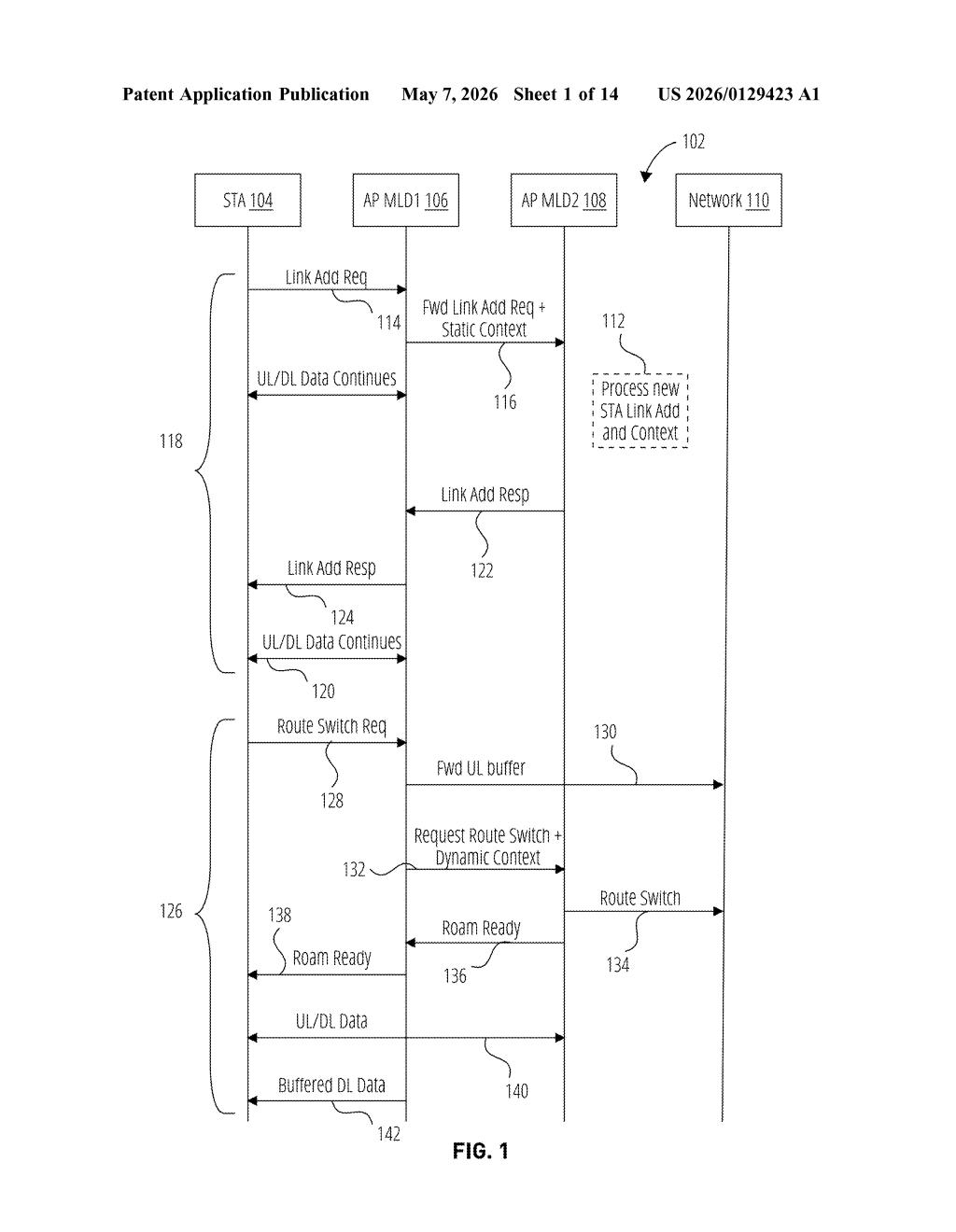
What Apple's MLMD roaming signaling actually does
Imagine you're on a video call at home and you walk from one room to another. Your phone has to switch from one Wi-Fi access point to a closer one — a process called roaming. On most home and enterprise networks, that switch can cause a brief but annoying hiccup.
Apple's patent describes a new way for your device to proactively kick off that handoff using a structured message called an MLMD link add request. Your device tells your current access point, "Hey, I want to connect to that other access point over there" — and the two access points coordinate the transition behind the scenes while your data keeps flowing.
This is specifically designed for Multi-link Multi-device (MLMD) Wi-Fi setups — the kind of multi-radio, multi-band architecture at the heart of Wi-Fi 7. The goal is to keep your upload and download streams alive throughout the switch, rather than dropping and reconnecting.
How the MLMD link-add request-response cycle works
The patent defines a specific frame format — basically a structured packet — that a device (called a STA, or station, which is your phone, laptop, or tablet) sends to its current access point to initiate a roam.
The MLMD link add request carries two key pieces of information: a target AP MLD identifier (which tells the origin access point which new access point to hand off to) and a configuration field (which carries roaming-specific settings like link preferences or security context).
The origin AP MLD (Access Point Multi-Link Device — a modern Wi-Fi 7 access point that can operate across multiple frequency bands simultaneously) then sends back an MLMD link add response, completing the negotiation. According to the patent's figures, the process also involves:
- Forwarding the link add request to the target AP
- Transferring static context (saved session info so you don't have to fully re-authenticate)
- Buffering uplink and downlink data during a brief route switch phase
- Resuming full data flow once the new link is established
The distinction between static context (transferred early) and dynamic context (transferred at the moment of the route switch) is a notable design choice — it's meant to minimize the window where your data is in limbo.
What this means for Wi-Fi 7 roaming in your home or office
Wi-Fi 7's multi-link operation (MLO) is a big deal — it lets a single device maintain simultaneous connections across the 2.4 GHz, 5 GHz, and 6 GHz bands. But the roaming story for MLO networks has been underspecified in standards discussions. Apple is essentially proposing a formal handshake protocol for how devices should negotiate a roam in that environment, which could influence how this gets standardized in IEEE 802.11be and successor specs.
For you as a user, this matters most in mesh Wi-Fi setups — like Eero, Google Nest Wifi, or Apple's own AirPort legacy — and in enterprise environments with dozens of access points. Seamless roaming is one of those invisible quality-of-life features that, when it works, you never notice. When it doesn't, you blame the network.
This is fairly deep infrastructure work — the kind of thing that gets debated in 802.11 working groups rather than keynotes. But Apple filing on specific MLMD frame formats is notable because it signals they're building proprietary roaming logic on top of the Wi-Fi 7 multi-link foundation, not just waiting for the standards body to figure it out. Whether this ends up in a future Airport revival, HomePod networking features, or just better iPhone handoffs in enterprise settings, it's worth tracking.
There are more where this came from
We read every patent application Big Tech publishes and send you the ones worth knowing. Plain English, free, every week.
Want this weekly breakdown for a company we don't cover? Patentlyze Pro →