
Nvidia Patents a Speech Recognizer That Outputs Multiple Transcript Formats at Once
Most speech recognition systems give you one transcript. Nvidia's new patent describes a single model that listens once and hands back several differently formatted versions at the same time, which could save significant compute time for anyone building voice-powered tools.
What Nvidia's multi-format transcription system actually does
Imagine you record a meeting and need three things from it: a quick, unpunctuated text dump for a search index; a properly capitalized, comma-and-period version for a document; and a speaker-by-speaker breakdown for a summary email. Today, you'd often run the audio through a transcription engine multiple times, or post-process one raw transcript in multiple ways.
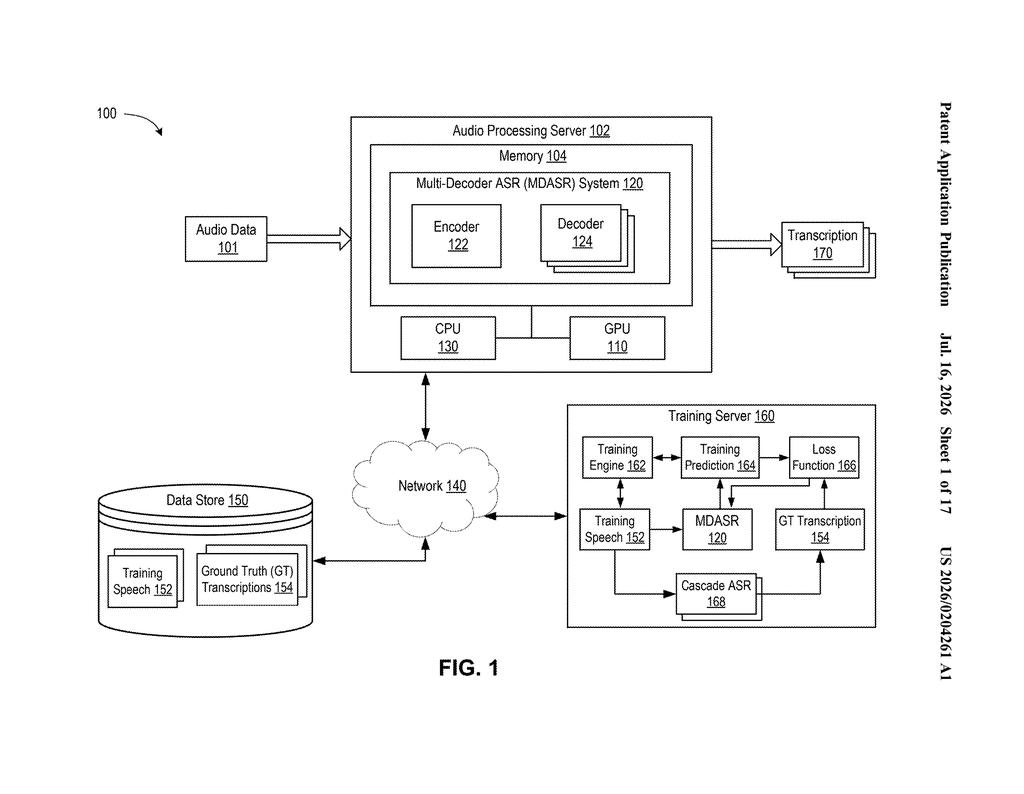
Nvidia's patent describes a system that does all of that in a single pass. The model listens to the audio once, builds an internal representation of what was said, then sends that representation to several specialized "decoders" at the same time. Each decoder produces its own formatted version: one might capitalize properly and add punctuation, another might strip everything down to bare words, and a third might label each speaker's turns separately.
The practical upside is speed and consistency. Because all the versions come from the same internal reading of the audio, they won't contradict each other. And running one model once costs less time and computing power than running several models back to back.
How one audio pass feeds several transcript decoders
The system has two stages. First, an encoder processes the incoming audio frames and converts them into a compact numerical representation called embeddings (think of embeddings as a dense summary of everything the model heard, capturing words, rhythm, and context all at once).
Second, a set of multiple decoders all read those same embeddings in parallel. Each decoder is trained to produce a transcript that follows a specific text format. According to the patent, formats can differ in:
- Capitalization (all lowercase vs. Sentence case vs. Title case)
- Punctuation (none, standard, or custom symbols)
- Use of non-alphabet characters (numbers written as digits vs. Words, for example)
- Speaker identification (a single block of text vs. Labeled speaker turns)
Because the decoders share the encoder's output rather than each running their own full audio analysis, the system avoids redundant computation. The patent frames this as a method, an apparatus, and a system, covering both the software approach and hardware implementations, which is consistent with Nvidia's focus on accelerating inference workloads on its GPUs.
What this means for real-time captions and voice tools
For developers building voice features into apps, products like meeting recorders, call-center analytics tools, or accessibility captions often need several transcript flavors. Generating them from a single model run means lower latency and lower cloud compute costs, both of which matter at scale.
For end users, the consistency benefit is real: if your meeting tool shows you a readable summary and also indexes your words for search, those two outputs will agree on what was said, because they came from the same internal model state. That might sound minor, but today's pipelines that chain separate models can produce small but confusing discrepancies. This approach removes that friction.
This is a practical, workmanlike patent aimed squarely at the infrastructure layer of voice AI. It won't make headlines the way a new language model does, but for any company running speech recognition at scale, cutting the number of model passes needed per audio clip is a real cost saving. Nvidia is positioning this as an efficiency play that fits naturally into its GPU-accelerated inference stack.
Get our take in your Top Stories
Liked this breakdown? Add Patentlyze as a preferred source on Google, and our plain-English take shows up more often in your Top Stories the next time Nvidia patent news breaks.
There are more where this came from
We read every patent application Big Tech publishes and send you the ones worth knowing. Plain English, free, every week.
Want this weekly breakdown for a company we don't cover? Patentlyze Pro →