
Qualcomm Patents AI Image Editors That Learn to Self-Correct Editing Strength
When you tell an AI image editor to 'make this photo look like a watercolor painting,' the system has to decide at every single processing step how literally to take that instruction. Qualcomm has filed a patent for a system that learns to make that call automatically rather than using a fixed setting.
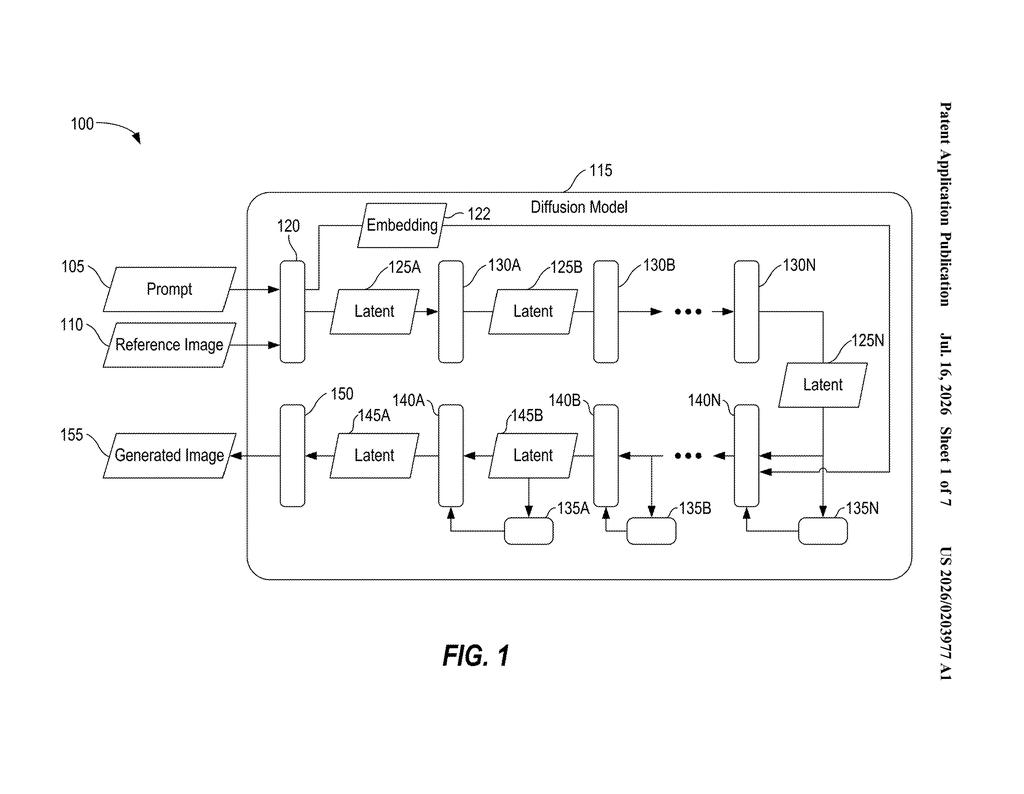
How Qualcomm's self-adjusting image editor works
Imagine you're giving directions to a driver, and instead of setting one speed limit for the whole trip, you could adjust the speed block by block based on traffic conditions. That's roughly what Qualcomm's patent does for AI image editing.
When you type a text prompt to edit a photo, AI image tools today typically apply the same level of "how much should I follow this instruction" throughout the entire editing process. Qualcomm's system instead uses a second, smaller AI to check in at each processing step and decide how closely to follow your text instruction at that moment.
The result is editing that's supposed to feel more accurate and natural, because the system can lean hard on your words when it needs to make a big change, then ease off when it's just refining fine details. Qualcomm trained this using reinforcement learning, where the AI improves by trial and error, like practicing until it gets the balance right.
How the guidance scale shifts at each diffusion step
AI image editors based on diffusion models work by gradually transforming noise into a finished image across dozens of processing steps. At each step, the model balances two signals: what the original image looked like and what your text prompt says to do. The balance between those two signals is controlled by a number called the guidance scale.
Most systems pick one guidance scale and stick with it for the whole process. Qualcomm's patent describes a setup where a secondary AI model, called the guidance machine learning model, looks at the current state of the image at each step (represented as a latent tensor, essentially a compressed numerical snapshot of the image-in-progress) and outputs a freshly calculated guidance scale tailored to that exact moment.
The secondary model is trained using reinforcement learning (a technique where an AI learns by receiving rewards for good outcomes and penalties for bad ones), so it develops a policy for when to push toward the text prompt aggressively and when to hold back.
- Step 1: The system takes a reference image and a text prompt.
- Step 2: At each diffusion step, a small guidance model reads the current latent state and outputs a scale value.
- Step 3: That scale shapes the next processing step, producing a new latent state.
- Step 4: After all steps complete, the final image is decoded from the last latent state.
What this means for on-device AI photo editing
For consumers, a fixed guidance scale is one of the less-visible reasons AI image editors sometimes over-edit or completely ignore your prompt. A system that dynamically tunes its own instruction-following could produce edits that are noticeably more faithful to what you actually asked for without accidentally overwriting details you wanted to keep.
Qualcomm's angle here is on-device AI, running powerful models on phones and laptops rather than in the cloud. A compact guidance model that improves output quality without requiring a much larger diffusion model fits neatly into that strategy. If this approach works at the efficiency levels Qualcomm needs for mobile chips, it could make text-based photo editing a genuinely reliable tool on your phone rather than a party trick.
This is a technically reasonable improvement to a well-known limitation of diffusion-based image editing, and the reinforcement learning angle is a legitimate way to solve it. The patent is fairly narrow in scope and reads like exploratory research rather than an announcement of an imminent product feature. It matters to engineers building on-device image tools, but general readers can safely wait to see whether it shows up in something shipping.
There are more where this came from
We read every patent application Big Tech publishes and send you the ones worth knowing. Plain English, free, every week.
Want this weekly breakdown for a company we don't cover? Patentlyze Pro →