
IBM Patent Covers AI That Retrieves Real Code Examples Before Generating Output
Most AI coding tools generate code from scratch, purely from pattern memory. IBM's patent describes a system that first searches a library of real, paired examples before putting pen to paper, the way a good developer might look up a known solution rather than reinventing one.
What IBM's code-retrieval AI actually does
Imagine asking a colleague to write a function that sorts a list of customer names. Instead of working purely from memory, a smart colleague might first flip through a notebook of solved problems, find one that's close enough, and use it as a starting point. IBM's patent describes an AI coding system that works exactly that way.
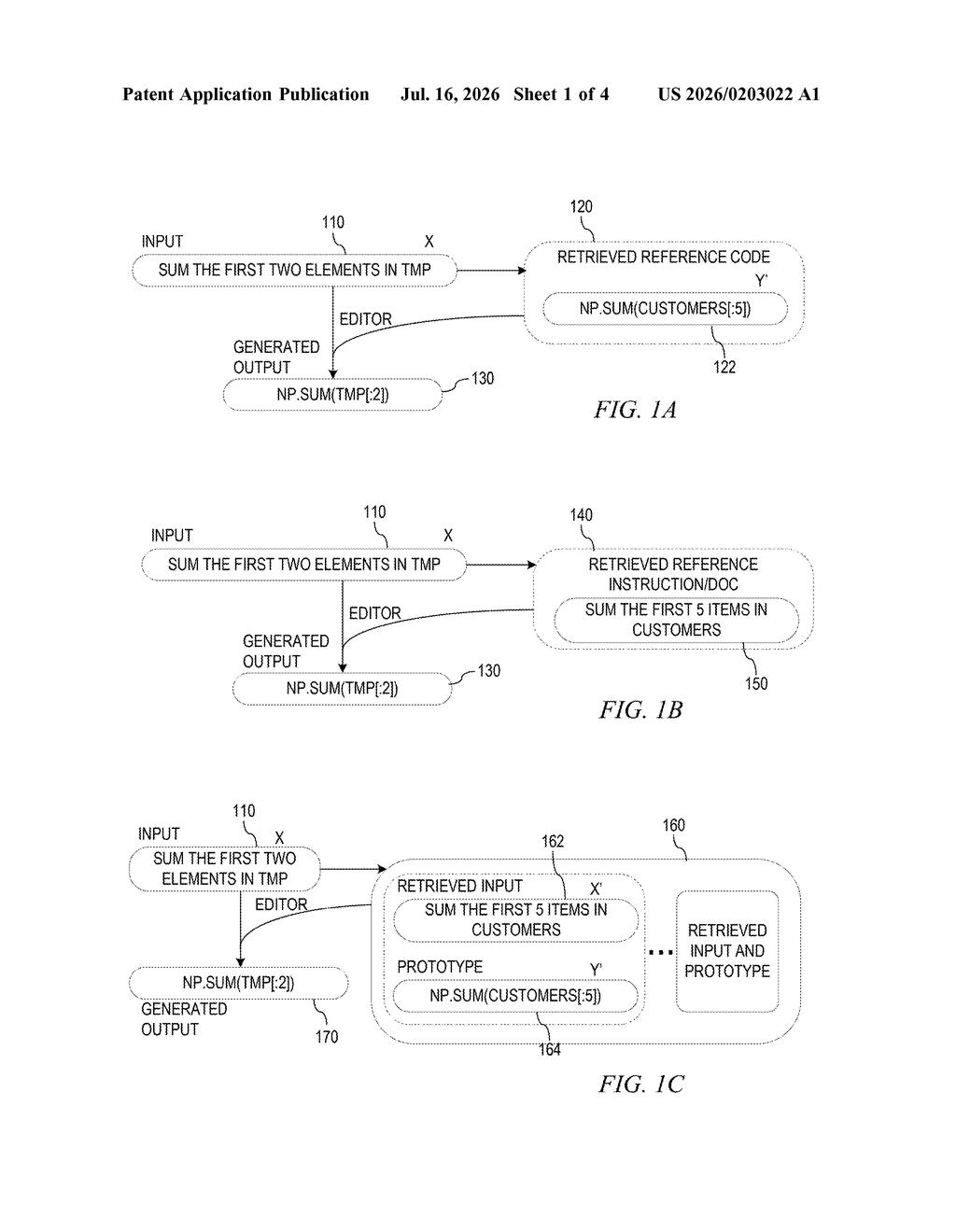
The system keeps a library of paired entries: each entry has a plain-English description of what a piece of code does, alongside the actual code that does it. When you describe what you want in plain English, the system finds the closest match in that library and uses it to guide the code it writes for you.
The result is code that's grounded in real, proven examples rather than generated purely from the AI's training instincts. That retrieval-first approach is meant to reduce hallucinated or buggy output, which is one of the most common complaints about today's AI coding tools.
How the encoder matches descriptions to code snippets
The patent describes a technique called retrieval-augmented code generation (think of it as giving the AI a reference book to consult before answering).
Here's the pipeline the system runs through:
- Build a retrieval pool: Before anything else, the system assembles a large collection of paired data samples. Each sample ties a plain-text description (for example, 'sort a list in descending order') to an actual code snippet that performs that task.
- Encode the request: When a developer types in what they want in plain English, an encoder (a neural network layer that converts text into a list of numbers representing meaning) converts that request into a compact numeric representation called an encoding.
- Search and rank: The system compares that encoding against the encodings of every description in the retrieval pool, finds the closest matches, and surfaces the most relevant candidate examples.
- Generate output: The selected candidate, the retrieved real-world code snippet and its description, is fed alongside the original request into a code-generation model, which produces the final output code.
This multi-source framing means the generator draws on both what it learned during training and on a curated, searchable bank of examples, giving it two inputs instead of one.
What this means for AI coding assistants
The biggest practical problem with AI code generators today is that they can produce code that looks plausible but is subtly wrong. By anchoring output to a library of verified, paired examples, IBM's approach adds a concrete reference point that the model has to stay close to, which could reduce the rate of confidently wrong answers.
For enterprise software teams, where IBM sells most of its developer tools, that reliability gap is a real blocker to adoption. If this approach ships in something like IBM's watsonx Code Assistant, it could make AI pair-programming feel more trustworthy for production use cases where a hallucinated function can cost real money.
Retrieval-augmented generation is already well-established for text tasks, so applying the same pattern to code generation is a natural and sensible move rather than a surprise. IBM's filing is solid engineering work aimed squarely at a real problem, but it's incremental territory that Google, Microsoft, and several startups are already exploring. The interesting detail to watch is whether IBM's pairwise pairing approach, matching text descriptions directly to code rather than to documentation or commit messages, gives it a meaningful accuracy edge.
There are more where this came from
We read every patent application Big Tech publishes and send you the ones worth knowing. Plain English, free, every week.
Want this weekly breakdown for a company we don't cover? Patentlyze Pro →