
Salesforce Patents a System Where AI Programs Adjust Each Other's Responses Automatically
Most AI agents run on a fixed set of instructions from start to finish. Salesforce's new patent describes a system where a separate AI agent watches what another agent says and reshapes how that agent behaves before passing its output along.
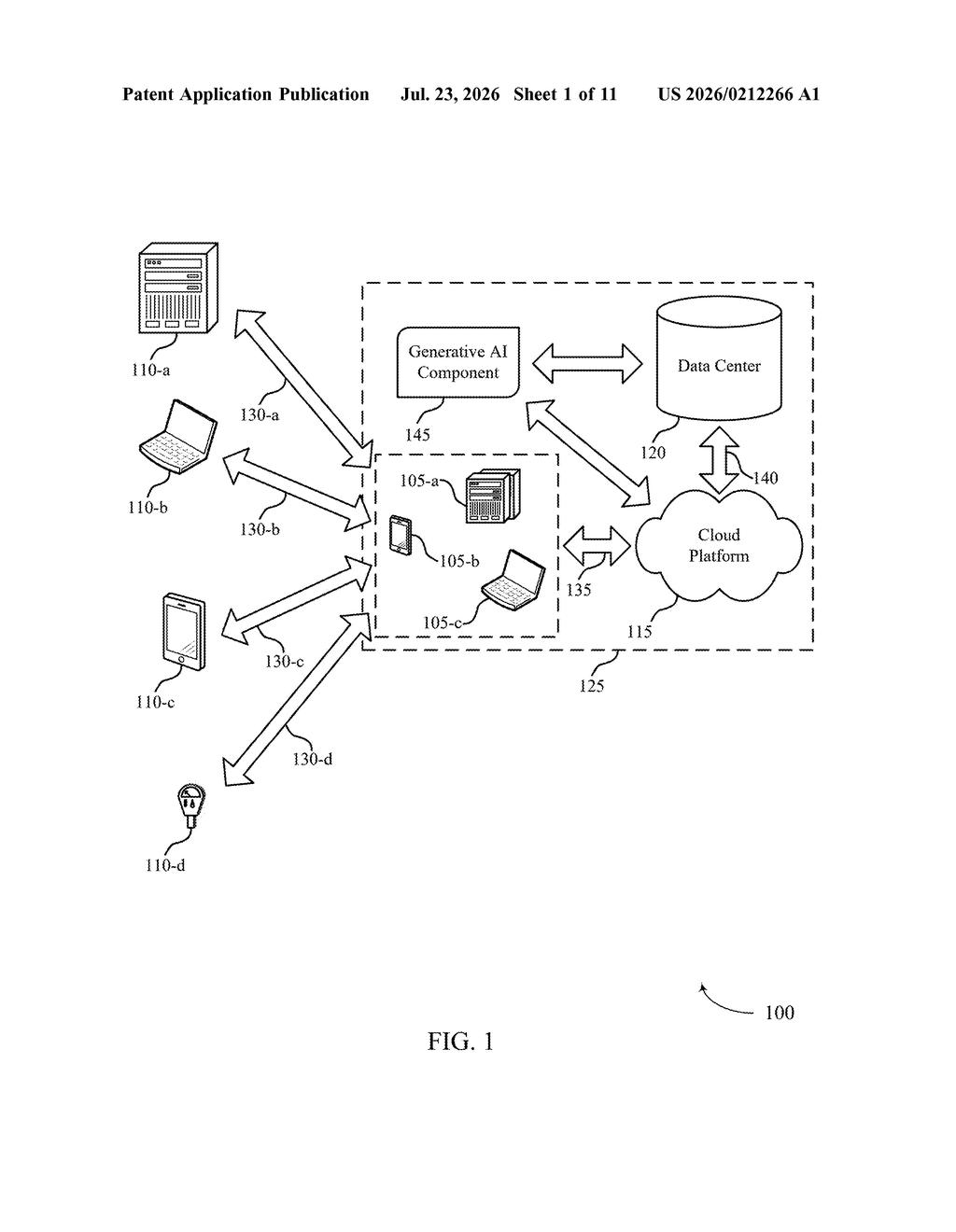
How Salesforce's AI agents adjust each other's behavior
Imagine you have two employees on a relay team. Before the first one hands off their work to the second, a third employee reviews the handoff note and decides whether the first employee needs to adjust their tone, style, or priorities for the next task. That's roughly what this patent describes, except all three employees are AI agents.
Salesforce is patenting a setup where one AI agent (call it the "watcher") monitors what a primary AI agent produces. If the watcher decides the content needs something different, it triggers a switch that changes how the primary AI is tuned. Only then does the output get passed to a second AI agent downstream.
Once the handoff is complete, the primary AI snaps back to its original settings. This creates a temporary, content-aware adjustment that happens automatically in the middle of a workflow, without a human needing to step in.
How the control agent triggers the weight switch
The patent describes a three-agent architecture running inside a cloud-based large language model (LLM) service.
- Agent 1 (the worker) generates content using its assigned prompt and configuration.
- Agent 3 (the controller) is configured with the same prompt as Agent 1 and runs in parallel, evaluating the content Agent 1 just produced.
- Agent 2 (the recipient) waits downstream to receive Agent 1's output.
When Agent 3 reviews Agent 1's output, it issues a control message that includes an indication, essentially a signal saying the content qualifies for a different mode. The system then switches the parameter weights (the internal tuning values that control how the model behaves) applied to the underlying LLM from one preset configuration to another.
Only after that weight swap happens does Agent 1's message get forwarded to Agent 2. Once the forwarding is complete, the weights flip back to their original values. The whole adjustment is temporary, automatic, and triggered by the content itself rather than by a human or a static rule. The patent frames this as a way to give LLM-powered cloud services finer control over multi-agent workflows without rebuilding the underlying model.
What this means for enterprise AI agent pipelines
For companies building AI-powered workflows on platforms like Salesforce's Einstein or Agentforce, this kind of dynamic adjustment matters because most current multi-agent setups are static: each agent gets its instructions at the start and keeps them until the task is done. Content-triggered retuning means the system can adapt mid-stream to what's actually happening in a conversation or a task pipeline.
For enterprise users, this could translate to AI workflows that automatically shift how they respond based on the type of request or the content of a message, without needing separate hardcoded rules for every scenario. It also raises questions about predictability: if the model's behavior can change mid-task based on what it just said, that introduces new complexity for anyone trying to audit or debug an AI workflow.
This is a genuinely interesting structural idea for multi-agent AI systems, and Salesforce is in a strong position to implement it given how deeply its enterprise customers rely on agent-based automation. The patent is narrow enough to be defensible and broad enough to matter, though whether this is actually novel compared to existing multi-agent orchestration techniques will be the real question at examination.
There are more where this came from
We read every patent application Big Tech publishes and send you the ones worth knowing. Plain English, free, every week.
The drawings
11 drawing sheets from US 2026/0212266 A1 · click any drawing to enlarge


Want this weekly breakdown for a company we don't cover? Patentlyze Pro →