
New Patent Cuts Cost of Training AI Search Models
Training the AI that ranks your search results and YouTube recommendations is expensive, Google's latest patent describes a shortcut that reuses old work instead of recomputing everything from scratch at each step.
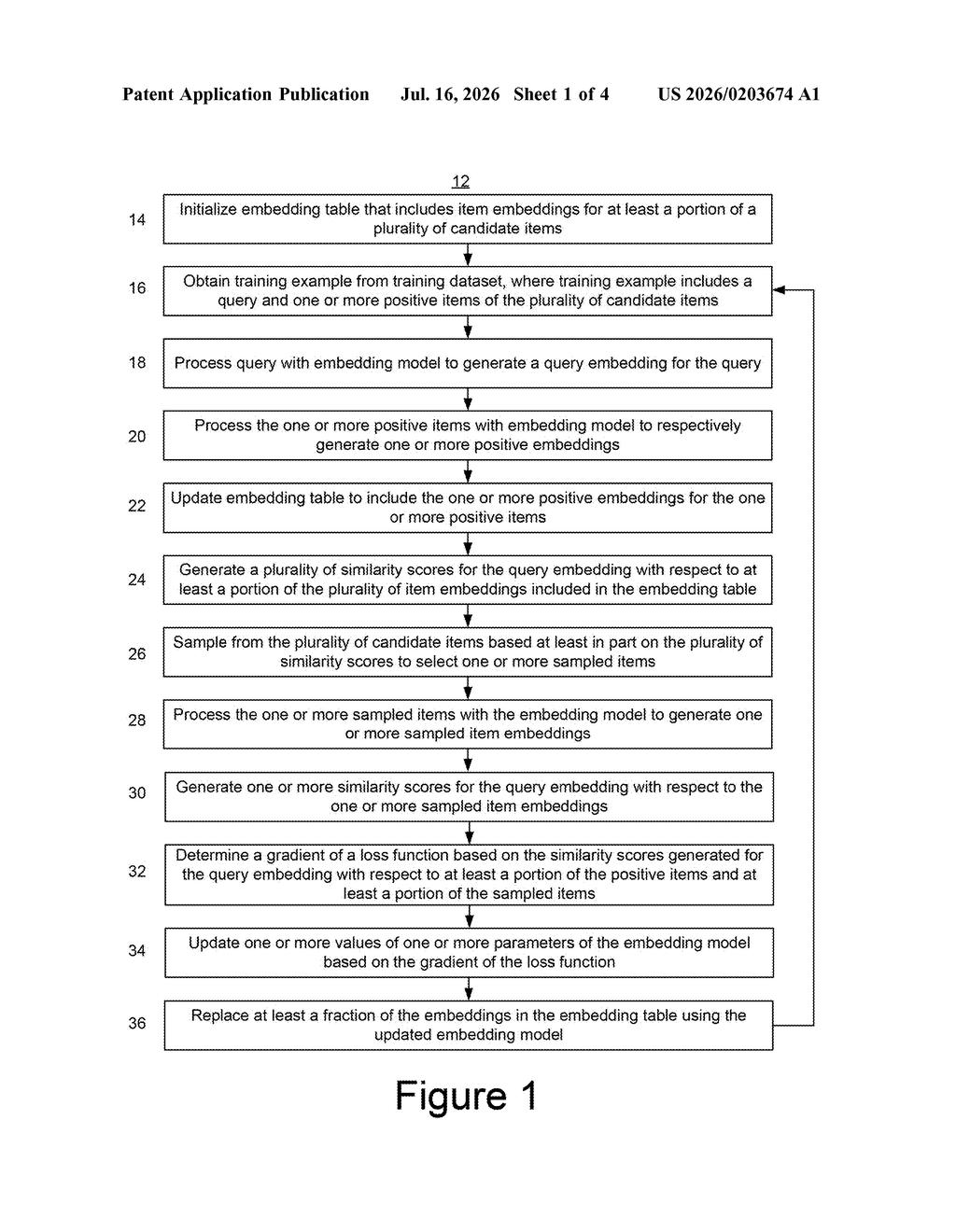
How Google's cached embeddings speed up AI training
Imagine a student studying for an exam who keeps re-reading the same textbook chapters they already know cold, instead of focusing on the tricky parts they keep getting wrong. AI training has a similar problem: to teach a model what bad matches look like, you normally have to recompute a huge pile of comparisons at every single training step, which burns through a lot of computing power.
Google's patent describes a smarter approach: keep a cache (a saved list) of recent comparison data, and reuse it across multiple training rounds instead of throwing it away each time. The cached data might be slightly out of date, but the patent argues that's fine. The model can still learn effectively from it while only doing fresh, expensive calculations for a small set of the most useful examples.
The end result is an AI model that learns which search results or recommended videos are relevant to you, but trained at a fraction of the usual computing cost.
How the negative cache and Gumbel-Max sampling work together
The patent covers training systems that use embedding models (AI models that convert things like search queries and web pages into lists of numbers, called vectors, so the system can compare them mathematically). Teaching these models requires showing them lots of negative examples (items that are not a good match for a query), so the model learns to distinguish good results from bad ones.
Normally, generating useful negative examples means recomputing vectors for a massive pool of candidate items at every training step. Google's approach instead stores a negative cache: a running bank of pre-computed item vectors from earlier training rounds. These are called stale embeddings because they were produced by an older version of the model, not the current one.
At each training step, the system uses those cached vectors to calculate rough similarity scores across the entire candidate pool. It then applies a technique called Gumbel-Max sampling (a mathematical method for picking random items weighted by how informative they are) to choose which negative examples are worth computing fresh. Only that smaller selected set gets fully recomputed with the current model.
- Cache stores item vectors from previous training rounds
- Gumbel-Max sampling picks the most informative negatives from the cache
- Fresh vectors are computed only for the selected items
- The model is updated using those fresh vectors, and the process repeats
What this means for Google Search and recommendation costs
The practical target here is any Google system that matches a query to a giant pool of candidates: Search, YouTube recommendations, Google Play app suggestions, Google Shopping. Training those models at scale requires enormous compute clusters running for days or weeks. A method that meaningfully reduces how much work each training step requires has real cost implications, and could also let Google iterate on its models faster.
For you as a user, the downstream effect would be that Google's ranking models could be updated more frequently or trained on more data without a proportional spike in server costs. That's not something you'd ever notice directly, but it's the kind of infrastructure improvement that shapes how relevant your search results feel over time.
This is an infrastructure patent, not a consumer-facing feature, but it's not trivial. Negative sampling efficiency is a genuine bottleneck in training large-scale retrieval models, and Google's researchers have published credible academic work in this area. This patent is essentially the productized form of that research. It matters more to ML engineers than to anyone reading their news feed.
There are more where this came from
We read every patent application Big Tech publishes and send you the ones worth knowing. Plain English, free, every week.
Want this weekly breakdown for a company we don't cover? Patentlyze Pro →
Be the first to weigh in