
Google Patents a Handwriting System That Turns Your Shorthand Into Full Words
Instead of writing out every letter of every word by hand, Google wants you to jot quick abbreviations and let AI fill in the rest. Think of it as autocomplete, but for handwriting.
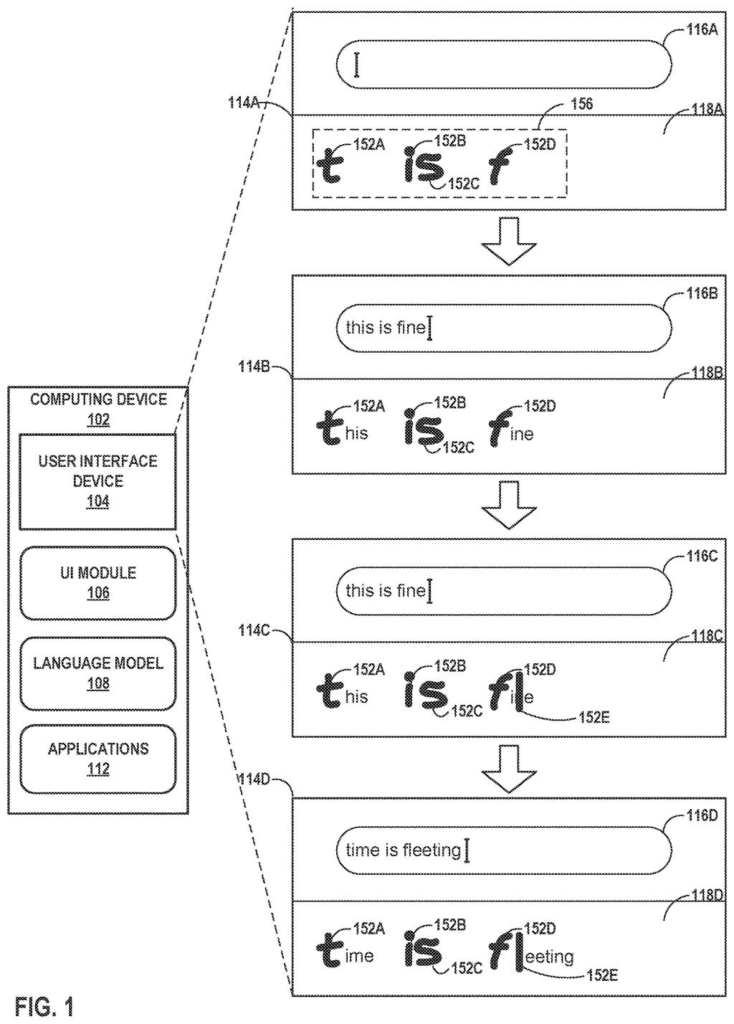
What Google's abbreviation-to-word handwriting idea actually does
Imagine writing a quick note on your tablet. Instead of carefully spelling out "appointment" or "presentation," you just scrawl "appt" and "prstn" and let the software figure out what you meant. That's the core idea here.
Google's patent describes a system where you write abbreviated versions of words with a stylus or your finger, and a built-in AI reads those abbreviations in context and suggests the full words you were probably going for. It considers the whole sequence of abbreviations together, so the surrounding words help it pick the right match when one abbreviation could mean several things.
The suggestions then pop up on screen for you to confirm or adjust, similar to how your phone's keyboard suggests words as you type. The difference is that it works with freehand writing, not tapping keys.
How the language model matches abbreviations to candidate words
The patent describes a three-step pipeline built on top of a language model (the same kind of AI that powers predictive text on smartphones).
- Input capture: The device records a sequence of handwritten characters, which may be incomplete abbreviations rather than fully spelled-out words.
- Contextual expansion: A language model processes the entire sequence of abbreviations together, using surrounding context to resolve ambiguity. For example, "dr" next to "appt" is more likely "doctor" than "drive" or "drawer."
- Candidate display: The system surfaces a list of candidate words on screen, letting the user pick the right one or continue writing.
The key technical detail is that the model evaluates abbreviations as a sequence, not individually. This means the probability of each word expansion is influenced by the words around it, which is how natural language models already work for typed text. Applying that same logic to handwritten shorthand is the novel step here.
What this means for stylus and tablet text input
Handwriting input on tablets and stylus devices has always had a friction problem: you have to write carefully and completely, or recognition breaks down. Speed-writers who naturally drop vowels or truncate words get poor results. This patent targets exactly that gap, making fast, sloppy, abbreviated handwriting a viable input method rather than a source of errors.
For Google, this fits naturally into Pixel Tablet, Android stylus support, and Workspace productivity tools. If it ships, you could take meeting notes in rapid shorthand and have the device expand them into readable text in real time, without slowing down to write every letter.
This is a genuinely practical idea aimed at a real frustration with stylus input. It's not flashy, but anyone who has tried to take fast handwritten notes on a tablet and ended up with a screen full of misrecognized gibberish will immediately understand why this matters. The hard part will be accuracy when abbreviations are highly ambiguous, and that will come down entirely to how good the underlying language model is.
There are more where this came from
We read every patent application Big Tech publishes and send you the ones worth knowing. Plain English, free, every week.
The drawings
13 drawing sheets from US 2026/0219740 A1 · click any drawing to enlarge


Want this weekly breakdown for a company we don't cover? Patentlyze Pro →
Be the first to weigh in