
Sony Patent Targets Flicker Noise Filtering in Event-Based Vision Sensors
Event-based cameras are among the most promising sensors in computer vision, but artificial lighting makes them noisy in a very specific, predictable way. Sony thinks it has found a clean fix.
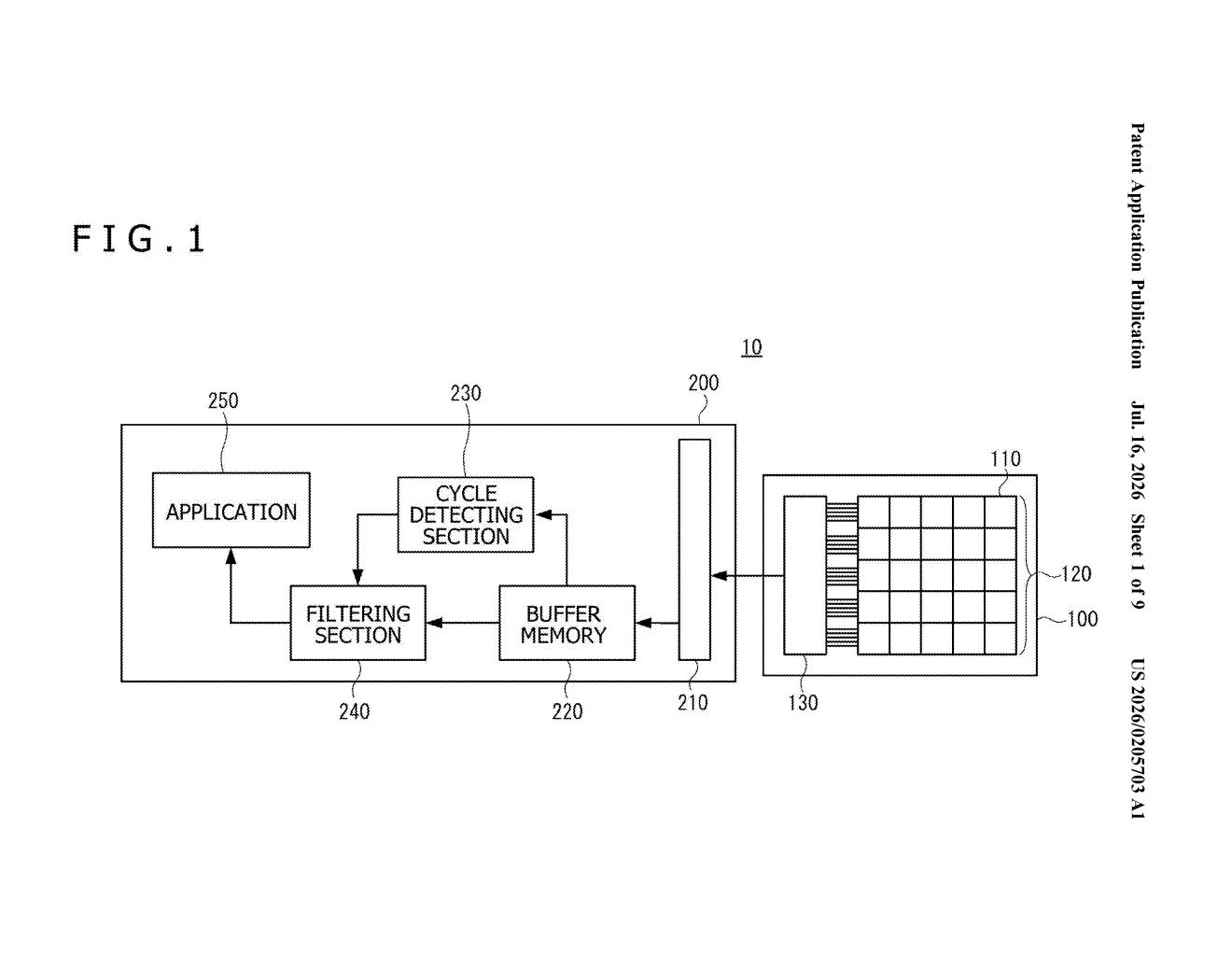
What Sony's event-camera flicker filter actually does
Imagine a super-fast camera that doesn't take regular photos but instead notices the exact moment any pixel gets brighter or darker. That's an event-based vision sensor, and it's much faster and more power-efficient than a normal camera. The catch: indoor lights flicker at a fixed rate (usually tied to your mains power frequency), and that flicker shows up as a constant stream of fake 'something changed' signals the sensor can't ignore on its own.
Sony's patent describes a circuit that watches the rhythm of those incoming signals. If a pixel keeps alternating between 'brighter' and 'darker' in a perfectly regular cycle, the circuit recognizes that pattern as flicker noise rather than real motion, and filters it out.
The result is a cleaner stream of data showing only genuine movement in the scene, without the constant background buzz of flickering fluorescent or LED lights. For applications like gaming peripherals, robotics, or AR headsets, that's the difference between a sensor that works reliably indoors and one that doesn't.
How the circuit detects and strips repeating flicker patterns
An event-based vision sensor (EVS) works differently from a regular camera. Instead of capturing full frames at fixed intervals, each pixel fires independently the instant it detects a change in light, outputting a tiny packet called an event signal that records the pixel location, the timestamp, and the polarity (whether the brightness went up or went down).
The problem is that artificial lighting flickers at a fixed frequency, typically 50 or 60 Hz depending on the country. That flicker produces a repeating pattern of events: bright, dark, bright, dark, over and over at a predictable rate. To a naive sensor, those look identical to real motion events.
Sony's circuit tackles this by monitoring the ratio of positive-to-negative polarity events per pixel over short time windows. If that ratio oscillates on a consistent cycle, the circuit flags it as periodic flicker rather than scene activity. It then applies a filter to suppress those events, letting only non-periodic signals through.
Key steps in the operation:
- Accumulate event signals per pixel over fixed time periods
- Compute the polarity ratio (how many 'brighter' vs 'darker' events) for each window
- Detect whether that ratio follows a repeating time cycle
- Filter out events from pixels whose ratio matches that flicker cycle
What this means for gaming cameras and motion sensing
Event-based cameras are already appearing in robotics, drones, and high-end motion-capture setups, and Sony has made clear it sees them as a future input device for gaming and mixed-reality hardware. Flicker noise is one of the main reasons these sensors struggle in ordinary office or living-room lighting, so a reliable on-chip filter directly addresses a real barrier to mainstream adoption.
For you as a potential end user, this kind of processing happening inside the sensor circuit means cleaner tracking and fewer false inputs without requiring extra compute power from the host device. Whether Sony is eyeing this for a future PlayStation camera, a VR/AR headset, or a robotics product, the underlying fix is the same: make the sensor trustworthy in the lighting conditions people actually live in.
This is focused, specific engineering work aimed at a genuine problem with event-based sensors. It won't make headlines on its own, but flicker rejection is exactly the kind of unglamorous prerequisite that has to be solved before these sensors can appear in consumer products. Sony filing this under its PlayStation division is the most interesting detail.
There are more where this came from
We read every patent application Big Tech publishes and send you the ones worth knowing. Plain English, free, every week.
Want this weekly breakdown for a company we don't cover? Patentlyze Pro →