
New Patent Speeds Up AI Image Processing by Scanning All Pixels at Once
Every time an AI model looks at an image, it traditionally has to compare every pixel or patch against every other one, a process that gets expensive fast. Nvidia's new patent describes a way to do that work in parallel, spreading it across spatial dimensions instead of grinding through it one pair at a time.
What Nvidia's parallel attention system actually does
Imagine you ask an AI to caption a photo. To understand what's in the image, the AI needs to figure out which parts of the picture relate to each other, the dog's face, its leash, the hand holding it. The way most AI systems do this today is by comparing every region of the image against every other region, which takes a lot of computing power and time.
Nvidia's patent describes a different approach: instead of doing all those comparisons one by one (or all at once in a brute-force way), the system passes information across the image in multiple directions simultaneously, like light spreading out from a source. Each part of the image picks up context from its neighbors as the signal travels, without the AI needing to explicitly compare every possible pair.
The result is a system that can understand the spatial relationships in an image more efficiently, which matters for tasks like object detection, image captioning, translation, and speech recognition tied to visual input.
How multi-dimensional linear propagation replaces pair-by-pair scanning
The patent introduces what Nvidia calls a Generalized Spatial Propagation Network (GSPN), a new kind of attention mechanism designed to replace the standard approach used in transformer-based AI models.
In a typical attention mechanism (the core tool that lets AI models decide what to focus on), the model computes a relevance score between every element in a sequence and every other element. For images, that means comparing every pixel region against every other region. This grows quadratically: double the image size and the computation roughly quadruples. A second approach processes elements one at a time in a chain, which avoids the explosion in compute but can't be parallelized well.
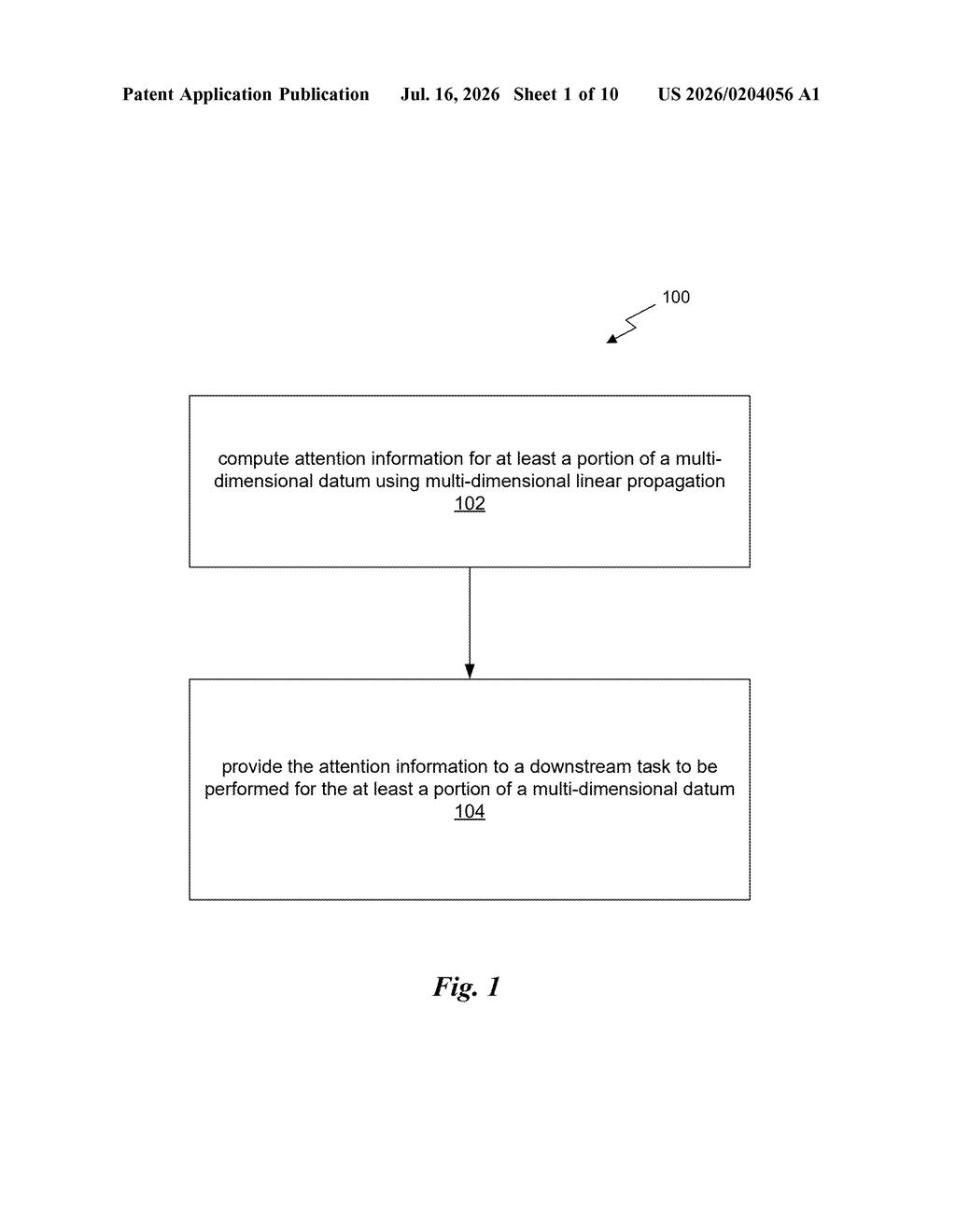
Nvidia's approach uses multi-dimensional linear propagation, meaning information flows across the image in multiple spatial directions at the same time (think: left-to-right, top-to-bottom, and diagonally, all happening in parallel). This lets the model build dense pairwise connections (where every part of the image is still aware of every other part) without explicitly computing each connection from scratch.
The patent's claim covers:
- Computing attention information for multi-dimensional data using this propagation method
- Using that attention information to complete a computer vision task
- Generating an output from that process
Applications listed include image captioning, machine translation, object recognition, and speech recognition.
What this means for AI vision speed and cost
For AI researchers and companies running vision models at scale, the cost of attention computation is a real bottleneck. Models that process high-resolution images or video frames burn through GPU time quickly, and the quadratic scaling of standard attention is a known pain point. A method that keeps spatial awareness intact while reducing that cost is genuinely useful, not just academically interesting.
For Nvidia specifically, this fits neatly into its position as the dominant supplier of AI training and inference hardware. A proprietary attention architecture that runs better on Nvidia GPUs could become a building block in its own AI frameworks, giving customers a reason to stay in the Nvidia ecosystem when building vision models.
This is solid, focused AI infrastructure research rather than a flashy product announcement. The problem it addresses (attention being computationally expensive for spatial data) is real and well-documented, and the propagation-based approach is a credible angle on solving it. Whether it outperforms existing efficient-attention methods like linear attention or state-space models in practice is the real question, but as a patent it stakes out a meaningful position.
There are more where this came from
We read every patent application Big Tech publishes and send you the ones worth knowing. Plain English, free, every week.
Want this weekly breakdown for a company we don't cover? Patentlyze Pro →