
IBM Files Patent for Automating AI Model Workload Distribution Across Processors
When you run a giant AI model across dozens of servers, someone has to decide how to slice it up. IBM wants to let the machine figure that out on its own.
How IBM wants to stop wasting parallel computing power
Imagine you're moving a very long couch through a narrow hallway. You need to figure out exactly where to bend it, and the wrong choice means you're stuck. Running a large AI model across many computers has the same problem: you have to decide how to divide the model into pieces, and a bad split wastes time and money.
Right now, engineers often guess at those splits or rely on rules of thumb. IBM's patent describes a system that treats the splitting decision itself as something the AI can learn to optimize. It looks at the structure of each layer of the model and automatically finds the best number of pieces for each part.
The result is that less human tuning is needed, and the model should run more efficiently across whatever hardware is available. It's essentially using AI to get better at running AI.
How the tuning loop picks the right split for each layer
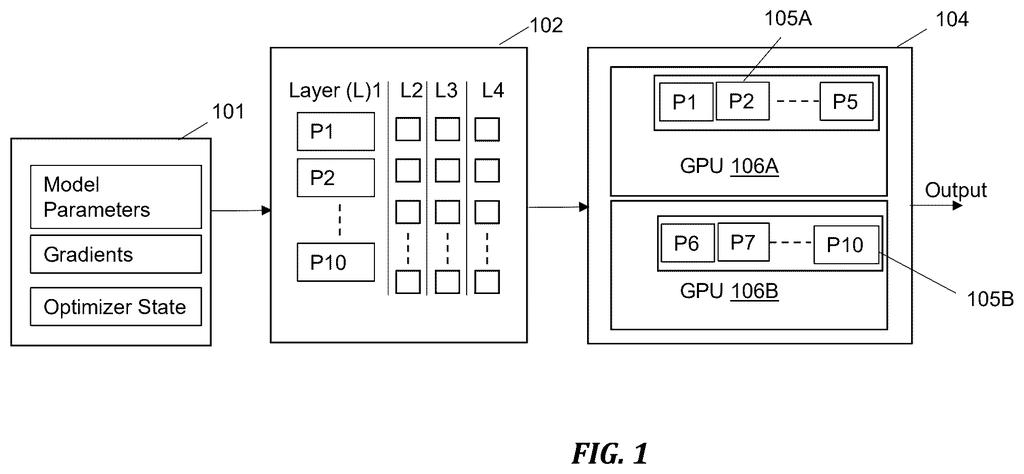
The patent describes a method for automatically determining how to divide, or "shard," a machine learning model across a parallel computing environment (think: a rack of GPUs or a cluster of servers working together).
Sharding means slicing a model into chunks so different pieces can be processed simultaneously. The tricky part is that different layers of a model (the stacked computational stages that transform input data into output) have different sizes, shapes, and workloads, so the ideal split point varies.
IBM's approach treats the shard count as a hyperparameter (a setting that controls how the model trains, rather than something the model learns directly) for every individual layer. It then runs a hyperparameter tuning operation (an automated search process that tries many combinations to find the best one) across all layers simultaneously, taking the model's overall structure into account.
Finally, it applies a loss function (a scoring formula that measures how far off the current settings are from optimal) to guide the search toward the best shard count per layer. The system balances compute efficiency with memory constraints to arrive at a final configuration.
What this means for running large AI models cheaply
Training and serving very large AI models is expensive, and a surprising amount of that cost comes from poor parallelization decisions made before a single training run begins. If IBM's approach works as described, it could reduce the manual engineering work needed to deploy large models and cut wasted compute cycles.
For enterprises running AI workloads on IBM infrastructure, this could mean lower costs and faster iteration. The broader implication is a trend toward fully automated model deployment pipelines, where humans set goals and the system handles the low-level configuration. That's a meaningful shift if it holds up in practice.
This is a narrow but genuinely useful infrastructure patent. The problem it solves (figuring out how to shard model layers optimally) is real and tedious, and automating it has clear practical value. It's not flashy AI research; it's the kind of unglamorous systems work that actually saves money at scale.
There are more where this came from
We read every patent application Big Tech publishes and send you the ones worth knowing. Plain English, free, every week.
The drawings
5 drawing sheets from US 2026/0220525 A1 · click any drawing to enlarge


Want this weekly breakdown for a company we don't cover? Patentlyze Pro →
Be the first to weigh in