
Meta Patents a Dynamic Audio Quality System That Reacts to Scene Conditions
What if your headset could tell the device sending you audio to dial back quality on less important sounds before your ears even notice a difference? That's exactly what Meta is patenting here.
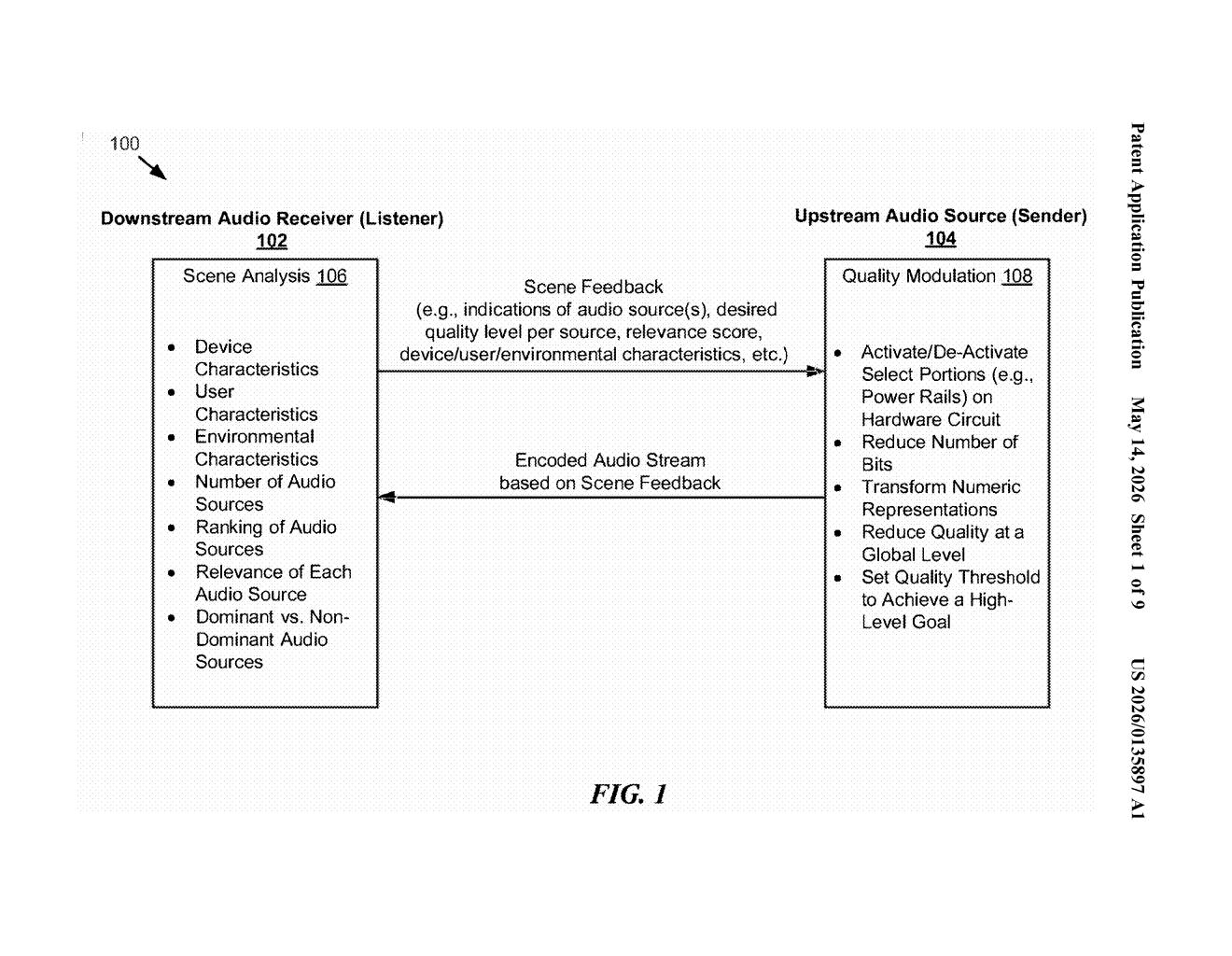
What Meta's scene-aware audio modulation actually does
Imagine you're in a virtual meeting wearing a Meta headset. There are multiple audio streams coming at you — a main speaker, background music, ambient crowd noise. Your headset knows which ones matter to you right now, and it can tell the other device to stop wasting bandwidth on the ones that don't.
That's the core idea behind this patent. The receiving device (say, your headset) sends "scene feedback" back to the sending device (a server or another user's system) — basically a report card saying "here's what I care about, and here's how good each stream needs to be." The sender then adjusts accordingly, even choosing which part of its own hardware to use for encoding each audio chunk.
The result is smarter, more efficient audio delivery. Instead of treating every sound equally, the system prioritizes what matters, degrades what doesn't, and adapts on the fly. It's less about raw quality and more about perceived quality — getting the most out of limited bandwidth.
How the ranking and degradation logic shapes audio encoding
The patent describes a two-device system where the receiving system (the "second computing system") sends scene feedback information back to the sending system (the "first computing system"). This feedback includes things like the receiver's hardware characteristics, a list of active audio sources, and a desired quality level for each one.
On the sending side, the system then does three key things:
- Ranks audio sources based on defined criteria — think: speaker proximity, role in the scene, user focus
- Determines a degradation level for each source, factoring in both the ranking and the sender's own hardware constraints
- Selects the appropriate encoder path — meaning it picks a specific portion of its hardware circuit (like a lower-power codec block vs. a full-quality encoder) to match the target quality level
The degradation level concept is important here. It's not just "low quality" vs. "high quality" — it's a graduated scale applied differently to each audio source based on how much the listener actually needs it. A background ambient track might get heavily compressed; the main speaker's voice stays crisp.
Transmission happens over "a particular communication protocol," which the patent leaves flexible — suggesting this is designed to work across Wi-Fi, Bluetooth, or whatever wireless stack the platform uses.
What this means for Meta's AR and VR audio pipeline
For Meta's AR and VR products — Quest headsets, Ray-Ban smart glasses, and whatever mixed-reality hardware comes next — audio bandwidth is a real constraint. Wireless headsets have limited throughput, and spatial audio with multiple simultaneous sources can eat through it fast. A system that intelligently degrades less important audio streams rather than uniformly compressing everything would be a meaningful improvement to audio fidelity in complex scenes.
There's also a broader implication for multi-user virtual environments. In a crowded virtual space with dozens of audio sources, this kind of feedback-driven prioritization could be the difference between intelligible conversation and muddy noise. If Meta is building toward persistent social spaces in mixed reality, this kind of plumbing matters.
This is unglamorous infrastructure work, but it's the kind of thing that separates a good spatial audio experience from a great one. Meta is clearly thinking carefully about bandwidth efficiency in wireless headset scenarios — and the two-way feedback loop between receiver and sender is a genuinely clever architectural choice. Don't expect a press release, but do expect this to quietly show up in a future Quest firmware update.
There are more where this came from
We read every patent application Big Tech publishes and send you the ones worth knowing. Plain English, free, every week.
Want this weekly breakdown for a company we don't cover? Patentlyze Pro →