
Nvidia Patents Technology That Makes Digital Characters Move and React Smoothly in Real Time
When you poke, click, or speak to a digital avatar, what happens in the fraction of a second before it reacts? Nvidia has filed a patent for a system that manages that exact moment, blending animations together so the character's response feels continuous rather than jarring.
What Nvidia's avatar animation blending actually does
Imagine chatting with a digital customer-service agent on a website. You ask it a question mid-sentence, and instead of freezing or snapping to a new pose, it smoothly transitions from nodding to gesturing as it starts to reply. That smooth handoff is harder to pull off than it looks, and Nvidia's patent is specifically about making it work.
The system keeps track of which animation a digital avatar is currently playing and secretly adjusts the settings of the next animation in the background while the first one is still running. Those settings include how long the new animation lasts and how much priority it gets over whatever is already playing. When your interaction triggers that second animation, the two overlap for a brief window so the switch feels natural.
In short, Nvidia is building the behind-the-scenes traffic controller that decides how a digital character moves from one action to another without looking robotic.
How the compositor queues and overlaps animation layers
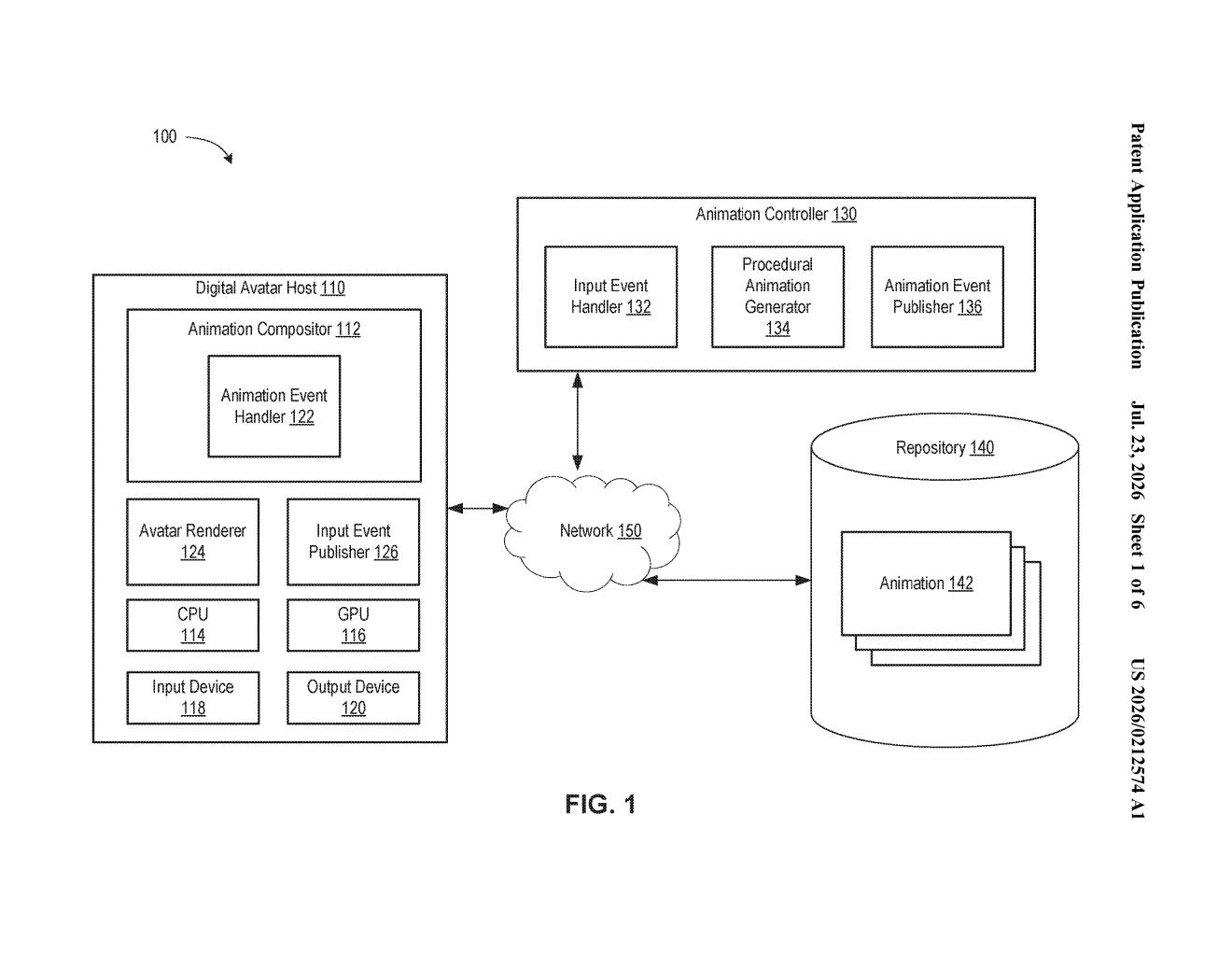
The patent describes an animation compositor, a software layer that sits between user input and the final rendered image of a digital avatar. Its job is to manage multiple animations at once so they can be blended together rather than played sequentially.
Here is how the key pieces fit together:
- State tracking: The system identifies what kind of interaction the user is having at any given moment, for example, hovering, clicking, or speaking to the avatar.
- Background configuration: While the current animation is still playing, the compositor adjusts the settings of any upcoming animation. Those settings include duration (how long it plays) and priority (how dominant it should be when layered over others).
- Overlap blending: When the next interaction triggers, the new animation does not wait for the old one to finish. Instead, both run simultaneously for an overlap period, and the compositor blends them into a single output frame.
The result is a temporal sequence of frames (essentially, a video clip) that the application then displays. The system is designed to handle the complexity of real-time interaction, where user input can arrive at any time and multiple animations may need to coexist.
What this means for AI-driven virtual characters
Digital avatars are showing up in more places: AI assistants, virtual agents, gaming NPCs, and video-call stand-ins. The quality of those characters depends heavily on how naturally they move, and jerky or abrupt animation transitions are one of the fastest ways to break the illusion.
For Nvidia, this patent sits in a space the company is actively building toward with its Omniverse and ACE (Avatar Cloud Engine) platforms, both of which are aimed at creating interactive digital humans. A compositor like this would be a core building block for any real-time avatar system, whether it runs locally on a PC or streams from a data center.
This is plumbing work, not a flashy AI demo, but it is exactly the kind of plumbing that separates a usable interactive avatar from a clunky one. If Nvidia is serious about its Avatar Cloud Engine platform, a robust animation compositor is not optional, it is foundational. Worth watching as a signal that Nvidia is filling in the lower layers of its avatar stack, not just the high-level AI models.
There are more where this came from
We read every patent application Big Tech publishes and send you the ones worth knowing. Plain English, free, every week.
The drawings
6 drawing sheets from US 2026/0212574 A1 · click any drawing to enlarge


Want this weekly breakdown for a company we don't cover? Patentlyze Pro →
Be the first to weigh in