
Qualcomm Patent Repurposes Traffic Lights as GPS-Style Positioning Beacons
Your phone's GPS can go fuzzy the moment you step into a dense city block. Qualcomm thinks the traffic light on the corner could help fix that.
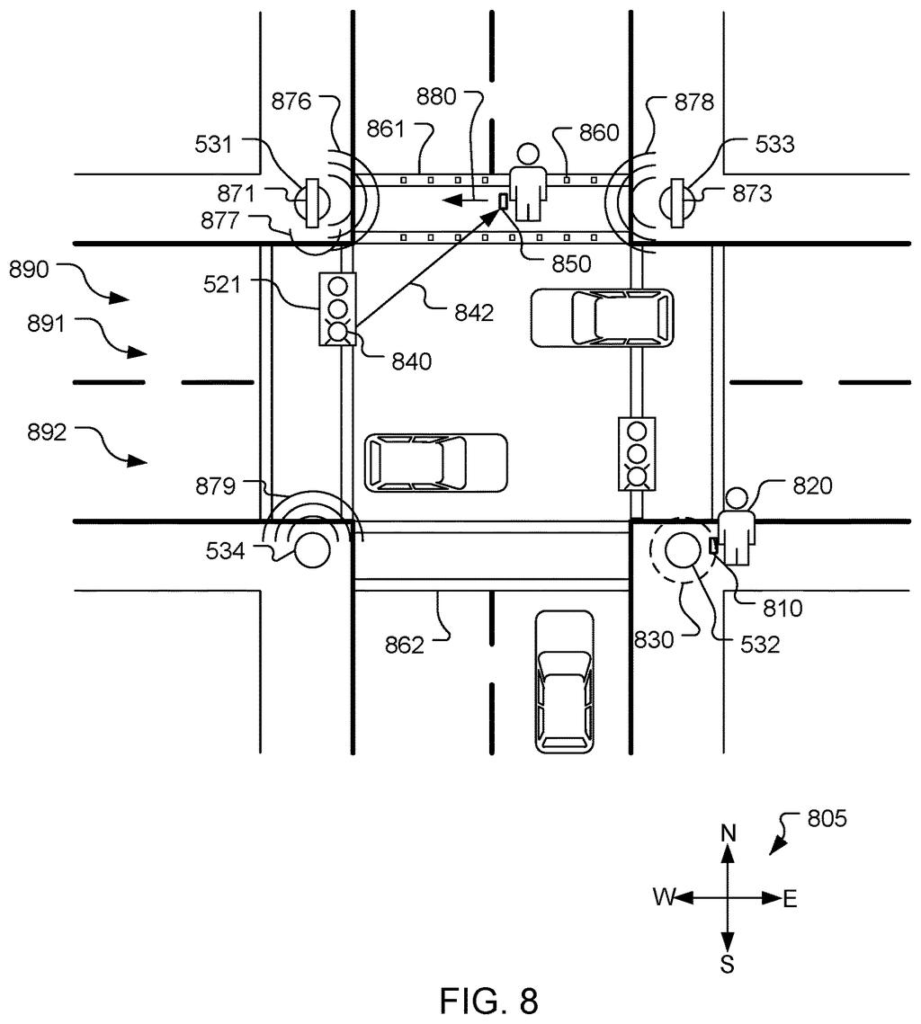
How Qualcomm wants traffic signals to help pinpoint you
Imagine you're driving through downtown and your navigation app loses track of exactly which lane you're in because tall buildings are blocking the GPS signal. Standard GPS works by listening to satellites far overhead, but those signals weaken or bounce off buildings in urban canyons.
Qualcomm's idea is to turn ordinary traffic lights into helpers. A traffic light would broadcast a short wireless message the moment it turns green (or red, or gives a walk signal), along with a precise timestamp. Your phone or car's system can receive that message and use the known location of that specific light, plus the exact timing, to figure out where you are and which direction you're facing.
Traffic signals are already everywhere, they're fixed at known locations, and they switch on a predictable schedule. Qualcomm is essentially asking: why not let them do double duty as positioning anchors? The patent covers both the smart traffic light hardware that sends these messages and the software on the receiving device that turns them into location data.
How a traffic light's timing becomes a position fix
The patent describes two pieces of a system working together.
On the traffic light side: a modified traffic control device (think a standard signal box with added wireless hardware) broadcasts a message the moment it emits a light or audio signal, such as a green light or a pedestrian chirp. That message includes a reference time, essentially a precise timestamp tied to the exact moment the signal fired. Because the traffic light is bolted to a pole at a fixed, known location, anyone receiving that timestamp and knowing the light's coordinates has a solid geographic anchor.
On the receiving device side: a phone, car, or other piece of user equipment (UE, the industry term for any wireless device) picks up the message. The system compares the timestamp from the light against its own clock. The small gap between the two, combined with the known position of the light, lets the device calculate how far it is from that light and in which direction it's pointing, a process similar to how GPS triangulates position from multiple satellites but using nearby infrastructure instead.
- Traffic light emits signal (green, red, walk, audio chirp)
- Light simultaneously broadcasts a wireless message with a precise timestamp
- Device receives the message and computes distance and heading
- Multiple lights in view can improve accuracy further
The claim covers both the hardware inside the traffic light and the positioning logic on the device side.
What this means for GPS in cities and self-driving cars
GPS accuracy in dense urban areas is a long-standing headache for navigation apps, delivery robots, and self-driving vehicles. Satellite signals bounce off buildings and arrive at your phone from unpredictable angles, a problem called multipath error. Ground-level reference points that are fixed and time-synchronized can cut through that noise in a way satellites simply can't.
For autonomous vehicles, knowing not just "I'm near this intersection" but "I'm in the left lane, facing north, and the light just turned green" is operationally important. If traffic infrastructure starts broadcasting timing signals as a standard feature, cars and phones could fuse that data with GPS and camera inputs for a much tighter position fix. Qualcomm, which supplies chips for cars and phones alike, is positioning itself to be the company that defines how that fusion happens.
This is a genuinely interesting idea because it doesn't require building new infrastructure from scratch; traffic lights already exist everywhere, already switch on a known schedule, and are already being upgraded with wireless radios for smart-city projects. The hard part is standardization: every city, every vendor, and every carmaker would need to agree on the same message format, and that kind of coordination takes years. The patent is a smart early stake in that territory.
There are more where this came from
We read every patent application Big Tech publishes and send you the ones worth knowing. Plain English, free, every week.
The drawings
11 drawing sheets from US 2026/0212757 A1 · click any drawing to enlarge


Want this weekly breakdown for a company we don't cover? Patentlyze Pro →
Be the first to weigh in