
Qualcomm Patents a System That Adjusts 3D Video Call Quality Per Viewer
Holographic video calls are only as good as the weakest link in the network, but Qualcomm's patent describes a way to let each participant get the best quality their connection can actually handle, without dragging everyone else down.
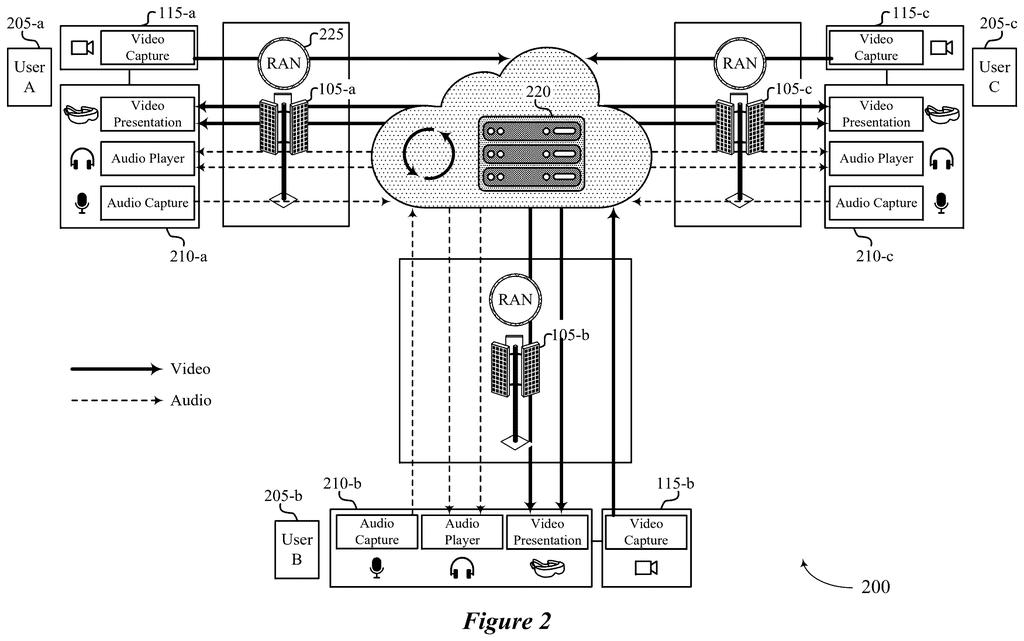
How Qualcomm's holographic call server handles a crowded network
Every time a video call gets choppy, the app usually has two bad options: drop quality for everyone or let one person's bad connection ruin the experience for the group. Qualcomm's new patent tackles that problem for holographic communications, the emerging category of 3D video calls that requires far more data than a standard video stream.
The patent describes a server that sits in the middle of a holographic call and acts as a traffic manager. When your connection hits a bottleneck, the server notices the congestion signal on your specific link and automatically selects a lower-quality version of the video just for you, while everyone else with a stronger connection keeps getting the full-quality feed.
The sender on the other end broadcasts multiple versions of the same video simultaneously, each at a different quality level. The server picks the right one per person in real time, so the call keeps going without freezing for anyone. A separate option also lets the server re-encode the video on the fly for specific recipients who need it.
obtain a feedback message that comprises congestion information pertaining to a traffic flow associated with holographic communications between a plurality of wireless communication devices …
Translation: The server receives a notice about network congestion during a multiway 3D video call.
How the server picks the right encoding layer for each recipient
The system centers on an application server (a computer in a network data center, not on your phone) that manages a holographic communications session between multiple wireless devices.
The transmitting device, say the person sending their hologram, encodes the video into a layered encoding scheme. Think of it like packing the same movie at HD, 4K, and 8K into the same stream at once. Each layer adds more detail. The device sends all of those coded versions up to the application server.
The server watches for explicit congestion notification (ECN) markings, which are small flags that network routers attach to packets when a link is getting overloaded. When the server sees those flags on packets headed to a specific participant, it knows that person's connection is struggling. It then:
- Identifies which encoding layer is appropriate for that destination based on how bad the congestion is
- Forwards only that layer's version of the video to the struggling participant
- Continues sending the full-quality version to everyone else
The patent also covers a selective re-encoding path, where the transmitting device can tell the server specific transcoding parameters (instructions for converting video to a different format or bitrate), and the server applies those conversions individually for each destination as needed.
The application server may select a respective coded version of the set of packets for transmission to each other device associated with the holographic communications session.
Translation: The server picks a different video quality version for each participant based on their connection.
What this means for early holographic calling experiences
For the average person, this kind of system is the difference between a holographic call that keeps working when your Wi-Fi dips and one that freezes or drops entirely. Today's group video calls typically degrade for everyone when one participant has a bad connection. A per-destination quality system means your bad hotel Wi-Fi doesn't become everyone else's problem.
Qualcomm has been filing around holographic communications since at least 2024, which tracks with the broader industry push toward volumetric and 3D video as a category that will eventually need its own network management tools. This patent is less about inventing holographic video and more about making it survivable on real-world networks, which is the unsexy engineering work that tends to determine whether a new format actually gets used.
Qualcomm's 478th filing in our Qualcomm coverage since May adds to a run of video-call work that includes live lag reporting and stall prevention under heavy load.
The concrete payoff here is simple: holographic calls that don't collapse when one person's connection wobbles. That's a real problem for any multi-person video format, and layered encoding with per-destination selection is a sensible architectural answer.
The catch is that this system requires the application server, the transmitting device, and the receiving devices to all support the same layered encoding and congestion-feedback protocol. That's a significant coordination requirement, and in practice the experience depends entirely on whether carriers and device makers adopt compatible standards.
For now, holographic communications is still a research-and-standardization story more than a product you can buy. This patent reads as infrastructure groundwork for a format that may be years away from your living room.
There are more where this came from
We read every patent application Big Tech publishes and send you the ones worth knowing. Plain English, free, every week.
The drawings
17 drawing sheets from US 2026/0303253 A1 · click any drawing to enlarge


Want this weekly breakdown for a company we don't cover? Patentlyze Pro →
Be the first to weigh in