
Disney Patents a System That Keeps Projected Images Locked to Moving Objects
When a character costume or a parade float moves, projected images tend to slip out of alignment. Disney has filed a patent for a system that tracks the object's position and continuously recalculates how each projector should blend its light so the picture stays perfectly locked.
What Disney's dynamic projection mapping actually does
Imagine a Disney parade float with a projection of swirling stars painted across its surface by hidden projectors. The float moves forward, the angle changes, and suddenly the stars are landing in the wrong spots. This patent is Disney's solution to that problem.
The system tracks exactly where the object is in space, then uses that position to calculate a fresh set of instructions, called blend maps, that tell each projector which portion of the image it should handle and how bright its contribution should be. Multiple projectors share the workload, and their outputs are stitched together invisibly.
The result is that the projected image moves and stretches with the object, staying perfectly registered no matter where the object is in the room. For guests at a theme park, it would look like the visuals are physically painted onto the surface rather than beamed from across the room.
How the graphics engine builds and applies blend maps
The patent describes a pipeline with three main steps.
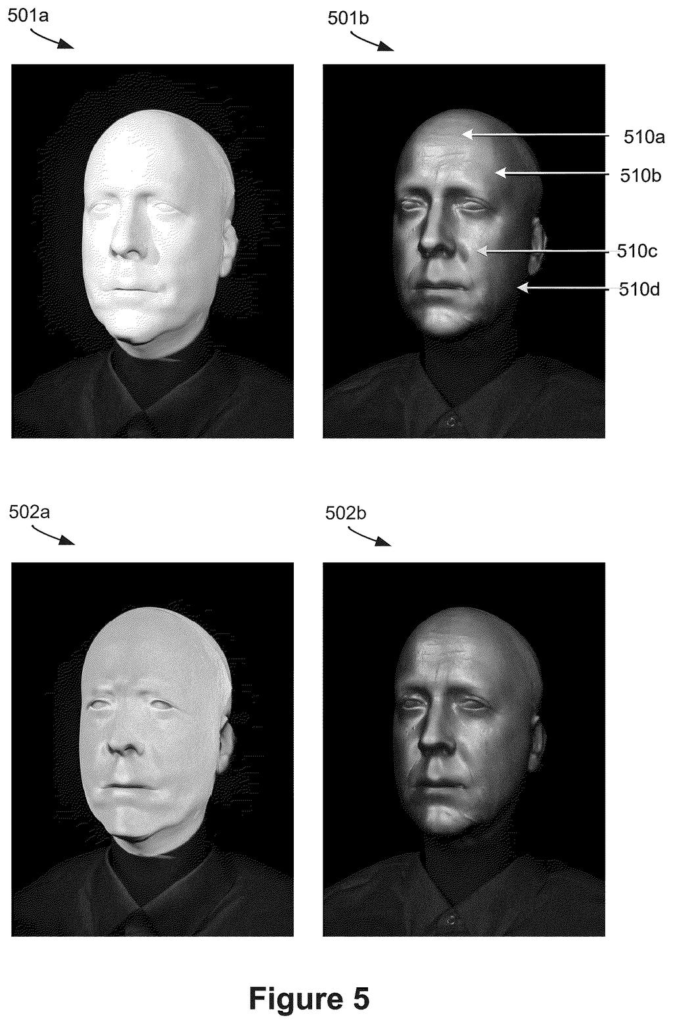
Pose tracking: The system knows the object's pose (position and orientation in 3D space) at any given moment. That data feeds into a graphics engine alongside two other inputs: projector calibration data (the precise location, lens distortion, and output characteristics of each projector in the rig) and scene geometry data (a 3D model of the object's shape).
Blend map generation: The graphics engine combines those three inputs to produce blend maps, per-projector masks that define which pixels each projector owns and how much weight its output carries in overlapping zones. Where two projectors' beams overlap, the blend map feathers the transition so the seam disappears.
Blended projection: The actual media (video, animation, or still imagery) is then composited against the blend maps to create individual output frames for each projector. The projectors fire simultaneously, and the audience sees a single coherent image on the object's surface.
The key distinction from older, static projection mapping setups is that this process runs through a graphics engine, meaning the blend maps can be regenerated on the fly whenever the object's pose changes, rather than being baked once during a pre-show setup.
What this means for theme park and live entertainment
Static projection mapping has been a theme park staple for years, but it only works reliably when the thing being projected on stays perfectly still. Applying it to moving objects, whether performers, floats, animatronic figures, or interactive props, has always required expensive custom engineering. A generalized, real-time pipeline for this would make dynamic projection feasible for a much wider range of attractions.
For guests, the payoff is immersive visuals that feel physically attached to the thing you're watching rather than projected from afar. For Disney's production teams, a graphics-engine-driven approach means the same artists who build animated content could control live projection without specialized projection-mapping expertise on every project.
This is exactly the kind of unglamorous infrastructure patent that ends up inside dozens of future attractions. Dynamic projection mapping on moving objects is a genuinely hard real-time rendering problem, and routing it through a standard graphics engine pipeline is a practical, scalable answer. Worth watching.
There are more where this came from
We read every patent application Big Tech publishes and send you the ones worth knowing. Plain English, free, every week.
The drawings
6 drawing sheets from US 2026/0220871 A1 · click any drawing to enlarge


Want this weekly breakdown for a company we don't cover? Patentlyze Pro →
Be the first to weigh in