
Meta Patents an AI That Drops 3D Objects Into Photos and Matches the Scene Automatically
Meta is patenting a way to let AI study a photo, figure out what's in it, and then insert a 3D object that actually looks like it belongs there, matching the angle, surface, and context of the scene automatically.
What Meta's context-aware photo editing actually does
Imagine you take a photo of your kitchen table and want to see what a new vase would look like sitting on it. Today, doing that realistically means manually adjusting the angle, shadows, and perspective so the fake object doesn't look pasted-on. Meta's new patent describes a system that handles all of that for you.
The AI analyzes your photo to understand what it's looking at: the surfaces, the angles, the overall setting. Then it picks a 3D object that fits the scene and positions it so the perspective lines up correctly, as if the object were really there when the photo was taken.
The system also adds supporting visual details tied to the scene's context, not just the main object. The whole result gets baked into a final image where the added elements look like part of the original photo rather than an obvious edit.
How the AI reads a scene and positions a 3D asset
The patent describes a pipeline with several distinct steps working together.
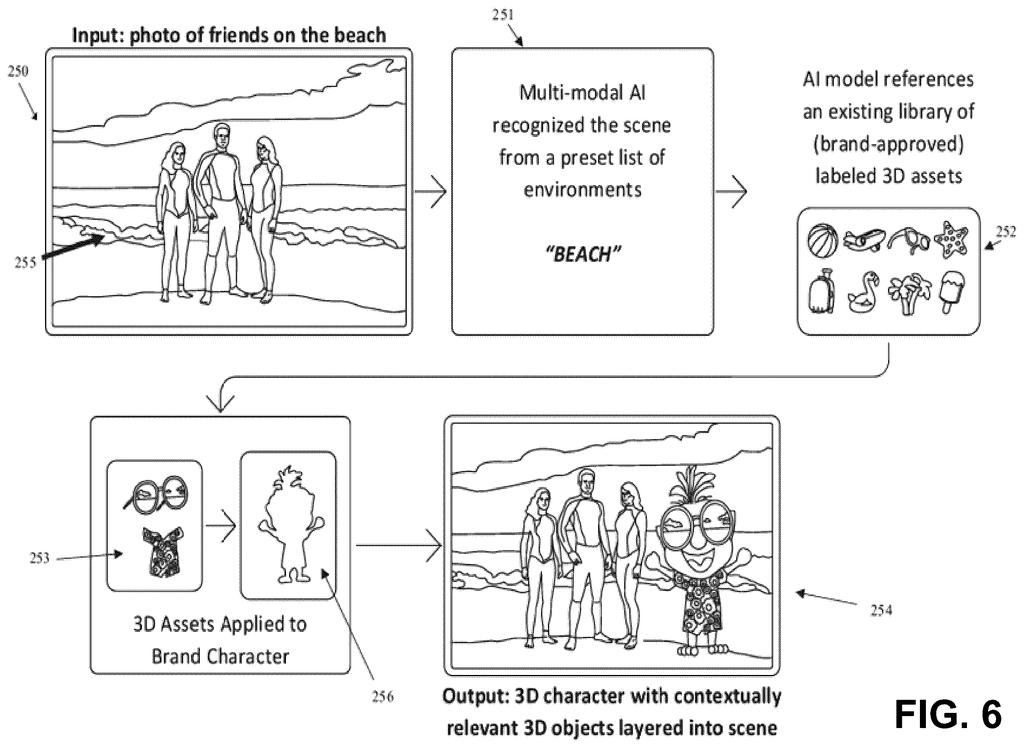
Scene analysis: A machine-learning model reads the photo to extract contextual attributes (information like what kind of room it is, what surfaces are visible, what angle the camera was at, and what objects are already in the scene).
Asset selection: Based on those attributes, the system picks a matching 3D asset from a library. So a photo of a living room might trigger a different set of object options than a photo of a park.
Geometric posing: The chosen 3D asset is then posed using geometric data pulled from the scene, meaning the system works out the perspective lines, surface normals (which way flat surfaces face), and orientation so the object sits in the photo at the correct angle rather than floating awkwardly.
Contextual decoration: Beyond the main object, the method also adds smaller 3D elements that fit the scene's context, placed according to the same spatial logic.
The output is a single composited photo with both the primary 3D asset and the supporting elements integrated. The patent does not specify a particular app, but the approach fits naturally into photo-editing or AR-preview tools.
What this means for AR filters and Instagram editing
For everyday users, this kind of automation collapses what is currently a multi-step, skill-dependent editing job into something the app just does. You wouldn't need to understand 3D modeling or manual perspective-matching to get a convincing result.
For Meta specifically, this fits into a broader push around augmented reality on Instagram and Facebook, as well as its Ray-Ban smart glasses platform. A system that can read scene context and drop in plausible 3D objects automatically is exactly the kind of building block that powers both social AR filters and potential future shopping features, where you'd preview a product in your own space from a single photo.
This is a real engineering problem with a genuinely useful payoff: getting 3D objects to look at home in a flat photo is harder than it sounds, and automating it well would make AR-style editing accessible to people who currently just skip it. The patent is light on specifics about the contextual-attribute detection, which is where the hard work actually lives, so whether this is a real system or a broad claim on the concept remains to be seen.
There are more where this came from
We read every patent application Big Tech publishes and send you the ones worth knowing. Plain English, free, every week.
The drawings
10 drawing sheets from US 2026/0220901 A1 · click any drawing to enlarge


Want this weekly breakdown for a company we don't cover? Patentlyze Pro →
Be the first to weigh in